

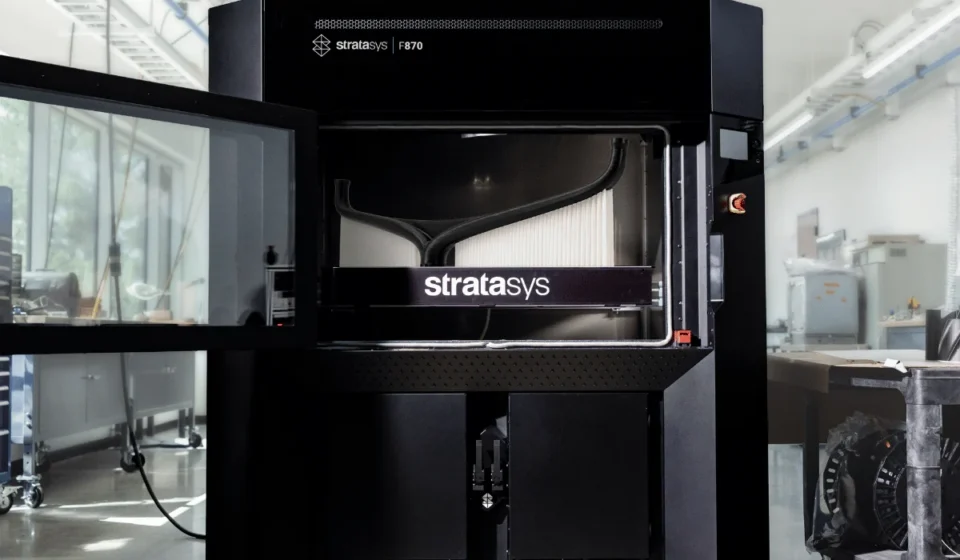
Scaling Innovation: Stratasys Unveils the F870 to Redefine Factory-Floor Additive Manufacturing

In a move set to disrupt the traditional boundaries of factory-floor production, 3D printing giant Stratasys has officially unveiled the F870, a large-format FDM (Fused Deposition Modeling) system engineered specifically for the rigorous demands of the automotive, aerospace, and defense sectors. By bridging the gap between high-speed prototyping and end-use production, the F870 represents the company’s strategic response to the increasing pressure on manufacturers to shorten supply chains and reduce the costs associated with conventional machining.
The F870 is not merely a larger printer; it is a specialized industrial workhorse. Featuring what Stratasys identifies as the longest heated build capacity in its competitive class, the platform is designed to maintain thermal consistency across an expansive build volume. This capability is critical for manufacturing large-scale tooling, complex fixtures, and end-use components that must withstand the punishing environments of modern assembly lines. Early adopters, including Toyota Production Engineering in Georgetown, Kentucky, and Rivian Automotive in Plymouth, Michigan, have already integrated the platform into their workflows, signaling a significant vote of confidence in its potential to replace time-intensive, traditional manufacturing methods.
Chronology of Development: From Concept to Factory Integration
The development of the F870 follows a multi-year trajectory of industry demand for larger, more reliable additive manufacturing (AM) systems. As manufacturers move away from purely experimental prototyping, the requirement for “production-grade reliability” has become paramount.
- Pre-Release Phase: Stratasys initiated internal testing to address the warping issues common in large-format parts, particularly those made from high-performance materials like Nylon 12CF. By refining the heated chamber dynamics, the engineering team ensured that the build environment remains at a constant 95°C.
- Early Access Deployment: In the months preceding the commercial announcement, Stratasys partnered with key automotive leaders. Toyota and Rivian began rigorous, real-world evaluation, deploying the machines to create assembly aids, inspection gauges, and complex jigs—parts that previously required weeks of CNC machining turnaround.
- Public Unveiling Strategy: The F870 is scheduled for its official public debut at the International Manufacturing Technology Show (IMTS) 2026, set to take place in Chicago from September 14–19. This strategic placement at the world’s premier manufacturing technology show underscores Stratasys’ intent to position the F870 as an essential tool for the smart factory of the future.
Technical Specifications: Engineering for the Factory Floor
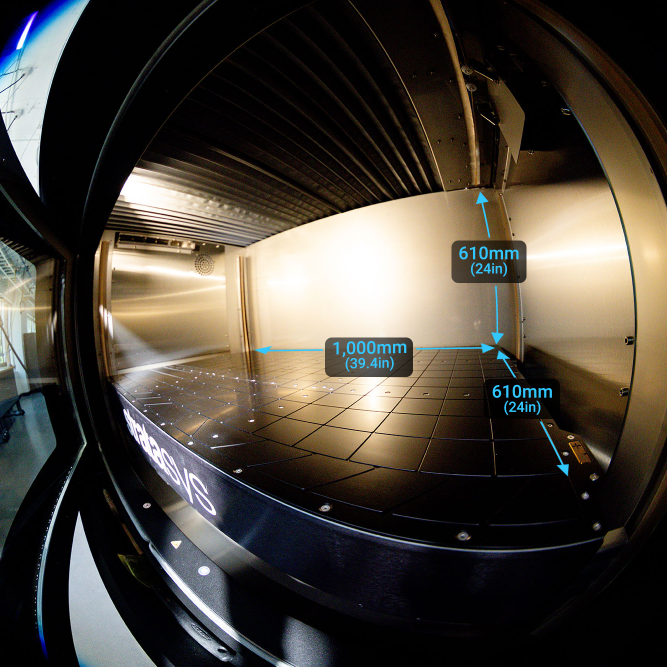
The F870 is designed with a build envelope of 1,000 x 610 x 610 mm (39.4 x 24 x 24 inches), providing the spatial capacity required for large-scale jigs and fixtures. However, the machine’s utility is defined as much by its environmental control as its size.
Advanced Thermal Management
One of the most significant challenges in large-format additive manufacturing is thermal contraction, which often leads to warping in large parts. The F870’s fully heated chamber mitigates this by maintaining a consistent 95°C throughout the entire build process. This is particularly advantageous for carbon-fiber-reinforced materials, ensuring dimensional accuracy and structural integrity for critical manufacturing components.
Versatile Print Head Architecture
The system utilizes three interchangeable print heads, allowing operators to optimize the machine for different tasks without the need for multiple platforms. These include:

- Precision Head: Optimized for fine-resolution work, such as high-accuracy inspection gauges and complex check fixtures.
- Composite Head: Specifically tuned for the deposition of carbon-fiber-reinforced materials, ensuring consistent mechanical properties for heavy-duty tools.
- High-Throughput Head: Designed for rapid production, this head can double the output speed on standard materials like ASA, making it ideal for large-scale protective housings or ergonomic aids.
Operational Longevity
Designed for 24/7 manufacturing environments, the F870 is rated for up to two weeks of continuous, unattended operation. An integrated regenerative drying system maintains material moisture levels at optimal points, while the four 4,100 cm³ spool capacity—featuring automatic changeover—ensures that the machine can complete long, complex prints without human intervention. This setup is interoperable with the Stratasys F3300, allowing larger facilities to standardize their material inventory across multiple platforms.
Official Perspectives: Industry Leadership and Strategic Vision
The launch of the F870 is framed by Stratasys executives as a pivotal moment for the industrialization of 3D printing. Rich Garrity, Chief Business Unit Officer at Stratasys, emphasized that the machine is a direct answer to the volatility of global supply chains.
“Manufacturers are no longer asking if additive manufacturing can work; they are asking how quickly and reliably it can scale,” Garrity noted. He highlighted that the F870 offers a "more competitive price point" compared to previous high-capacity systems, effectively lowering the barrier to entry for firms looking to bring outsourced tooling in-house.
This sentiment is echoed by those on the front lines of production. Dallas Martin, an Additive Manufacturing Engineer at Toyota North America, stated, “We’ve already seen the value Stratasys additive manufacturing can deliver. The next challenge is expanding its use across more applications. The F870’s combination of build size, material performance, and industrial features aligns with the kinds of manufacturing needs we’re looking to address.”
For Toyota and Rivian, the transition represents a move away from the "wait-and-see" approach of traditional machining. By producing tools, alignment jigs, and drill guides in-house, these companies can iterate on production line configurations in days rather than weeks.
Implications: The Shift Toward On-Demand Industrial Production
The arrival of the F870 has profound implications for the manufacturing landscape, particularly regarding the concept of the "agile factory."
1. The Death of Outsourced Tooling
For decades, the production of large-scale manufacturing aids has been outsourced to third-party machine shops, creating significant bottlenecks in the production cycle. By enabling the fabrication of large-scale components (such as robotic end-of-arm tooling) in-house, the F870 allows companies to reclaim control over their production schedules. The use of lightweight, durable materials like Nylon 12CF allows for the creation of robotic grippers that reduce payload, thereby increasing the speed and efficiency of robotic arms on the assembly line.
2. Standardization and Interoperability
By utilizing the same material delivery system as the F3300, Stratasys is encouraging a unified ecosystem within the factory. This interoperability reduces the logistical complexity for supply chain managers, who now only need to manage one type of material spool for multiple machines. This shift simplifies inventory management, reduces the potential for human error, and ensures that critical materials are always on hand.
3. Economic Impact and ROI
The F870 is not merely an engineering achievement; it is a financial one. By reducing the time required for tooling production, companies can realize a faster return on investment (ROI). Every day saved in the lead-up to a new vehicle launch—or the recalibration of an existing line—translates into massive operational savings. The ability to print a part that would normally require days of welding or machining represents a paradigm shift in how manufacturers view their capital expenditures.
4. Future-Proofing the Factory Floor
As the manufacturing sector continues to move toward Industry 4.0, the role of 3D printing is expanding from a niche technology to a foundational pillar. The F870’s compliance with standard network protocols and its integration with software suites like GrabCAD Print Pro ensure that it can communicate seamlessly with existing factory management systems. This connectivity is essential for data-driven manufacturing, where quality assurance and process repeatability are the keys to long-term success.
Conclusion: A New Standard for Industrial FDM
The Stratasys F870 stands as a testament to the maturation of additive manufacturing. It is no longer about the novelty of what can be printed, but the reliability of the system producing it. With its impressive build volume, advanced thermal controls, and a material ecosystem designed for consistency, the F870 is poised to become a staple in high-volume production environments.
As the industry prepares for the full public reveal at IMTS 2026, the success of the F870 will likely be measured by its ability to integrate into the existing workflows of the world’s most demanding manufacturers. If the early results from Toyota and Rivian are any indication, the future of the factory floor is not just about faster machines, but about the ability to innovate, adapt, and produce at the speed of the market. Stratasys has delivered a tool that finally matches the ambition of the engineers who use it, marking a significant step forward in the ongoing industrialization of additive manufacturing.