



Bridging the Gap: MIT’s New Design Framework Revolutionizes Sustainable 3D-Printed Concrete

Concrete, the silent titan of modern civilization, is responsible for more than just our infrastructure; it is also one of the primary drivers of global carbon emissions. As the construction industry faces mounting pressure to decarbonize, 3D printing has emerged as a promising, "robotic" alternative. By depositing material only where structural integrity demands it—much like a precise icing pipe—engineers can theoretically eliminate the waste associated with traditional, labor-intensive formwork.
However, a persistent "reality gap" has hampered this vision: the most mathematically efficient computer-generated designs are frequently impossible to print. Now, researchers at the Massachusetts Institute of Technology (MIT) have unveiled a breakthrough design framework that bridges this divide, proving that the true bottleneck for sustainable construction isn’t the concrete itself, but the hardware limitations of the printers tasked with laying it.
The Core Challenge: Topology Optimization Meets Reality
For years, structural engineers have utilized a process called "topology optimization" to create lighter, stronger forms. By simulating the stresses a building or bridge must endure, algorithms carve away unnecessary material, often resulting in intricate, web-like structures that minimize mass while maximizing load-bearing capacity.
The problem arises when these digital designs move to the factory floor. Industrial 3D printers, while revolutionary, are governed by rigid physical constraints. They require thick nozzles to extrude mortar, possess limited turning radii, and must lay down concrete in a single, unbroken, continuous path to ensure structural consistency. Traditional optimization software ignored these variables, producing designs that required days of manual reworking to make them "printable."
The MIT team, led by researchers in the Department of Civil and Environmental Engineering, decided to flip this process on its head. Instead of designing a shape and then trying to make it printable, they embedded the printer’s physical constraints directly into the optimization algorithm itself.
A Chronology of Innovation: From Residency to Real-World Proof
The journey to this framework was marked by a collaborative effort between academia and industry.
1. The Autodesk Collaboration
To ensure their mathematical models reflected reality, the MIT researchers joined the Autodesk Research Residency Program in Boston. Working directly with the operators of Autodesk’s large-scale industrial printers, the team learned which design features were "safe" and which were impossible. "They pointed at some of our sharp angles, and they went, ‘I don’t feel safe printing something like that,’" recalls postdoc Hajin Kim-Tackowiak.
These field sessions allowed the team to pin down three primary constraints:
- Bead Width: The physical thickness of the extruded concrete bead.
- Turning Radius: The mechanical limit on how sharply a nozzle can pivot without compromising the structure.
- Continuity: The necessity of a single, non-interrupted print path.
2. Solving the Speed Dilemma
Historically, the math required to solve these "mixed-integer" optimization problems was considered too computationally expensive for practical use. Previous methods demanded massive, multi-day post-processing sessions. The MIT team, however, utilized advanced solvers that allowed them to produce fully printable designs in roughly two minutes on a standard laptop. Even when last-minute adjustments were required on the day of printing, the framework could re-run the entire simulation in under ten minutes.
3. The 2.3-Meter Bridge Test
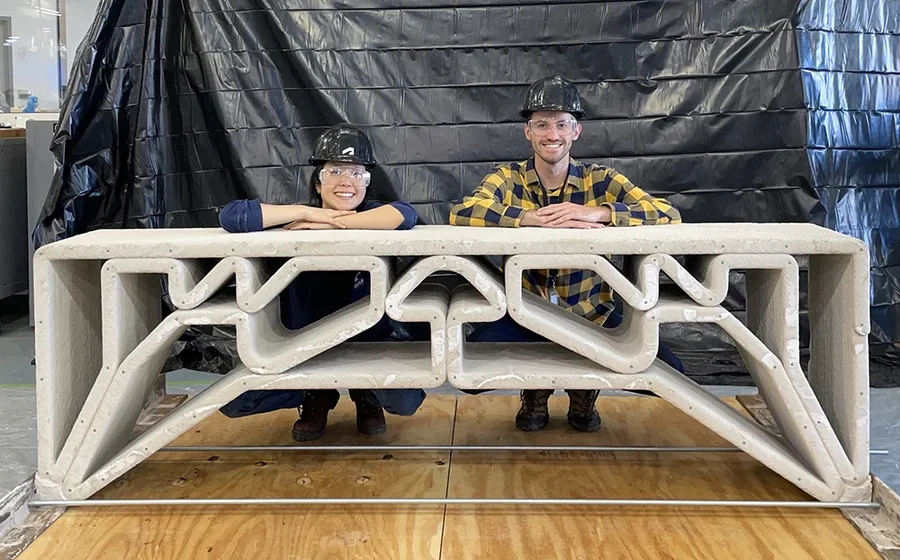
To validate the model, the team designed and printed a 2.3-meter bridge. Constructed from off-the-shelf mortar in just 30 minutes, the 900-pound structure underwent rigorous load testing. It successfully supported over 2,000 pounds—more than double its own weight—without any measurable bending, aligning almost perfectly with the team’s initial computer simulations.
Supporting Data: The Efficiency Paradox
The most striking revelation from the project was the extent to which the current hardware, rather than material science, is dictating structural efficiency.
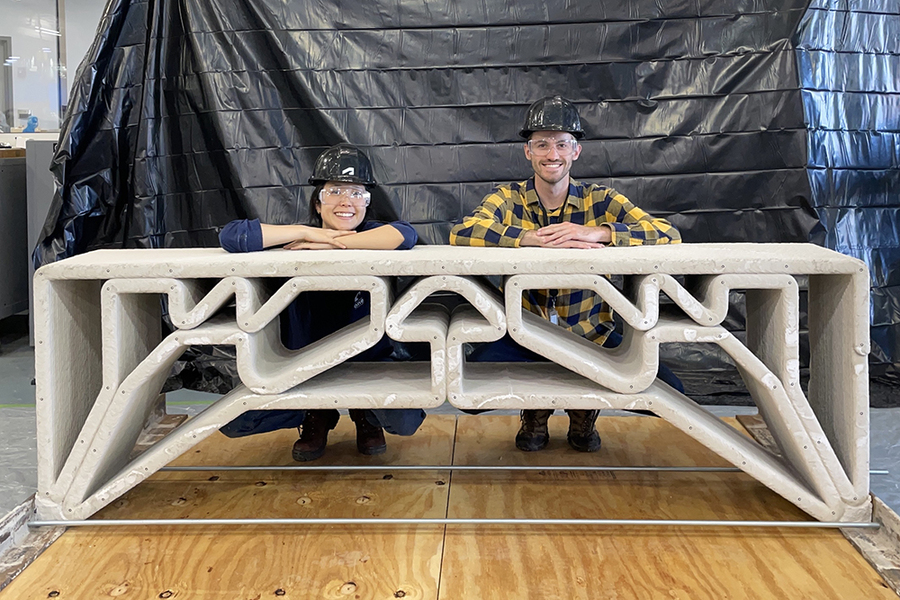
During the testing phase, the researchers discovered that their initial design was "super over-engineered." According to Kim-Tackowiak, the bridge was so strong that the structural requirements were entirely secondary to the "can I build it or not" constraints. In other words, the printer’s physical limitations were forcing the use of far more material than the laws of physics actually required.
The team’s analysis produced a clear, actionable roadmap for hardware manufacturers:
- The Bead Width Factor: While the test bridge utilized a 4-centimeter bead, the framework showed that reducing the bead width to 1 centimeter could cut material usage by up to 76 percent while remaining well within safety margins.
- Efficiency vs. Complexity: Contrary to initial hypotheses, the "continuous path" requirement was not the primary hindrance to efficiency; the bead width was the dominant variable.
This finding is a significant departure from conventional wisdom, providing machine-makers with a quantifiable target for future hardware iterations. By simply enabling thinner, more precise extrusions, manufacturers can trigger massive reductions in the carbon footprint of 3D-printed concrete projects.
Official Responses and Strategic Implications
The research team, which includes senior author Josephine Carstensen and PhD student Zane Schemmer, emphasizes that this is not merely a material innovation—it is a strategic shift in how we approach construction.
Redefining Sustainability
"With mixed-integer optimization, we can find the global optimum—the best solution there is—as opposed to just a good solution," says Carstensen. By "pricing" each physical constraint in units of wasted material, the team has turned sustainability into a hard, calculable metric. This allows architects and engineers to justify the cost of advanced hardware by demonstrating the long-term material savings.
The Compression-Only Advantage
The bridge was designed to operate entirely in compression, which is where concrete excels. However, the test also highlighted the limitations of such designs. When a worker lifted one corner of the bridge to clean beneath it, the structure snapped. This occurred because the lift introduced tension into areas of the bridge not designed to handle it. As Kim-Tackowiak noted, "It’s optimal in one way, but it’s definitely not optimal in every way."
Moving Toward Reinforcement
The next frontier for the MIT team is the integration of reinforced concrete. "We know a pure concrete structure is not necessarily going to be the most optimal thing," says Kim-Tackowiak. The team is now tackling the complex challenge of embedding rebar into 3D-printed concrete, a hurdle that, once cleared, will make this technology viable for load-bearing structures in the real world.
The Broader Landscape: Geometry, Chemistry, and Machines
The MIT research arrives at a pivotal moment in the construction industry. As the global community scrambles to meet climate goals, multiple pathways to sustainable concrete are emerging simultaneously:
- Geometric Optimization: Much like the MIT project, the "Diamanti" bridge in Venice (unveiled in 2025 by Professor Masoud Akbarzadeh and Sika) uses hollow, patterned geometry to reduce material consumption and embodied carbon.
- Chemical Innovation: Researchers at Oregon State University have pioneered rapid-setting clays that cure instantly upon extrusion, circumventing the need for carbon-heavy traditional cement.
- Material Blends: Firms like SCG are experimenting with LC3 (Limestone Calcined Clay Cement), which swaps a portion of traditional cement for calcined clay, drastically lowering the carbon profile of the final product.
The MIT breakthrough is the missing piece of this puzzle. It demonstrates that regardless of whether one uses traditional concrete, LC3, or rapid-setting clay, the geometry of the structure is a primary lever for sustainability. By integrating printer-specific constraints into the design phase, the industry can finally stop "over-building" and start building smarter.
As the industry looks toward 2026 and beyond, the message from MIT is clear: the future of sustainable infrastructure lies at the intersection of advanced mathematics and machine capability. By upgrading our hardware and embracing constraint-aware design, we can transform one of the world’s most carbon-intensive industries into a model of modern, material-efficient engineering.