


Cal/OSHA Moves Toward Emergency Silica Restrictions for Engineered Stone Amid Rising Silicosis Crisis

By Danielle Naidu
Assistant Editor, Occupational Health & Safety
California is taking decisive steps to combat a severe occupational health crisis among stonecutters and countertop fabricators. The California Division of Occupational Safety and Health (Cal/OSHA) has released a discussion draft for sweeping emergency regulations aimed at reining in the devastating rates of silicosis linked to the fabrication of engineered stone.
The proposed emergency rule would fundamentally alter the landscape of the state’s multi-million-dollar countertop industry by prohibiting the fabrication of artificial stone containing more than 1% crystalline silica by weight. Designed to address an epidemic of disabling and fatal lung diseases among workers who cut, grind, and polish modern building materials, the draft introduces strict material bans, aggressive exposure controls, and heavy compliance burdens for employers across the state.
Main Facts of the Proposed Emergency Regulation
Under the discussion draft released by Cal/OSHA—which proposes adding Section 5204.1 to the state’s General Industry Safety Orders and amending existing requirements in Sections 5204 and 1532.3—the regulatory landscape for stone fabricators is poised for radical change.
The core components of the proposed emergency rule include:
- The 1% Threshold: Beginning 60 days after the emergency regulation officially takes effect, employers will be legally barred from manufacturing or fabricating artificial stone that contains more than 1% crystalline silica by weight. This ban encompasses a broad array of architectural elements, including countertops, backsplashes, walls, flooring, waterfall edges, and similar slabs or panels.
- Broad Definition of Fabrication: The prohibition covers virtually all mechanical processes used to transform artificial stone into finished or semi-finished products. This includes cutting, grinding, drilling, routing, polishing, finishing, and joining.
- Mandatory Worker Notifications: Employers must directly inform their workers—both verbally and in writing, delivered in a language that the employees fully understand—that the fabrication of covered materials is both prohibited and exceptionally hazardous to human health. Additionally, warning signs in both English and Spanish must be posted prominently at all workplace entrances.
- Imminent Hazard Designation: Engaging in prohibited manufacturing or fabrication will be legally classified as an "imminent hazard." This empowers Cal/OSHA inspectors to issue an immediate Order Prohibiting Use (OPU) to shut down operations on the spot.
- Documentation Burden: Employers will be legally required to maintain verifiable documentation proving that all engineered stone materials in their possession contain no more than 1% crystalline silica by weight. In the absence of sufficient documentation, Cal/OSHA will automatically treat the material as exceeding the legal limit.
- Tightened Action Levels: The proposal introduces a distinct artificial-stone action level, setting a strict limit of 3 micrograms of respirable crystalline silica per cubic meter of air ($3 mutextg/m^3$) calculated over an eight-hour time-weighted average (TWA). Wet methods will be mandated to suppress dust and keep exposures below this threshold.
- Respiratory Protection Mandates: For high-exposure trigger tasks, employers generally must provide full-face, tight-fitting powered air-purifying respirators (PAPRs) or alternative respirators carrying an assigned protection factor (APF) of at least 1,000. Less stringent protective options will only be permitted under specific conditions, such as when representative air sampling proves that exposures remain comfortably below the action level.
Chronology of the Regulatory Push
The path toward these emergency measures has been accelerated by mounting medical evidence and mounting pressure from labor advocates, public health officials, and affected workers.

The Groundswell: Late 2023 to Early 2024
For years, occupational health professionals noted an alarming surge in cases of accelerated and acute silicosis—an irreversible, often fatal lung disease caused by the inhalation of microscopic silica dust—among relatively young workers in the engineered stone industry. Unlike natural stone like granite or marble, which typically contains lower percentages of silica, engineered stone products (frequently marketed as quartz countertops) can consist of up to 90% or more crystalline silica. When dry-cut or polished without adequate protection, these materials release massive plumes of respirable dust that deeply penetrate human lungs, causing severe inflammation, fibrosis, and scarring.
Petition 609 and Board Action (May 2024)
Recognizing the unfolding public health catastrophe, stakeholders petitioned the California Occupational Safety and Health Standards Board for immediate intervention. In May, the Standards Board formally and partially approved Petition 609, directing Cal/OSHA to fast-track emergency rulemaking to curb the epidemic. Occupational Health & Safety closely tracked this milestone decision, which signaled that standard, slow-moving administrative rulemaking processes were inadequate for an industry experiencing life-threatening exposures on a daily basis.
The Discussion Draft Release (September 2026)
Following months of internal drafting, risk assessment, and stakeholder engagement, Cal/OSHA published its discussion draft detailing the specific mechanics of the emergency restrictions. The agency established a strict public comment window, setting a deadline of September 30 for interested parties, industry representatives, labor unions, and medical professionals to submit feedback to the Cal/OSHA Research and Standards Branch.

While the discussion draft represents a major milestone, it is not yet a final regulation, and Cal/OSHA has not yet announced an official effective date for the emergency standard.
Supporting Data and Technical Specifications
The technical parameters outlined in Cal/OSHA’s draft reflect a science-based approach to mitigating microscopic hazards that standard industrial hygiene practices have historically struggled to control in small-scale fabrication shops.
The Legacy Inventory Exception
Acknowledging that fabricators and distributors currently possess substantial inventories of engineered stone purchased prior to the rule, Cal/OSHA has carved out a limited exception.

- Eligibility: The exception applies strictly to covered materials that an employer purchased, contracted for, or physically possessed before the effective date of the emergency regulation.
- Compliance Obligations: Employers utilizing this transition period must continue to comply fully with existing, stringent silica standards.
- The Sunset Date: All manufacturing and fabrication activities involving legacy materials possessing more than 1% silica must completely cease within 180 days of the emergency regulation’s effective date. After this window closes, zero tolerance will be applied to materials exceeding the threshold.
Exposure Action Levels and Engineering Controls
The implementation of a 3 $mutextg/m^3$ action level over an eight-hour TWA represents a significant lowering of allowable exposure limits compared to general industry standards, reflecting the extreme toxicity associated with engineered stone dust.
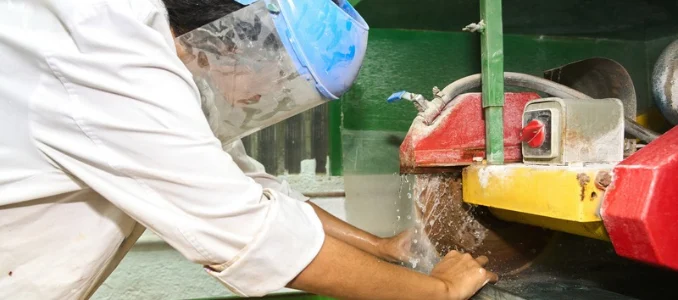
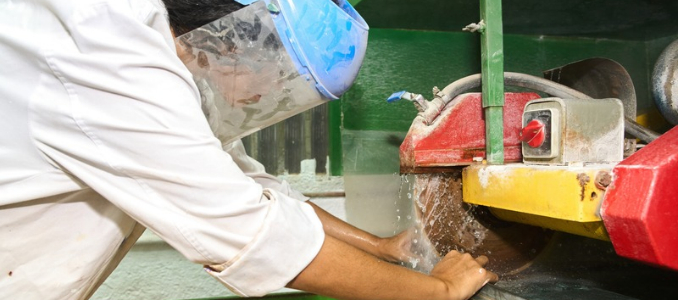
To achieve compliance, shops will be legally required to utilize continuous wet-cutting methods—such as specialized saws and routers equipped with integrated water feeds that suppress dust at the point of contact. Where wet methods alone are insufficient to maintain air quality below the action level, heavy engineering ventilation and personal protective equipment (PPE) must be deployed. The requirement for respirators with an APF of 1,000 (such as specific PAPR configurations) underscores the agency’s view that standard dust masks are completely inadequate for high-risk engineered stone tasks.
Official Responses and Stakeholder Perspectives
The release of the discussion draft has triggered intense debate across California’s industrial sector, dividing business owners, trade associations, labor unions, and medical communities.

Labor and Public Health Advocates
Public health experts, pulmonologists, and labor advocates have largely championed the move toward emergency restrictions. Medical professionals across California have documented a staggering influx of young, otherwise healthy workers presenting with advanced stages of pulmonary fibrosis, requiring double lung transplants or facing terminal prognoses.
Advocacy groups argue that voluntary compliance and standard safety guidelines have utterly failed to protect vulnerable workers—many of whom are immigrants working in small, unregulated, or poorly ventilated fabrication shops. For these groups, a ban on high-silica engineered stone and immediate shutdown powers are seen as the only ethical responses to a preventable public health crisis.
Industry and Business Owners
Conversely, representatives of the stone fabrication and countertop distribution industries have expressed deep concern over the commercial viability of the proposed rules. Small- and medium-sized business owners point out that finding compliant, alternative materials containing less than 1% crystalline silica on a global market remains difficult and expensive.

Industry associations have questioned whether the 180-day grace period for existing inventory provides sufficient time to liquidate stock, retool operations, and retrain workforces without facing catastrophic financial losses. Furthermore, business groups have raised practical implementation questions regarding supply chain verification, asking how smaller shops can independently guarantee and document the exact crystalline silica content of every slab they source from international manufacturers.
Implications for the Countertop Industry and Beyond
If finalized in its current form, Cal/OSHA’s emergency regulation will send shockwaves far beyond California’s borders, potentially establishing a regulatory template that other states and federal agencies may choose to follow.
- Supply Chain Transformation: Engineered stone manufacturers targeting the lucrative California market will be forced to rapidly reformulate their product lines to produce low-silica or silica-free alternatives (such as glass-based composites, sintered stone alternatives, or modified resin blends) that meet the strict 1% threshold.
- Operational Overhauls: Fabrication shops will need to invest heavily in advanced wet-infrastructure, specialized filtration systems, rigorous air-monitoring equipment, and high-tier respiratory protection programs. Those unable to absorb these capital expenditures risk closure or severe penalties.
- Legal and Financial Liability: With prohibited fabrication classified as an "imminent hazard," employers face unprecedented legal exposure, including immediate work stoppages, steep administrative fines, and potential criminal liabilities associated with worker injury or death resulting from willful safety violations.
- National Precedent: California has historically served as a regulatory bellwether for nationwide occupational safety standards. The state’s aggressive stance on engineered stone silicosis may accelerate federal scrutiny by the Occupational Safety and Health Administration (OSHA), paving the way for a broader national crackdown on high-silica building products.
As Cal/OSHA reviews feedback submitted following the late-September comment deadline, the agency moves closer to finalizing a regulation that promises to fundamentally reshape how commercial spaces are designed, how kitchens are built, and—most importantly—how the lives and lungs of stoneworkers are protected.