





The gold rush to integrate humanoid robots into the global workforce is no longer a futuristic speculation; it is an industrial reality. As tech giants and startups alike race to achieve mass production, the narrative has been dominated by capabilities: gait stability, generative AI integration, and dexterous manipulation. Yet, as thousands of these units prepare to roll off assembly lines, a multi-billion-dollar shadow looms over the industry. What happens when these complex, data-laden, energy-dense machines reach the end of their operational lifespan?
For the robotics sector, decommissioning is not merely a waste management issue—it is a high-stakes, surgical, and potentially dangerous endeavor that threatens to derail the industry’s sustainability goals if not addressed immediately.
The Anatomy of the Challenge: Why Robots Aren’t Appliances
To understand why a humanoid cannot simply be tossed into an industrial shredder, one must look at the sheer density of its engineering. A single modern humanoid robot is an architectural marvel, housing between 10,000 and 15,000 individual components. These are organized into sophisticated sub-assemblies—typically involving power management, sensory arrays, actuation, and structural frames—all protected by a combination of high-impact polymers and carbon-fiber shells.
Unlike a car, which is designed for standard maintenance and eventual salvage, a humanoid is a dense, interconnected web of proprietary hardware and software. The complexity of its "anatomy" creates four critical liabilities that the industry is currently ill-equipped to handle.
1. The Kinetic Data Breach
In the era of hyper-connectivity, a retired robot is essentially a mobile, high-capacity server rack. These machines are constantly ingesting and processing data: proprietary site maps, biometric logs, facial recognition databases, and behavioral patterns that reveal how a company operates.
If these memory assets are not cryptographically erased or physically destroyed, they represent a massive security vulnerability. Repurposing or selling decommissioned hardware without stringent data sanitization leaves "backdoors" into sensitive enterprise infrastructure. As these robots become ubiquitous in logistics, manufacturing, and healthcare, the potential for corporate espionage—or even personal privacy violations—becomes a critical enterprise risk.
2. Stored Energy and Volatility
Humanoids require significant power, usually supplied by high-density lithium-ion or lithium-polymer battery packs. These units are highly volatile. Traditional recycling centers, which often use heavy machinery to crush scrap metal, are ill-suited for these batteries. Puncturing or crushing a high-capacity humanoid battery pack invites thermal runaway—a process that can trigger toxic gas releases or violent, self-sustaining explosions.
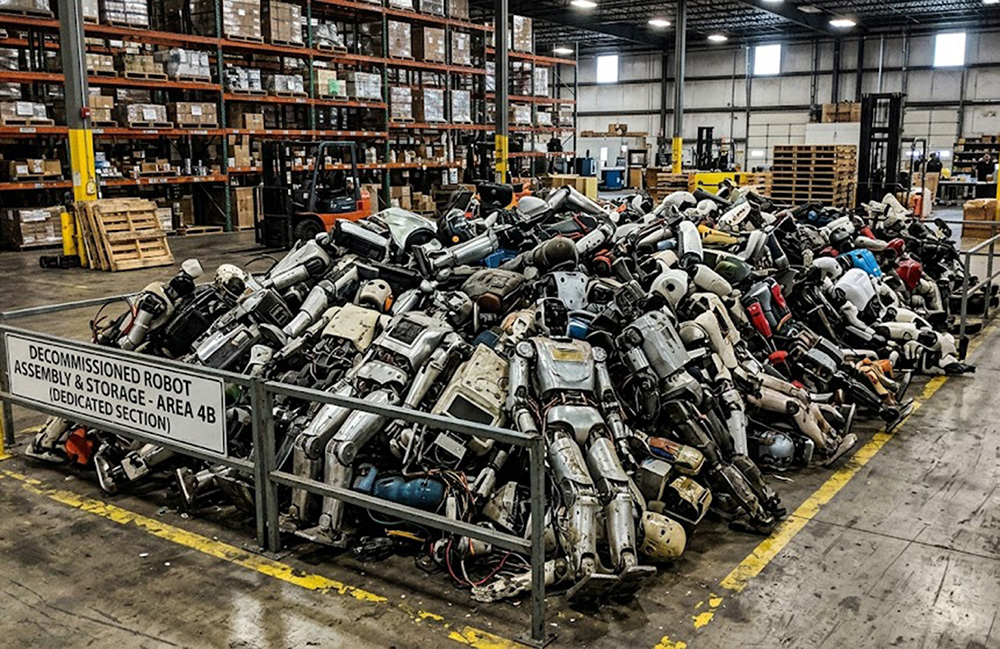
Furthermore, these robots often contain hydraulic or pneumatic systems that store high-velocity pressure. Unless these systems are systematically discharged by specialists, they act like dormant landmines, threatening the safety of anyone attempting to dismantle the robot for parts.
3. The Material Fatigue Paradox
There is an economic temptation to reclaim high-performance servo motors and actuators for a "second life." While these components are expensive, they are also subject to specific "Mean Time to Failure" (MTTF) metrics. Using salvaged structural components—like carbon-fiber chassis frames—introduces severe liability. Material fatigue in these frames is often invisible to the naked eye. Integrating a "pre-owned" structural element into a new build could lead to sudden, catastrophic failure under load, posing significant safety risks to human coworkers.
4. The Magnet Bottleneck: A Surgical Crisis
Perhaps the most surprising hurdle is the reliance on rare-earth neodymium magnets (NdFeB). A single humanoid robot can contain between 3.5 and 4 kg (7.7 to 8.8 lb.) of these magnets—an amount that often exceeds the concentration found in an entire electric vehicle chassis.
Traditional industrial recycling relies on bulk crushing. However, crushing a humanoid robot cross-contaminates these precious rare-earth metals with shredded aluminum, titanium, and carbon fiber. This creates a "useless soup" of materials that is nearly impossible to separate economically. Consequently, the only way to recover these materials is through manual, human-in-the-loop "surgery." This is hazardous work, exposing technicians to sharp metal shrapnel, potential pinch injuries, and the risk of rapid magnet oxidation, which produces corrosive, flammable dust.
Chronology of an Industry in Transition
- 2020-2023 (The R&D Phase): The robotics industry focuses almost exclusively on proof-of-concept. Sustainability is relegated to a secondary concern as companies struggle to prove that humanoids can stand and walk.
- 2024-2025 (The Scaling Phase): Early deployment begins in controlled warehouse environments. The first units reach end-of-life status, and original equipment manufacturers (OEMs) realize they have no established "take-back" programs.
- 2026 (The Awareness Inflection): As the density of humanoid deployment increases, experts like Robert Belt and organizations like Re-Teck begin sounding the alarm. The industry shifts from "innovation-first" to "lifecycle-conscious."
- 2027 and Beyond (The Regulatory Horizon): Industry experts predict that government oversight will soon mandate "Design for Recycling" (DfR) protocols, forcing manufacturers to account for the end-of-life cost of their machines during the design phase.
Supporting Data: The Scale of the Problem
While exact figures on the global robot population are protected by corporate confidentiality, industry analysts estimate that if 50,000 humanoid robots are deployed by 2030, the amount of neodymium magnets needing responsible extraction would exceed 200,000 kg.
The economic model of robotics is currently built on a linear path: Manufacture, Deploy, Discard. However, the cost of manual extraction of components like NdFeB magnets is estimated to be three to five times higher than traditional electronic waste processing. Without a radical shift in manufacturing, the "cost to recycle" could effectively eat the profit margins of the entire robotics sector.
Official Perspectives and Industry Response
Robert Belt, a principal at Mummy LLC and a veteran of the wireless and automotive sectors, argues that the current paradigm is fundamentally unsustainable. "We are building machines that are essentially puzzles," Belt notes. "If we don’t design them to be taken apart as easily as they are put together, we are creating a massive environmental and security liability."

Re-Teck, a global leader in circular economy services, has begun positioning itself as a vital bridge between robotics OEMs and responsible decommissioning. Their approach emphasizes:
- Modularization: Encouraging manufacturers to move away from permanent industrial adhesives in favor of standardized decoupling joints.
- Data Sanitization: Implementing military-grade protocols to ensure that every byte of proprietary data is wiped before hardware recycling begins.
- Component Salvage: Using diagnostic testing to determine which parts are safe for secondary use, rather than blindly recycling everything.
Implications for the Future
The implications for the robotics industry are clear: The winners of the humanoid race will not just be those who build the most capable machines, but those who build the most responsible ones.
The Path Forward: Design for Recycling (DfR)
To prevent the coming bottleneck, the industry must adopt "Design for Recycling" (DfR) principles. This is not merely an environmental altruism; it is a business necessity. Future humanoids must be constructed with modular cartridges, allowing for the rapid, safe extraction of batteries and sensitive memory units.
Furthermore, robotics OEMs must collaborate with recycling firms during the R&D phase. By sharing the "blueprints" for dismantling, manufacturers can ensure that their products don’t become the next global e-waste crisis.
As we celebrate 20 years of industry growth at events like RoboBusiness, the message is clear: The lifecycle of a humanoid robot is a circle, not a straight line. If the industry ignores the "decommissioning" phase, it risks a future where its greatest innovations become its most significant liabilities. The era of the humanoid is here, but the era of the responsible humanoid must follow immediately behind it.