






Illuminating the Invisible: University of Toronto Engineers Revolutionize Molecular Detection with Upconversion Nanoparticles

In the quest to detect trace chemicals—whether they be life-saving pharmaceutical contaminants or hidden environmental toxins—scientists have long been constrained by the limitations of traditional light-based sensors. Now, a breakthrough from the University of Toronto (U of T) is poised to rewrite the rules of molecular detection. Engineers have developed a novel class of dye-sensitized, upconversion nanoparticles capable of identifying chemicals at extraordinarily low concentrations with unprecedented precision. By mastering the art of "turning off the sun" in a laboratory setting, these researchers have created a diagnostic tool that turns invisible threats into bright, unmistakable signals.
The Science of Upconversion: Defying Conventional Physics
To understand the magnitude of this discovery, one must first understand the limitations of conventional fluorophores. For decades, the gold standard for chemical detection has involved the use of organic molecules known as fluorophores. These molecules absorb high-energy light and re-emit it at a lower energy—a process that is fundamentally unidirectional.
"With fluorophores, the excitation frequency has to be higher than the emission frequency," explains Professor Kai Huang, the senior author of the study published in the Journal of the American Chemical Society. "They convert high-energy photons into low-energy photons. What makes our dye-sensitized nanoparticles special is that they are capable of upconversion—they absorb low-energy, near-infrared light and emit higher-energy, visible light."
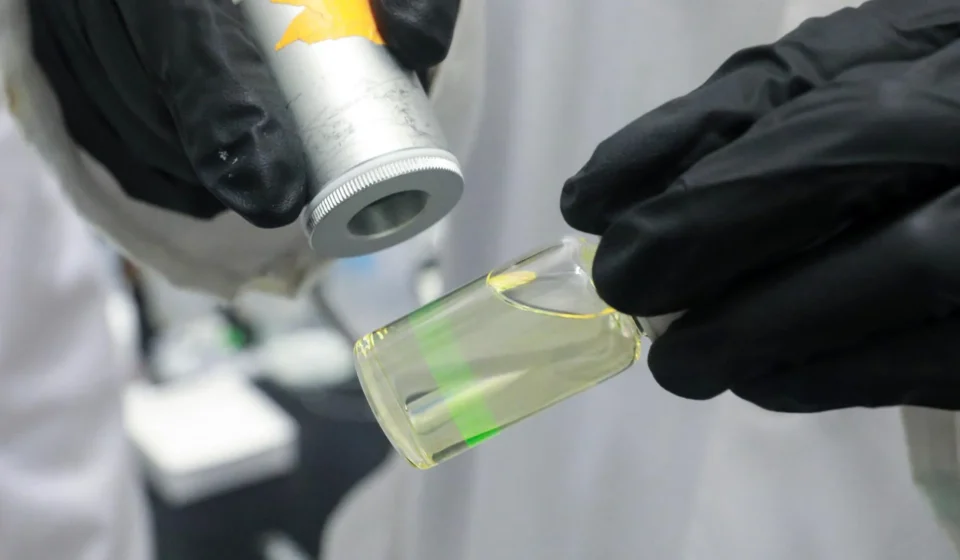
This ability to perform "upconversion" is a game-changer. By using low-energy near-infrared (NIR) light—which can be produced cheaply with standard lasers—the particles glow with a bright, intense green light. Because the activation frequency differs so sharply from the emission frequency, researchers can filter out the "background noise" that typically plagues biological and chemical samples.
Professor Huang likens the process to stargazing. "It’s like the difference between stargazing at night versus the daytime," he says. "The stars shine the same brightness all the time, but during the day the sun is so powerful that it overwhelms them. Shifting the excitation frequency lower produces zero-autofluorescence background in the samples you are analyzing, while the luminescent nanoprobes keep shining; it is like turning off the sun, so you can see the stars better."
Chronology of an Innovation: From Chocolate Chips to Energy Tunnels
The journey to this breakthrough was not linear. The research team initially faced significant hurdles in optimizing the brightness of the nanoparticles, which rely on rare-earth lanthanide ions—specifically ytterbium and erbium—to facilitate the upconversion process.
The Legacy Design
Earlier iterations of these particles were typically flat, hexagonal structures. The ytterbium and erbium ions were distributed uniformly throughout a host matrix of sodium, yttrium, and fluorine. The team often described this as a "chocolate chip cookie" model, where the host material provided the structure, the ions acted as the chips, and organic dye molecules layered on the exterior functioned like icing to capture incoming light.
While this structure worked in theory, it suffered from a phenomenon known as "back-energy transfer." As Jiaze Wu, a PhD student in Professor Huang’s lab and the study’s lead author, discovered, packing too many ytterbium ions into the matrix created a bottleneck. Instead of passing the energy along to the erbium to trigger the green light, the ions would re-absorb the energy, trapping it inside the particle.
The Redesign
To overcome this, the team shifted from a flat, uniform composition to a sophisticated, multi-layered, three-dimensional geometry. They replaced the sodium-based matrix with a lithium, lutetium, and fluorine combination. The new particles were shaped into distinct, diamond-like structures featuring a dense core, an inner shell, and an outer shell.
This gradient design was crucial. "The concentration of embedded ytterbium ions gets denser as you go through each layer, with the core being the most dense," Wu explains. "This arrangement enabled us to pack in much more ytterbium. In our particles, the light energy coming in flows almost entirely in one direction, inward toward the erbium ions."
This structural evolution was guided by rigorous computational modeling. Undergraduate student Weixiang Ben led the computational effort, utilizing Monte Carlo simulations and density functional theory. By simulating how energy interacts at the subatomic level, the team was able to prove that their core-shell-shell structure functioned as a one-directional energy tunnel, effectively preventing the "energy leakage" that had hampered previous attempts.
Supporting Data: By the Numbers
The performance metrics of the new nanoparticles are staggering compared to previous standards. According to the data reported in the Journal of the American Chemical Society, the new particles are approximately 150 times brighter than standard upconversion nanoparticles that lack dye sensitization. Furthermore, when compared to the most highly optimized conventional structures reported in scientific literature to date, these particles are roughly 50 times brighter under identical excitation conditions.
This leap in brightness is not merely an academic achievement; it is a functional necessity for high-sensitivity detection. Because each nanoparticle acts as a high-intensity beacon, even a minuscule number of particles bound to a target molecule can produce a detectable signal. This allows for the identification of chemicals at concentrations that were previously "invisible" to conventional benchtop equipment.
Implications for Industry and Environment
The potential applications for this technology are vast, spanning across multiple high-stakes industries.
Revolutionizing Pharmaceutical Quality Control
One of the most immediate applications is in the pharmaceutical sector, particularly regarding "structural isomers." These are molecules that possess the same atomic composition but are arranged in different geometric configurations. In the manufacturing of complex drugs, the presence of even a 10% concentration of the wrong isomer can render a medication ineffective or, worse, introduce toxic side effects.
"The current process for detecting this relies on very expensive analytical tests," says Wu. "With these nanoparticles, you could do it using low-cost lasers and a very small sample." This could drastically reduce the cost of quality control while increasing the safety of drug manufacturing lines.
Environmental Monitoring
Beyond the pharmaceutical lab, these particles offer a powerful tool for environmental scientists. Searching for trace chemical pollutants in groundwater is a logistical challenge; pollutants are often diluted to such a degree that they become nearly impossible to track. By creating custom-tailored probes that latch onto specific contaminants, environmental researchers could utilize these nanoparticles to map the spread of hazardous materials with unprecedented speed and accuracy.
The Path to Commercialization
Despite the success of the proof-of-concept, the team at the University of Toronto acknowledges that there is significant work ahead before these nanoparticles reach the commercial market. The primary challenge is scale—moving from a laboratory setting where small batches are synthesized with precision, to large-scale industrial manufacturing.
"We’re working on this already, in fact," says Professor Huang. "We think it’s feasible, but it requires a very long roadmap."
The roadmap involves optimizing the synthesis process to ensure that the complex core-shell-shell architecture can be replicated consistently at scale without sacrificing the precise chemical properties that make the particles effective. Furthermore, the researchers are currently working to expand the "library" of target molecules these particles can detect. By customizing the surface of the nanoparticles to bind with different specific chemicals, the researchers hope to create a universal platform for molecular detection.
Conclusion: A New Era of Sensing
The development of these dye-sensitized, upconversion nanoparticles represents a significant milestone in material science. By combining advanced computational modeling with innovative structural engineering, the U of T team has successfully bypassed the physical limitations that have stalled light-based sensing for years.
While the technology currently sits at the proof-of-concept stage, the implications are clear. Whether it is ensuring the purity of a life-saving medication or detecting a hidden toxin in a community water supply, the ability to "turn off the sun" and illuminate the unseen will undoubtedly prove to be an invaluable asset in the years to come. As the team moves forward toward the long-term goal of commercialization, the scientific community watches with anticipation, recognizing that this tiny, diamond-shaped innovation could have a massive impact on the world at large.