



Small Components, Major Consequences: The Critical Role of Mechanical Seals in Pump Reliability and Process Safety

Published: July 29, 2026
Main Facts
In the vast ecosystem of industrial machinery, pumps, motors, and extensive piping networks command the majority of engineering attention. However, nestled within this rotating equipment is a component so diminutive it is frequently overlooked: the mechanical seal. Despite their modest footprint, mechanical seals serve a monumental function. They are not merely consumable, replaceable wear parts; rather, they operate as frontline containment devices, core reliability components, environmental emissions-control barriers, and—in many hazardous industrial applications—vital safety mechanisms.
When functioning correctly, a mechanical seal allows rotating equipment to operate reliably with minimal human intervention over extended periods. Conversely, when a seal fails, the repercussions ripple across the entire facility. Unplanned downtime, catastrophic environmental releases, severe equipment damage, and exorbitant maintenance costs often follow in the wake of a single seal failure. Understanding the engineering, operational nuances, and support systems surrounding mechanical seals is paramount for industrial plants striving for maximum uptime and uncompromising safety.

Chronology and Evolution of Industrial Sealing
The journey of industrial fluid sealing has evolved significantly alongside the demands of modern manufacturing, chemical processing, and energy generation.
- Early Industrial Era: Historically, rotating shafts relied on soft packings—braided ropes or fibrous materials compressed around the shaft—to restrict fluid leakage. While inexpensive, packing required constant manual adjustment, permitted continuous controlled leakage, and caused accelerated wear on rotating shafts due to high friction.
- Mid-20th Century: As industrial processes began handling higher pressures, elevated temperatures, and hazardous or toxic chemicals, traditional packing proved inadequate. The introduction of the modern mechanical seal revolutionized rotating equipment reliability by replacing high-friction sliding contact with precision-lapped, highly engineered interface faces.
- Modern Era (Late 20th Century to Present): The implementation of stringent global environmental regulations and safety standards catalyzed rapid advancements in seal technology. Standards such as API 682 established rigorous criteria for pump shaft seals, giving rise to sophisticated dual-seal arrangements and advanced seal support systems. Today, the integration of Variable Speed Drives (VSDs) represents the latest frontier, forcing engineers to reconsider how dynamic operating speeds influence seal face dynamics and thermal management.
Supporting Data and Engineering Mechanics
To comprehend why mechanical seals require such rigorous attention, one must examine the delicate physics governing their operation. A mechanical seal is engineered to prevent process fluids from escaping the narrow clearance where a rotating shaft penetrates a stationary pump casing.
The Fluid Film Interface
At the heart of every mechanical seal are two exceptionally flat, highly finished seal faces: one stationary component mounted to the housing and one rotating component secured to the shaft. Mechanical forces—typically exerted by springs, metal bellows, or elastomeric elements—maintain continuous contact between these two faces while the equipment operates.

Crucially, a mechanical seal is not designed to run completely dry. A microscopic fluid film—often measured in micrometers—must exist between the rotating and stationary faces. This ultra-thin film serves a dual purpose:
- Lubrication: It prevents direct solid-on-solid friction between the precision-lapped faces.
- Cooling: It dissipates the thermal energy generated by face friction.
If this delicate fluid film is compromised—whether through dry running, liquid flashing, particulate contamination, excessive thermal spikes, or severe mechanical vibration—the seal faces can separate or overheat. This breakdown rapidly leads to catastrophic leakage and premature component failure.
The Anatomy of Failure
Industry experts emphasize that a leaking mechanical seal is rarely an isolated defect; rather, it is almost always a physical symptom of a deeper, systemic issue within the pumping circuit. Simply pulling a failed seal cartridge and installing a replacement without diagnosing the root cause guarantees repeated failures. Common root causes include:
- Thermal Shock and Overheating: Caused by inadequate flush rates or dry running, leading to face cracking or carbon blistering.
- Mechanical Misalignment and Vibration: Excessive shaft runout or bearing wear that disturbs the parallel alignment of the seal faces.
- Chemical Incompatible Media: Fluid degradation of secondary sealing elements (such as O-rings or elastomers).
- Particulate Ingress: Abrasive solids entering the fluid film interface, causing rapid scoring and face destruction.
Maintaining seal integrity demands extreme manufacturing and handling precision. Seal faces are manufactured to optical flatness tolerances measured in light bands; consequently, field repairs, improper handling, or particulate contamination during installation can immediately cripple their operating lifespan.
Official Responses and Industry Best Practices
Recognizing the high stakes of containment and safety, reliability engineers and industry bodies have established comprehensive standards for managing seal environments. Chief among these are the API (American Petroleum Institute) seal plans, which dictate how external support systems regulate the micro-environment surrounding the seal faces.
Optimizing Environments Through Seal Support Systems
Mechanical seals perform at their absolute best when isolated from harsh operating conditions. Seal support systems actively control temperature, pressure, lubrication, and flush cleanliness around the seal cavity. In demanding hydrocarbon processing or toxic chemical applications, single seals are frequently replaced by dual-seal arrangements governed by standardized API plans:

- API Plan 52: Utilizes an unpressurized external reservoir containing a buffer fluid situated between dual mechanical seals. This system captures normal inboard leakage and provides secondary containment, ensuring environmental emissions are strictly controlled.
- API Plan 53B: Employs a pressurized barrier fluid system driven by an accumulator. By maintaining a barrier fluid pressure higher than the internal process pressure, this system completely prevents process fluids from migrating across the inner seal faces. This ensures superior lubrication, eliminates particulate entry, and drastically enhances reliability in lethal or volatile services.
The operational distinction between pressurized and unpressurized systems is profound. Pressurized barrier setups encourage clean fluid flow directly into the process, whereas unpressurized buffer systems safely direct process leakage away from the atmosphere. Selecting the correct plan is a critical engineering decision that dictates long-term plant safety.
The Complex Impact of Variable Speed Drives (VSDs)
In recent decades, the widespread adoption of Variable Speed Drives (VSDs) has transformed industrial energy efficiency. VSDs allow pumps to dynamically track changing system demand, curbing energy consumption and mitigating issues like hydraulic cavitation and excessive wear. However, these operational fluctuations introduce complex challenges for mechanical seals.
Mechanical seal performance is intrinsically tied to pressure, temperature, fluid characteristics, and the sliding velocity of the seal faces. While fluid properties generally remain constant, altering a pump’s rotational speed directly shifts both internal pressures and face velocities.
- High-Speed Operation: Increased rotational velocity accelerates frictional heat generation at the seal faces, requiring robust cooling capacity.
- Low-Speed Operation: Conversely, reduced pump speed can drastically diminish the discharge pressure differentials relied upon by standard seal support systems (such as API Plan 11, 21, or 31). When circulation drops, flushing efficiency plummets, causing localized heat accumulation and accelerated seal degradation.
Consequently, plant engineers must carefully evaluate the entire operational envelope before integrating VSDs into legacy pumping systems. The lowest operating speed is frequently the most perilous condition for a mechanical seal, as diminished fluid circulation can easily trigger thermal distress.
Implications for Industrial Reliability and Future Outlook
The broader implications of mechanical seal management extend far beyond routine maintenance budgets. In heavy process industries, power generation, and chemical manufacturing, seal reliability is inextricably linked to environmental compliance, plant safety, and corporate sustainability.
Actionable Strategies for Maximizing Seal Life
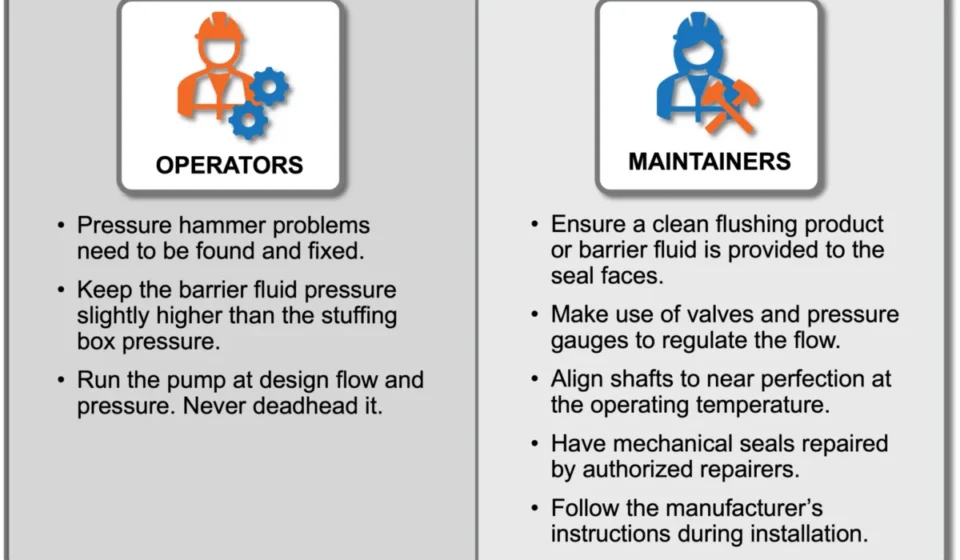
Achieving optimal mechanical seal performance—often exceeding five years of continuous, trouble-free service in clean applications—requires a holistic, system-wide management philosophy. Industry leaders advocate for the following best practices:

- Treat the Seal as a System Component: Never evaluate a seal in isolation. Analyze the pump, motor, piping alignment, and operating envelope as an interconnected system.
- Evaluate VSD Impacts Rigorously: Model the thermal and hydraulic effects of low-speed operations on seal flush plans prior to deploying variable speed drives.
- Implement Robust Monitoring: Utilize advanced condition monitoring tools—such as temperature sensors on seal glands and emission sniffers—to detect anomalies before catastrophic failure occurs.
- Prioritize Precision Installation: Ensure maintenance technicians are thoroughly trained in handling optical-flat surfaces, avoiding contamination, and verifying correct axial setting lengths.
- Standardize Support Plans: Match the application to the appropriate API seal plan, ensuring that barrier or buffer fluids are properly maintained, pressurized, and monitored.
By shifting the organizational mindset from reactive replacement to proactive environmental management, industrial facilities can drastically curtail unplanned downtime. Ultimately, while mechanical seals remain among the smallest components in a facility, mastering their care yields major, measurable consequences for operational excellence and process safety.