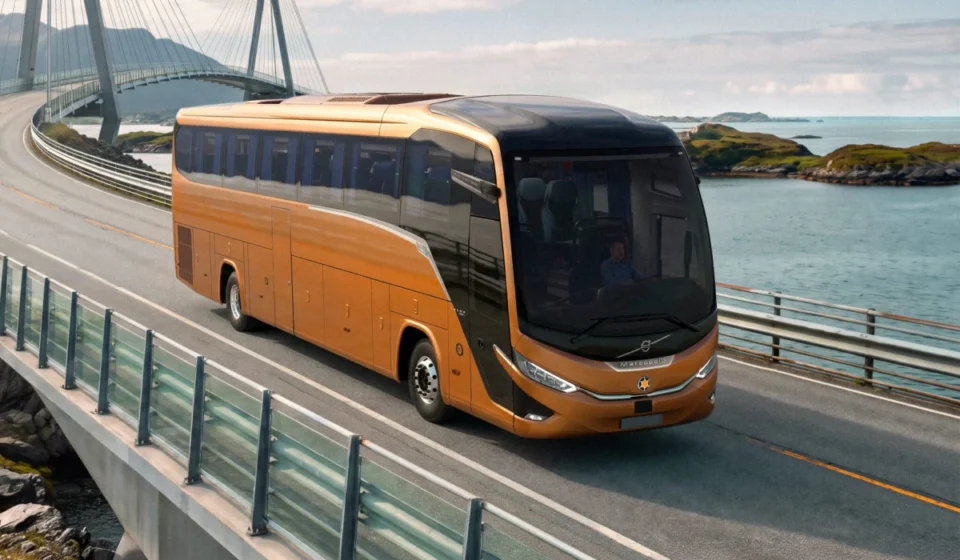
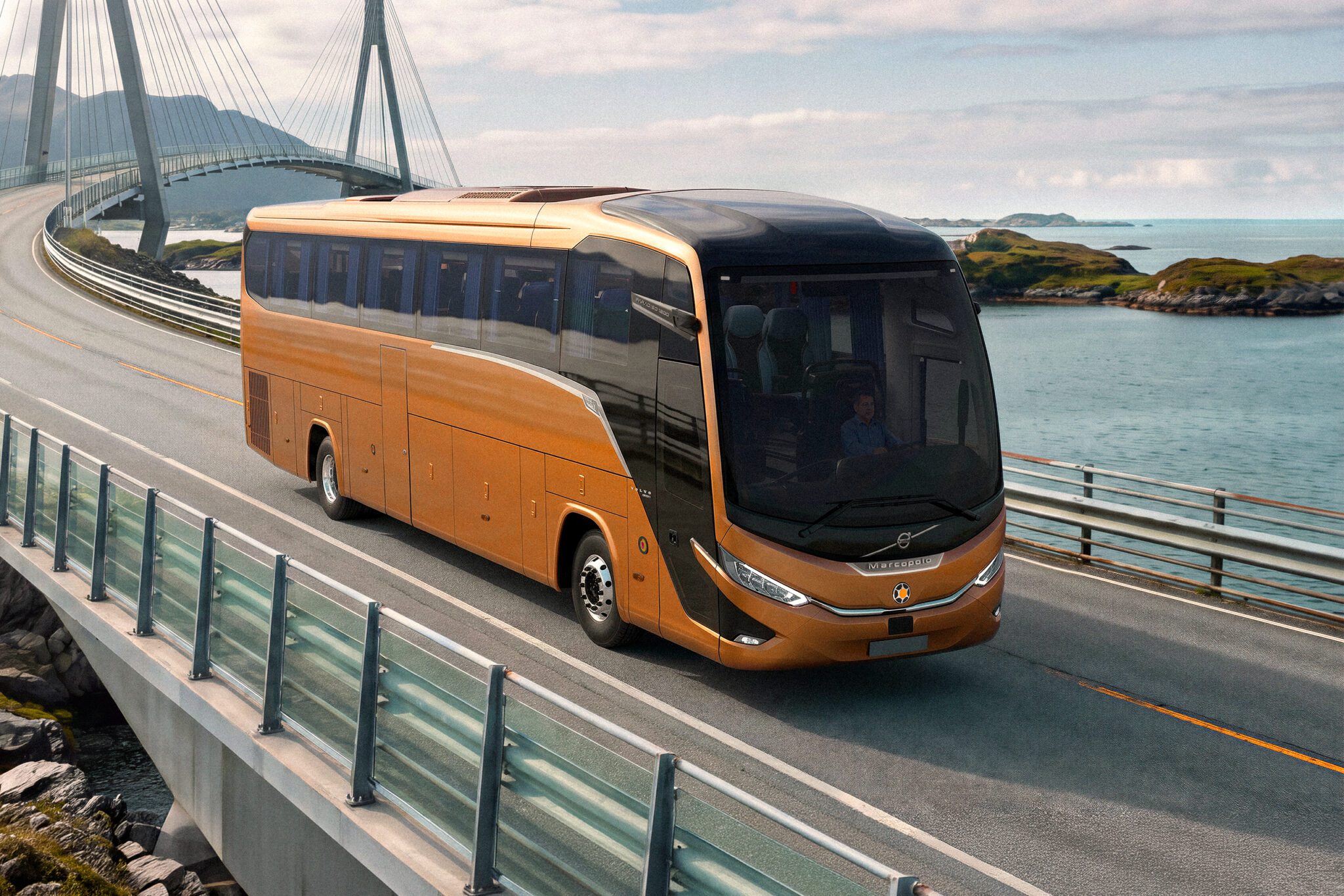
MADRID — In a major development for the global commercial vehicle sector, Volvo Buses and Brazilian bus-building giant Marcopolo have announced a strategic partnership to launch a high-end, premium coach pairing Volvo’s Swedish-engineered B13R chassis with Marcopolo’s cutting-edge Paradiso G8 bodywork. Aimed squarely at the European long-distance and tourism sectors, the new vehicle will make its official public debut next week at the prestigious Feria Internacional del Autobús y del Autocar (FIAA) in Madrid.
For Marcopolo, this collaboration represents a calculated and efficient re-entry into the fiercely competitive European coach market. By utilizing an established, highly regarded chassis platform rather than attempting to build European homologation and partnership networks entirely from scratch, the South American manufacturer has secured a fast-track route back into the region. Meanwhile, for Volvo Buses, the partnership broadens its product portfolio, combining its legendary powertrain and safety credentials with Marcopolo’s world-class body-building expertise and sleek aesthetic design.
Main Facts
The core of this new European offering is a sophisticated vehicle combination tailored specifically to the rigorous demands of modern passenger transport operators:
The Mechanical Foundation: The coach is built upon the Volvo B13R chassis, manufactured in Sweden. Known for its robust reliability, high-torque engine options, and class-leading fuel efficiency, the B13R forms the structural and mechanical backbone of the vehicle.
The Superstructure: Mounted atop the Volvo chassis is the Marcopolo Paradiso G8 body. Renowned globally for its aerodynamic efficiency, modern styling, and superior passenger comfort, the G8 represents the pinnacle of Marcopolo’s engineering capabilities.
Target Market: The vehicle has been meticulously developed for long-distance scheduled routes and high-end tourism operators across Europe.
Configurations: To accommodate varying route capacities and regional regulations, the coach will be available in both 4×2 and 6×2 axle configurations.
Commercial Availability & Launch: The official unveiling takes place at FIAA Madrid next week. Impressively, early pre-orders have already been secured from key launch markets, including France, Italy, and Portugal. Customer deliveries are officially slated to commence in early 2027.
Commercial and After-Sales Governance: Responsibilities for sales and support are strategically divided: Volvo Buses will retain full commercial and after-sales responsibility in Italy and France. In Spain and Portugal, the two companies will share these responsibilities, establishing a framework that could potentially expand into additional European markets as the partnership matures.
Chronology of the Partnership and Market Re-Entry
The path to the FIAA Madrid unveiling has been years in the making, reflecting a calculated strategy by both organizations to identify market gaps and align their respective strengths.
Pre-2026 (Strategic Alignment): Marcopolo evaluates options for re-establishing a manufacturing and commercial footprint in Europe. Simultaneously, Volvo Buses looks to optimize its European chassis offerings by partnering with a globally recognized body builder capable of meeting the stringent quality and comfort expectations of European operators. Talks between executives from Volvo Buses and Marcopolo intensify, focusing on a synergistic pairing of the B13R chassis with the Paradiso G8 body.
Mid-2026 (Engineering and Homologation): Teams from Sweden and Brazil collaborate to integrate the Paradiso G8 body onto the Volvo B13R platform, ensuring that the combined vehicle meets or exceeds European Union safety, environmental, and structural standards. Initial orders are quietly negotiated with early-adopter fleet operators in France, Italy, and Portugal.
September 2026 (Official Announcement): Volvo Buses and Marcopolo issue a joint press release formally announcing their expanded European coach offering, generating significant buzz ahead of the autumn trade show circuit.
Next Week (FIAA Madrid Debut): The premium coach makes its public world premiere at the Feria Internacional del Autobús y del Autocar in Madrid, allowing industry experts, press, and potential fleet buyers to inspect the vehicle firsthand.
Early 2027 (Projected Milestone): The first customer deliveries are scheduled to roll out, marking the operational rebirth of Marcopolo’s presence on European highways alongside Volvo.
Supporting Data and Technical Specifications
To understand the competitive edge this partnership brings to the European market, it is necessary to examine the technical attributes and economic fundamentals underpinning the Volvo B13R and Marcopolo Paradiso G8 combination.
The Volvo B13R Chassis
Volvo’s B13R chassis is a cornerstone of the company’s heavy-duty coach lineup. Designed for maximum uptime and operational economy, it features:
Powertrain Efficiency: Equipped with Volvo’s advanced, fuel-efficient engines (typically pairing the 13-liter engine platform with automated I-Shift transmissions), the B13R is engineered to minimize carbon footprints while delivering high average speeds on hilly or undulating terrain.
Safety Systems: Volvo’s proprietary active and passive safety suites—including Electronic Stability Program (ESP), Adaptive Cruise Control (ACC), Forward Collision Warning with Emergency Braking, and Lane Keeping Support—come integrated into the chassis architecture.
Axle Versatility: The availability of both 4×2 and 6×2 configurations allows operators to optimize payload capacities, passenger counts, and axle-load distribution based on national highway regulations.
The Marcopolo Paradiso G8 Body
Marcopolo’s Generation 8 (G8) bodies have set new benchmarks in global coachbuilding. Key design and functional metrics include:
Aerodynamic Performance: The G8 body boasts a significantly reduced drag coefficient compared to its predecessors. Wind-tunnel optimization translates directly into lower fuel consumption at sustained highway speeds.
Passenger Experience: Enhanced interior ergonomics, optimized HVAC air-distribution systems, reduced cabin noise vibration and harshness (NVH), and modern seating layouts ensure that long-distance passengers arrive refreshed.
Driver Ergonomics: The cockpit has been designed with direct feedback from professional drivers, featuring intuitive instrument placement, exceptional outward visibility, and reduced fatigue-inducing elements.
Total Cost of Ownership (TCO)
In the European long-distance coach sector, Total Cost of Ownership is the ultimate arbiter of success. Fleet operators evaluate vehicles based on fuel consumption, maintenance intervals, residual value, and uptime. By combining Volvo’s legendary mechanical durability and extensive European service network with Marcopolo’s lightweight, durable composite and steel body structures, the joint offering promises a highly competitive TCO equation. Operators benefit from reduced maintenance overhead, high fuel economy, and strong resale values backed by established warranty and parts-supply channels.
Official Responses and Executive Insights
Leadership from both companies have emphasized the strategic alignment and mutual benefits of the agreement.
Thomas Nylund, Head of Europe for Volvo Buses, highlighted the regional strategic value of the collaboration:
"This partnership with Marcopolo further strengthens our offer to customers in Southern Europe. Marcopolo is already a trusted partner in many markets around the world."
Nylund further elaborated on the synergies unlocked by combining the two brands:
"Together, we can now offer a premium coach that combines Volvo’s renowned chassis technology, fuel efficiency, and safety with Marcopolo’s modern design, comfort, and coach-building expertise. This partnership gives us greater flexibility to meet the diverse needs of our customers."
Industry analysts note that Nylund’s emphasis on "flexibility" points to a broader industry trend: as European passenger transport companies face fluctuating demand, driver shortages, and tightening environmental regulations, flexible manufacturing partnerships allow established OEMs to deliver tailored solutions without exorbitant, standalone research and development costs.
Marcopolo executives have similarly echoed these sentiments, noting that aligning with Volvo provides an immediate bridge of trust with European operators who might otherwise hesitate to adopt a returning brand. By leveraging Volvo’s existing dealer, parts, and service infrastructure in key territories like France and Italy, Marcopolo bypasses the decades-long process of building an independent after-sales support network from the ground up.
Market Implications and Future Outlook
The entry—or rather, the strategic re-entry—of Marcopolo into the European coach market via a joint venture with Volvo Buses carries several profound implications for the industry at large:
1. A Blueprint for Cross-Continental Collaboration
Building a brand-new vehicle platform compliant with European Union General Safety Regulations (GSR) and environmental directives is an extraordinarily expensive endeavor. By sharing a proven Swedish chassis with a Brazilian bodybuilder, Volvo and Marcopolo have demonstrated a pragmatic template for how non-European giants can enter mature markets by partnering with established local heavyweights. Observers will be watching closely to see if other international builders adopt a similar playbook.
2. Heightened Competition in the Premium Tourism and Long-Distance Segments
The European long-distance coach market is currently dominated by legacy domestic groups such as Daimler Buses (Mercedes-Benz and Setra), MAN Truck & Bus (Neoplan and MAN), and Iveco Bus. The introduction of the Volvo B13R / Marcopolo Paradiso G8 combination injects a fresh competitive dynamic. Operators looking to differentiate their fleets with striking, modern aesthetic designs backed by reliable European mechanical engineering now have a compelling alternative option.
3. Expansion Potential Beyond Southern Europe
While initial commercial and after-sales responsibilities are firmly established in France and Italy (managed fully by Volvo) and shared in Spain and Portugal, the agreement leaves the door wide open for future expansion. Should early customer deliveries in 2027 prove successful and demand surge, the partnership could easily scale into Central and Northern European markets, altering the competitive landscape across the entire continent.
4. Focus on Sustainability and Efficiency
As European municipalities and transport authorities push aggressively toward decarbonization and tighter efficiency standards, fuel economy remains paramount for diesel and alternative-drivetrain coaches alike. The aerodynamic enhancements of the Marcopolo G8 paired with Volvo’s efficient powertrain management directly address fleet operators’ needs to reduce greenhouse gas emissions and operational expenses simultaneously.
Conclusion
As the industry gathers in Madrid next week for FIAA, the Volvo Buses and Marcopolo display will undoubtedly serve as one of the focal points of the exhibition. By uniting Swedish engineering excellence with Brazilian design innovation, the two companies have crafted a formidable contender for the future of European long-distance travel. With pre-orders already locked in and deliveries set to commence in early 2027, the stage is set for a major new chapter in European coach transportation.