




Hydraulic systems have long been the backbone of industrial progress. From the massive forces required in metal forging and plastics processing to the intricate movements of automated assembly lines, fluid power remains unmatched in its power density, robustness, and reliability. However, as global industrial sectors face mounting pressure to reduce carbon footprints and optimize operational expenditures, the traditional hydraulic system is undergoing a profound transformation. The challenge is no longer just about generating force—it is about doing so with unprecedented energy intelligence.
The State of the Industry: The Efficiency Imperative
For decades, hydraulic systems were prioritized for their ability to deliver consistent performance under extreme conditions. The design philosophy was simple: build for peak demand, prioritize safety, and ensure reliability above all else. Consequently, many systems were designed with significant "safety margins"—essentially over-engineered capacity that, while ensuring durability, often led to wasted energy during standard operation.
Today, the industrial landscape has shifted. With energy costs rising and stringent ESG (Environmental, Social, and Governance) mandates becoming the standard for manufacturing, the focus has moved toward "lean fluid power." This shift represents a transition from mechanical brute force to intelligent, adaptive energy management.
Chronology: The Evolution of Fluid Power Efficiency
To understand where hydraulics are headed, we must look at the milestones that have brought us to the current era of "Smart Hydraulics":
- The Mechanical Era (1950s–1980s): Hydraulics were dominated by fixed-displacement pumps and constant-speed motors. Energy efficiency was largely ignored in favor of mechanical simplicity and component longevity.
- The Control Revolution (1990s–2000s): The introduction of proportional valves and basic pressure-compensated systems allowed for better flow control, reducing some of the waste associated with constant-pressure dumping.
- The Digital Integration (2010–2020): The rise of Variable Speed Drives (VSDs) and early electrohydraulic controllers enabled systems to respond to real-time load requirements, marking the first major step in dynamic energy saving.
- The Intelligent Era (2020–Present): We are currently witnessing the integration of AI, machine learning, and advanced sensor fusion. Modern systems like those developed by industry leaders such as The Atos Group are no longer just "executors" of commands; they are self-monitoring, self-optimizing nodes within a larger industrial network.
Supporting Data: Where the Energy Goes
The fundamental challenge in hydraulics is the energy conversion cycle. Mechanical energy is converted into fluid power, which is then transmitted and converted back into mechanical work. Each stage presents an opportunity for entropy.
Research suggests that in poorly optimized legacy systems, as much as 40–60% of input energy can be lost to heat generation, pressure drops across valves, and leakage. By contrast, modern electrohydraulic architectures can reduce these losses by 30% or more.
Key metrics for modern efficiency include:
- Duty Cycle Matching: Aligning pump output with the exact force required for a specific millisecond of the work cycle.
- Standby Power Reduction: Utilizing VSDs to bring pump speeds to near-zero during idle periods, compared to the old method of "throttling" against a relief valve.
- Regenerative Capture: In gravity-fed applications, such as large presses, capturing potential energy during the downward stroke and storing it in accumulators for the next cycle.
Technological Pillars of the New Hydraulic Standard
The path to efficiency is paved by four distinct technological advancements:
1. Variable Speed Drives (VSDs)
VSDs have become the "brains" of the modern power unit. Instead of running an electric motor at a constant speed—effectively "idling" while wasting energy—the motor now ramps up or down based on the specific load demand. This is particularly transformative for machines with variable cycles, where the power requirement changes drastically within seconds.
2. Electrohydraulic Servopumps
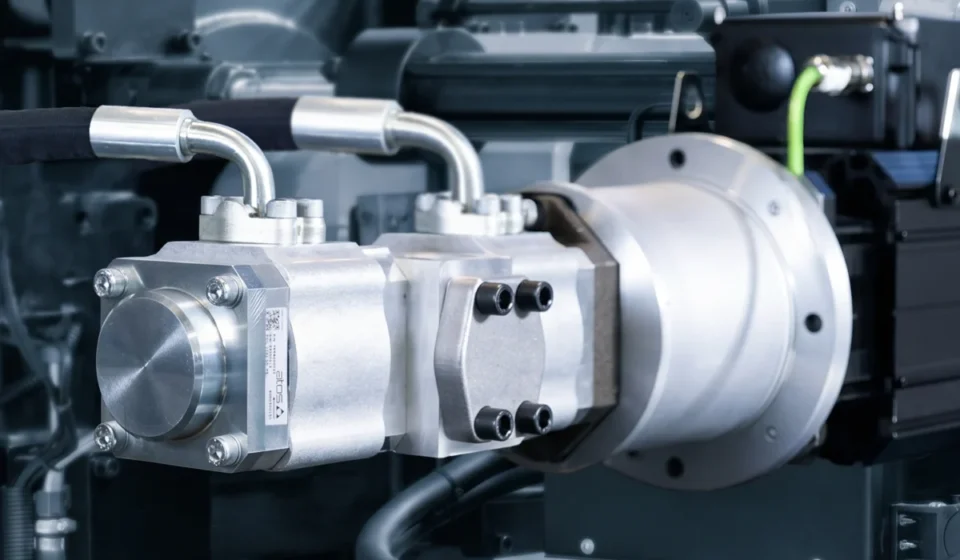
The convergence of electronic precision and hydraulic power is perhaps the most significant leap forward. Companies like Atos have pioneered servopump technology that allows for the fine-tuned control of flow and pressure. By bypassing traditional valve-based throttling, these pumps provide exactly what is needed, when it is needed, virtually eliminating the energy waste associated with traditional bypass circuits.
3. The Digital Twin and Predictive Maintenance
Efficiency is not just about the moment of operation; it is about the health of the system over its entire lifecycle. Digital controllers now feed data into cloud-based platforms, enabling predictive maintenance. By monitoring fluid viscosity, filter health, and temperature in real-time, operators can prevent inefficiencies caused by friction and degradation before they manifest as increased power consumption.
4. Advanced Fluid Chemistry
Even the best hardware is limited by the medium it uses. Advances in hydraulic fluid technology—specifically synthetic fluids with high viscosity indices—have reduced internal friction. These fluids maintain their performance characteristics across a wider temperature range, ensuring that the system spends less energy fighting its own internal resistance.
Implications for Industrial Strategy
The transition to energy-efficient hydraulics has implications far beyond the factory floor.
For Procurement and Operations
Companies are moving away from purchasing based solely on "sticker price" and toward Total Cost of Ownership (TCO) models. An energy-efficient hydraulic system may have a higher initial capital expenditure, but the ROI—achieved through electricity savings and reduced maintenance downtime—is often realized within 18 to 24 months.
For Sustainability Reporting
As corporations face pressure to report Scope 1 and Scope 2 emissions, the "smart" hydraulic system becomes an asset. By integrating these systems into a plant-wide Energy Management System (EMS), managers can generate real-time reports on the energy footprint of their production lines, providing a transparent, data-backed path to meeting sustainability goals.
For Technical Training
The "hydraulic mechanic" of yesterday must become the "mechatronics technician" of tomorrow. The integration of AI and digital control means that workforce development is now a critical pillar of energy efficiency. Operators must be trained not just in wrench-turning, but in interpreting sensor data and optimizing software-defined hydraulic parameters.
Expert Perspectives: The Role of AI and Machine Learning
The integration of AI and Machine Learning (ML) is the next frontier. As noted in recent industry discourse, fluid power is currently being augmented by machine learning algorithms that can "learn" the optimal pressure profiles of a machine.
By analyzing thousands of cycles, an AI-driven controller can identify inefficiencies that even a human engineer might miss. For example, it might determine that a machine can complete a specific forming operation at 5% less pressure without sacrificing part quality, or that a pump can enter a "sleep" mode a half-second earlier in the cycle. These micro-optimizations, when compounded across millions of cycles, represent a massive reduction in the industrial carbon footprint.
Conclusion: A Balanced Future
The narrative that hydraulics are an "outdated" technology is factually incorrect. In reality, hydraulics are undergoing a renaissance. By embracing electrohydraulic integration, digital monitoring, and smarter component design, the industry is proving that high force and high efficiency are not mutually exclusive.
The future of manufacturing lies in a balanced approach: one that respects the inherent power of fluid systems while utilizing the precision of modern electronics. As we move toward an increasingly digitized industrial world, hydraulics will not only remain relevant—they will serve as the intelligent, efficient, and reliable engines of the future economy.
Sponsored content by The Atos Group.