





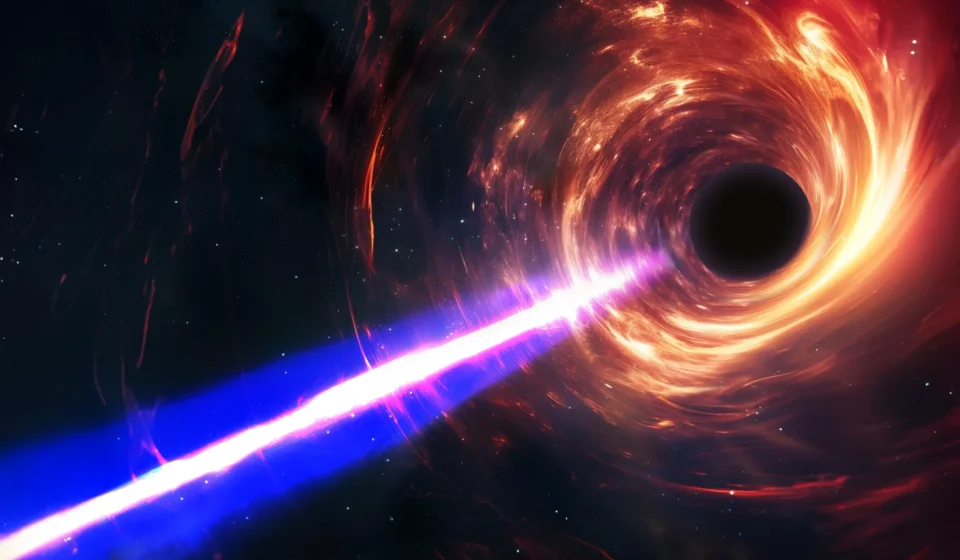

In the silent, dark expanse of the cosmos, few phenomena are as violent or as spectacular as the awakening of a black hole. For decades, astrophysicists have been captivated by the mysterious "jets"—colossal, high-speed beams of plasma and radiation—that erupt from the hearts of galaxies. Now, a groundbreaking international study has revealed that these chaotic eruptions may not be random, but rather follow a precise, universal rule dictated by the black hole’s "feeding cycle."
An international team of astronomers, co-led by researchers from the Institute for Advanced Study (IAS) and Curtin University, has identified a critical accretion threshold that triggers these powerful outflows. This discovery suggests that whether a black hole is a "stellar-mass" runt, roughly ten times the mass of our Sun, or a supermassive titan weighing millions of solar masses, it obeys the same fundamental physical laws when it decides to fire its cosmic cannons.
The Mechanics of a Celestial Feast: Main Facts
The study, published in the prestigious journal Nature Astronomy under the title "A universal critical accretion rate for black hole jet formation," represents a milestone in high-energy astrophysics. The research team, led by Andrew Mummery—a Martin A. and Helen Chooljian Member at the IAS—and Adelle Goodwin, a Forrest Research Foundation Fellow at Curtin University’s International Centre of Radio Astronomy Research, synthesized years of multi-wavelength observational data.
The core finding is a specific tipping point: black holes appear to trigger jet production when their accretion rate—the speed at which they consume surrounding matter—drops to approximately two percent of their "Eddington limit." The Eddington limit is a theoretical benchmark in astrophysics, representing the point where the outward pressure of a black hole’s intense radiation perfectly balances the inward pull of its gravity.
When a black hole consumes matter at a rate exceeding this two-percent threshold, the physics of its environment behaves differently. Once the "fuel" supply dips to this critical level, the black hole undergoes a transition that inevitably results in the launch of a radio jet. This consistency across scales ranging from solar-mass objects to supermassive giants suggests a "scale-invariant" nature to black hole physics that has long been theorized but never definitively proven.
A Rare Opportunity: The Role of Tidal Disruption Events
To confirm this hypothesis, the researchers turned their focus to Tidal Disruption Events (TDEs). A TDE occurs when a star wanders too close to a supermassive black hole. The black hole’s immense gravitational tidal forces stretch and shred the star, transforming it into a stream of gas that spirals inward toward the event horizon.
These events are the "laboratories" of modern astronomy. While supermassive black holes usually evolve over timescales of millennia—far longer than a human lifetime—TDEs compress this process. When a star is torn apart, the resulting feeding frenzy provides a high-resolution, time-accelerated view of how a black hole handles a sudden, massive influx of matter.
"We really wanted to figure out this massive puzzle," says Mummery. "Why do some supermassive black holes blast out radio jets right after shredding a star, while others just sit there looking completely dormant, only to suddenly fire up their jets months or even years later?"
By observing these events, the team could watch in near real-time as the black hole "digested" the stellar debris, observing the transition from a dormant state to an active, jet-producing engine.
Chronology of Discovery: From a Madrid Bar to Global Observatories
The journey to this discovery was as unconventional as the physics it describes. The breakthrough did not originate in a high-tech lab, but during an informal conversation at an astrophysics conference in Madrid. Mummery and Goodwin, discussing the disparate behaviors of black holes, realized that the rules governing smaller, "stellar-mass" black holes in our own Milky Way might be the "Rosetta Stone" for understanding their larger counterparts.
To test this, the team curated a sample of twenty TDEs, drawing on observations from an international network of telescopes across America, Australia, India, and South Africa, as well as space-based observatories. They narrowed this list down to ten high-quality events where the data was sufficiently precise to correlate the black hole’s feeding rate with the exact timing of its radio jet emission.
The Two-Phase Eruption
The analysis revealed that jet formation in TDEs occurs in two distinct phases:
- The Early Phase: An immediate, often chaotic, release of energy as the star is shredded and the black hole is overwhelmed by a sudden surge of material.
- The Late-Stage Trigger: A delayed jet eruption, occurring hundreds or even thousands of days after the initial event.
It is during this second phase that the "two-percent rule" becomes visible. As the initial tidal debris is consumed or expelled, the accretion rate eventually settles toward the two-percent Eddington threshold. At that specific moment, the jet is triggered. This consistency confirms that the physics of the "central engine" is remarkably robust, indifferent to the absolute size of the black hole.
Supporting Data: The Physics of the "Cosmic Burp"
Black holes are frequently described as "cosmic vacuum cleaners," but the reality is significantly messier. As Adelle Goodwin notes, "When a black hole tears apart a star, it does not swallow everything neatly."
The process is inherently inefficient. Much of the stellar material is indeed pulled toward the event horizon, but a significant fraction is violently redirected. These outflows—essentially colossal, high-energy "burps"—can propel stellar material across light-years of space. These outflows are not mere side effects; they are transformative. By depositing energy and matter into the surrounding interstellar medium, these jets can fundamentally alter the chemical and structural evolution of the host galaxy.
The team’s data analysis showed that the two-percent threshold acts as a switch. In smaller black holes, this threshold has long been associated with the state transition between a "soft" (disk-dominated) and "hard" (jet-dominated) state. By proving this same switch exists in supermassive black holes, the team has effectively unified the study of black hole accretion across the entire cosmic spectrum.
Official Responses and Scientific Impact
The implications of the study have been met with excitement across the astronomical community. By establishing a predictive model for jet formation, the researchers have moved black hole study from a reactive field to a proactive one.
"We hope that our work will pave the way for even more profound discoveries about our universe," says Mummery. The ability to predict when a black hole is likely to erupt is a significant boon for operational efficiency. Currently, major observatories are in constant demand; knowing when to point a telescope at a TDE candidate can be the difference between capturing a once-in-a-lifetime event and wasting precious observation time on a dormant source.
This predictive capability will be vital for the next generation of radio astronomy. The Square Kilometre Array (SKA), slated to begin data collection in 2028, will possess unprecedented sensitivity to these types of transient events. With the team’s new framework, astronomers will be better prepared to utilize the SKA to observe the birth and evolution of these jets with a clarity never before possible.
Implications for Future Research
The discovery of a universal critical accretion rate is more than just a box checked in a textbook; it provides a new lens through which we view the history of the universe. If the growth and behavior of black holes are constrained by these specific rules, then our models for galaxy formation must be updated to account for these predictable, yet violent, feedback cycles.
Furthermore, this research demonstrates the power of multi-wavelength astronomy. By combining optical, ultraviolet, X-ray, and radio data, the team was able to map the entire life cycle of a TDE, from the initial light flash of the star’s destruction to the final, radio-loud roar of the jet.
As the scientific community looks toward the future, the work of Mummery and Goodwin serves as a reminder that even in the most extreme and seemingly unpredictable environments in the universe, there is a hidden, elegant order. The "two-percent rule" is a testament to the fact that, whether dealing with a stellar-mass black hole in our own galactic backyard or a supermassive giant in a distant galaxy, the universe operates by a set of rules that are as enduring as they are powerful.
The next phase of this research will likely involve applying this threshold to even more diverse samples of black holes, testing the limits of the rule and investigating whether other environmental factors—such as the black hole’s spin or the composition of the consumed star—might create subtle variations in this universal clockwork. For now, astronomers have a new, reliable tool for peering into the hearts of galaxies, turning the "random" chaos of the cosmos into a predictable, observable cycle.