

The Future of Racing: Indy Autonomous Challenge Marks Historic Milestone at Laguna Seca

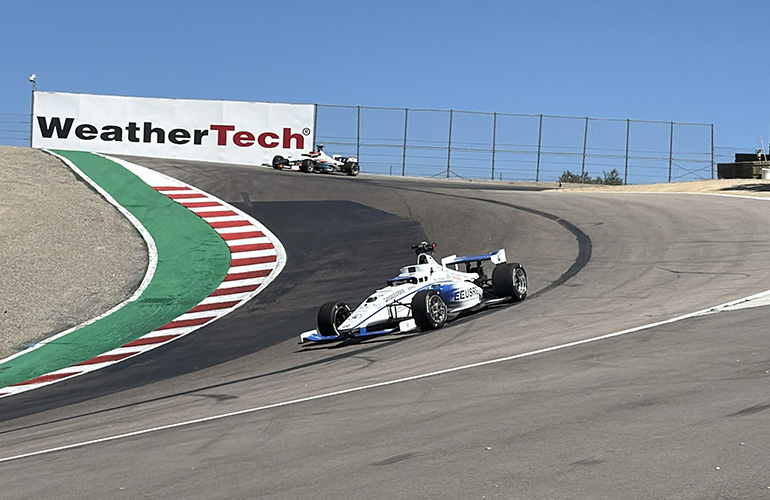
On September 3, 2026, the world of motorsports underwent a fundamental shift. At the legendary WeatherTech Raceway Laguna Seca, the Indy Autonomous Challenge (IAC) achieved a milestone that, just a few years ago, was considered the "holy grail" of robotics: the first-ever successful wheel-to-wheel overtaking maneuvers performed by autonomous racecars on a complex road course.
While previous IAC events have demonstrated the capability of artificial intelligence to navigate oval tracks at high speeds, the Laguna Seca event represented a quantum leap in difficulty. Unlike the predictable banking of an oval, a road course demands intricate knowledge of elevation changes, varied corner radii, and sophisticated braking zones—most notably the circuit’s infamous "Corkscrew," a turn that drops five stories in a horizontal distance of only 450 feet.
The Main Event: A New Era of Autonomous Competition
The 2026 IAC event saw nine elite university teams from North America, Europe, and Asia converge on the California coast. These teams, composed of Ph.D. and master’s students at the cutting edge of robotics research, were tasked with piloting the standard-issue IAC AV-24 racecars. These vehicles are marvels of modern engineering, featuring a Dallara base, Honda engines, high-resolution Luminar LiDAR sensors, and the raw computational power of NVIDIA GPUs.
The highlight of the weekend was the head-to-head heat format. In a display of machine learning maturity, the AI drivers were tasked with "attacking" and "defending" against their counterparts. For the first time in the history of the challenge, the cars were not simply competing against the clock or against a virtual ghost; they were competing against each other in real-time, making autonomous decisions about when to pass, when to brake, and how to maintain traction through the circuit’s technical sectors.
The victory was ultimately claimed by Unimore Racing, representing the University of Modena and Reggio Emilia. Their performance in the final heat against Purdue AI Racing demonstrated a level of tactical awareness that underscored the rapid evolution of autonomous decision-making algorithms.
Chronology of an Autonomous Breakthrough
To understand the magnitude of this achievement, one must look at the timeline of the IAC, which has served as a crucible for autonomous vehicle (AV) development since its inception in 2021.
- 2021: The Inaugural Run: The IAC launched at the Indianapolis Motor Speedway, proving that autonomous vehicles could successfully navigate the world’s most famous oval.
- 2022–2024: The Oval Era: Over the next several years, the organization focused on six passing competitions on high-speed ovals, including the Las Vegas Motor Speedway and Texas Motor Speedway. These events pushed the limits of top-speed stability and sensor synchronization at velocities exceeding 170 mph.
- 2025: The Road Course Prelude: The IAC returned to Monterey, California, for a historic first attempt at a road course. While successful, the format was limited to time-trial racing, with only one vehicle on the track at a time. This allowed researchers to map the track and calibrate their sensors to the environment.
- September 3, 2026: The Overtaking Breakthrough: The barrier was finally shattered. By utilizing one-on-one heats, the IAC moved from "autonomous driving" to "autonomous racing," requiring the AI to interpret the erratic movements of a competitor rather than just the static geometry of the track.
The Technical Infrastructure: Simulation as the Foundation
A critical component of this year’s success was the mandate for virtual qualification. Before any car touched the asphalt at Laguna Seca, every team was required to qualify through a simulation event hosted by D-Space.
This "software-in-the-loop" environment created a high-fidelity digital twin of the Laguna Seca circuit. In this virtual realm, teams validated their race strategies and collision-avoidance algorithms. The necessity of this step cannot be overstated; by the time the vehicles arrived in California, the AI models had already "raced" thousands of laps in simulation, encountering edge-case scenarios that would have resulted in catastrophic, expensive, and dangerous crashes on a physical track.
The human element remains essential, though its role has shifted from driver to "systems architect." During the heats, crews monitored telemetry, managing engine power limits and overseeing safety protocols. While the AI made every split-second decision regarding steering, throttle, and braking, the human engineers kept their hands on the e-stop buttons, a necessary fail-safe that highlights the ongoing bridge between human oversight and machine autonomy.
Supporting Data and Technical Specifications
The IAC is not merely a sport; it is an industrial research platform. By forcing all teams to use identical hardware, the challenge isolates the performance of the AI software, effectively turning the race into a high-speed, high-stakes coding competition.
| Component | Specification |
|---|---|
| Vehicle Platform | Dallara AV-24 |
| Powertrain | Honda 2.0L Turbo |
| Perception | Luminar Iris LiDAR |
| Compute | NVIDIA Drive Orin |
| Qualification | D-Space Software-in-the-Loop |
The data gathered during the race—specifically the interaction between cars during the passing phases—is invaluable to the automotive industry. It provides researchers with real-world data on how autonomous agents handle "adversarial" driving, where another vehicle’s actions are unpredictable and potentially aggressive. This data is the lifeblood of current research into Level 4 and Level 5 autonomous consumer vehicles.
Industry Implications and Future Outlook
The success at Laguna Seca serves as a powerful proof-of-concept for the future of transportation. When an AI can successfully navigate the "Corkscrew" while overtaking a competitor, it suggests that the software is becoming increasingly capable of handling the chaotic, unpredictable nature of public roadways.
The IAC is already acting as an incubator for the next generation of industry leaders. Several alumni of the program have gone on to launch their own ventures, including Aidoptation, driveblocks, and Autonoma AI. These companies are directly applying the lessons learned from the track to solve challenges in logistics, trucking, and passenger transport.
"The research being conducted by these university teams is fundamentally altering the pace of innovation," a representative from the IAC noted following the event. "We are moving from a world where autonomous cars struggle to stay in a lane, to a world where they can exhibit race-craft."
Official Responses and Reflections
The mood at Laguna Seca was one of profound accomplishment. For the team from Unimore Racing, the victory was the culmination of thousands of hours of simulation and iterative coding. The Purdue AI Racing team, despite a second-place finish, was praised for the technical prowess displayed during their pursuit of the leader.
Industry experts attending the event noted that the most impressive aspect was not the speed, but the decisiveness of the machines. In previous years, autonomous cars would often be overly conservative, resulting in "procession-style" racing. This year, the algorithms were tuned for aggression, proving that the latency in sensor fusion and path planning has reached a point where the AI can react to a closing gap in milliseconds.
As the 2026 season concludes, the IAC looks toward even more complex environments. With the successful execution of overtaking on a road course, the organization has effectively cleared the path for future events that may include multi-car fields, variable weather conditions, and even more technical street circuits.
The race at Laguna Seca was more than a display of speed; it was a definitive signal to the global automotive market. The age of the autonomous machine, capable of complex decision-making in high-pressure environments, has officially arrived. As these students transition from the classroom to the boardroom, the ripple effects of their work in Monterey will likely be felt in every autonomous vehicle that enters the commercial market in the coming decade.