
New Jersey ModWash Facility Hit with $446,864 OSHA Penalty Following Serious Safety and Hazardous Energy Violations

By Danielle Naidu | Enriched and Expanded Report
Workers at an automated car wash facility in Sicklerville, New Jersey, faced severe occupational hazards ranging from uncontrolled dangerous electrical currents to damaging workplace noise levels, according to findings released by the U.S. Department of Labor’s Occupational Safety and Health Administration (OSHA).
ModWash, a prominent regional car wash operator, is now facing a staggering $446,864 in proposed federal penalties. The financial sanction comes on the heels of a comprehensive workplace safety inspection that uncovered a litany of compliance failures. Federal regulators slapped the company with a total of eight citations, categorizing the infractions as one willful, two repeat, and five serious violations.
The investigation underscores federal regulators’ ongoing crackdown on standard industrial negligence, particularly concerning the failure to protect service technicians and maintenance personnel from the catastrophic risks associated with unexpected machinery startup and unchecked hazardous energy.
Main Facts: The Anatomy of the Sicklerville Violations
The core of OSHA’s case against ModWash centers on systemic failures to protect workers from two major workplace hazards: hazardous energy sources during equipment servicing and chronic occupational noise exposure without proper hearing protection.
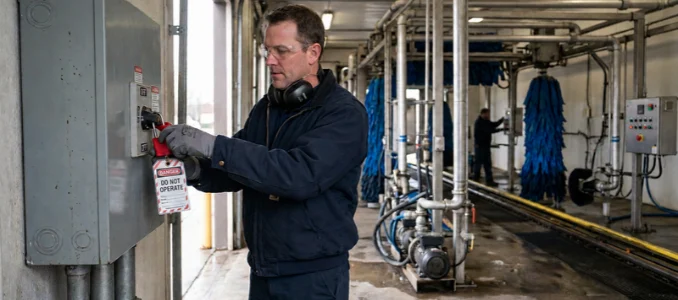
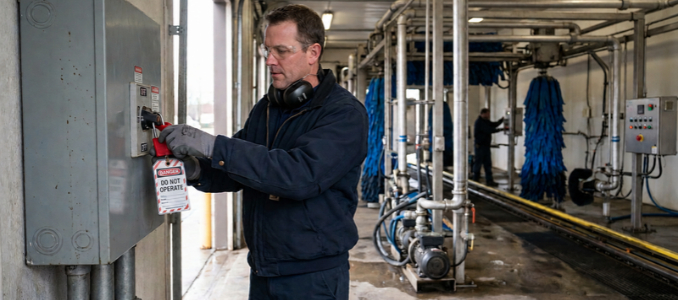
According to federal safety documents, the ModWash location in Sicklerville failed to adhere to fundamental safety protocols designed to prevent machinery from unexpectedly energizing during maintenance operations. Technicians were routinely required to service complex automated car wash equipment—which features high-powered rotating brushes, high-pressure water pumps, and heavy mechanical conveyor systems—without the basic protections afforded by lockout/tagout (LOTO) safety programs.

Breakdown of the Citations
- The Willful Citation: OSHA issued a willful violation after determining that employees serviced and maintained equipment without first isolating hazardous energy sources or following established energy-control procedures. In OSHA terminology, a "willful" violation is assigned when an employer either knowingly fails to comply with a legal requirement or acts with plain indifference to employee safety. Furthermore, the willful citation highlighted that ModWash failed to maintain adequate written lockout procedures and neglected to train its workforce on essential LOTO protocols.
- The Repeat Citations: ModWash was hit with two repeat violations, indicating that federal safety inspectors had previously cited the company or its corporate entities for similar infractions at other work sites. Repeat violations signal a systemic failure to learn from past regulatory enforcement actions.
- The Serious Violations: The five serious citations covered a broad spectrum of occupational health and safety failures. Most notably, these included severe deficiencies within the company’s hearing-conservation program. OSHA inspectors found that workers were regularly exposed to noise levels exceeding 85 decibels—the threshold at which prolonged exposure can cause permanent hearing loss—without adequate noise monitoring, baseline audiometric testing, or protective training. Additional serious violations noted that ModWash failed to provide physical lockout/tagout devices to employees and neglected to ensure those safety mechanisms were actively engaged before equipment servicing began.
Chronology of an Inspection: How the Case Unfolded
While OSHA routinely conducts targeted inspections based on employee complaints, industry-specific emphasis programs, or workplace injuries, the timeline of a major safety violation case follows a highly structured legal and administrative path.
- The Initiation: OSHA compliance safety and health officers (CSHOs) arrived at the Sicklerville ModWash facility to conduct a routine or targeted safety inspection. During their walkthrough, inspectors evaluated machinery guarding, maintenance logs, employee interviews, and environmental noise levels.
- The Discovery: Investigators quickly identified severe lapses in standard operating procedures. They observed or uncovered evidence that maintenance personnel routinely worked on energized electrical panels and mechanical assemblies without implementing physical lockouts, creating an imminent danger environment. Additionally, environmental sampling and employee interviews revealed that workers operating loud equipment lacked mandatory hearing protection and baseline medical surveillance.
- The Citation Issuance: Following the conclusion of the inspection—which can take several weeks or months as evidence is compiled and reviewed by OSHA area directors—the agency formally issued the citation package, proposing the $446,864 penalty.
- The 15-Business-Day Window: Upon receipt of the citations, ModWash entered a critical legally mandated timeframe. Under federal labor law, the company has precisely 15 business days to determine its course of action. During this window, ModWash leadership can choose to pay the proposed fines in full, request an informal conference with the OSHA Area Director to negotiate a settlement or modified abatement terms, or formally contest the findings and penalties before the independent Occupational Safety and Health Review Commission (OSHRC).
Supporting Data: The High Stakes of Lockout/Tagout and Hearing Conservation
To understand the gravity of the fines levied against ModWash, it is essential to examine the statistical and operational dangers associated with the cited violations within the modern car wash and general light-industrial sectors.
The Danger of Hazardous Energy
Lockout/tagout regulations (29 CFR 1910.147) are among OSHA’s most frequently cited standards, and for good reason. Unexpected energization or startup of machinery—or the release of stored electrical, pneumatic, hydraulic, or mechanical energy—causes thousands of injuries and dozens of fatalities nationwide every year.

In an automated car wash environment, the dangers are multi-layered:
- Electrical Hazards: High-voltage control panels power pumps and sensors. Contact with live circuits can result in severe electrocution, cardiac arrest, or severe burns.
- Mechanical Hazards: Conveyor chains, automated wash mitts, and high-speed drying fans store immense kinetic and potential energy. If a machine cycles while a technician is clearing a jam or performing routine lubrication, limbs can be crushed, severed, or caught in pinch points.
- Fluid Dynamics: High-pressure water and chemical delivery systems operate under extreme psi ratings. Uncontrolled pressure releases can cause severe lacerations, eye injuries, or chemical burns.
The Hidden Threat of Noise-Induced Hearing Loss
OSHA’s Occupational Noise Exposure standard (29 CFR 1910.95) mandates that employers implement a hearing conservation program when workplace noise equals or exceeds an 8-hour time-weighted average (TWA) of 85 decibels (dBA).
Car washes are notoriously loud work environments. The combination of roaring industrial blowers, high-pressure water jets, vacuums, and mechanical motors routinely pushes ambient noise levels well past safe limits. Without proper monitoring, annual audiometric testing, and the provision of certified earplugs or earmuffs, workers suffer gradual, irreversible hearing loss. The lack of training cited by OSHA means workers were left entirely unprotected against a chronic, occupational health hazard that diminishes their quality of life long after their shift ends.

Official Responses and Regulatory Context
As a corporate entity, ModWash operates in a rapidly expanding sector of automated, express exterior car washes. These facilities pride themselves on speed, convenience, and high-volume throughput. However, federal labor regulators have increasingly turned their attention to the service and maintenance side of these businesses, where the push to minimize equipment downtime often clashes with rigorous safety compliance.
When an organization receives a "willful" citation accompanied by a nearly half-million-dollar penalty, it signals that OSHA views the safety failures not merely as oversights, but as conscious disregard or gross negligence regarding worker protections.
While ModWash has not yet publicly released a detailed operational defense, companies facing such enforcement actions typically utilize the informal conference process. During these meetings, employers often present evidence of corrective actions taken—such as purchasing new LOTO kits, hiring third-party safety consultants, or retraining staff—in exchange for potential reductions in financial penalties or reclassification of citations. However, the presence of a willful violation makes substantial penalty reductions much more difficult to negotiate without a formal legal challenge.

Broader Implications for the Car Wash and Industrial Sectors
The hefty penalty imposed on the Sicklerville ModWash facility serves as a stark warning to the broader automated car wash industry and light-manufacturing sectors alike.
1. Shift Toward Proactive Safety Culture
Automated car washes are becoming increasingly complex, utilizing advanced programmable logic controllers (PLCs), robotics, and high-speed moving parts. As these facilities modernize, the safety protocols governing maintenance must evolve at an equal pace. Companies can no longer treat maintenance as a quick fix done on the fly. Implementing robust, auditable energy-control procedures is mandatory, not optional.
2. Increased Scrutiny on Small-to-Mid-Sized Operations
While OSHA frequently targets heavy manufacturing, construction, and warehousing, the retail service sector—including automated car washes, quick-lube facilities, and drive-thru services—is facing heightened scrutiny. Regulators are looking closely at how multi-unit operators manage safety compliance across disparate geographic locations. A safety failure at one facility often triggers a corporate-wide evaluation, particularly if repeat violations are discovered.

3. Personal and Corporate Accountability
The financial impact of a $446,864 fine is significant, but the long-term costs associated with workplace injuries are far higher. Beyond regulatory penalties, companies face increased workers’ compensation insurance premiums, potential civil liability litigation, reputational damage, and difficulties in employee recruitment and retention. In an era where corporate social responsibility and worker safety are paramount, failing to protect front-line staff carries profound economic consequences.
Next Steps for ModWash
As the 15-business-day response window ticks down, industry observers will be watching closely to see whether ModWash chooses to contest the findings before the Occupational Safety and Health Review Commission or negotiate a settlement with OSHA. Regardless of the legal outcome, the case reinforces an uncompromising regulatory reality: employee safety must always take precedence over operational speed, and the failure to control hazardous energy will be met with the full force of federal enforcement.