




Hydraulic systems have long served as the backbone of industrial manufacturing, heavy equipment, and automated production. Known for their unparalleled power density, robustness, and reliability, these systems are essential in sectors ranging from metal forming and plastics processing to aerospace and infrastructure development. However, as the global industrial landscape shifts toward sustainability and carbon neutrality, the traditional perception of hydraulics as "energy-intensive" is being challenged.
Engineers and manufacturers are now at a critical juncture: how to harness the raw power of fluid motion while meeting the increasingly stringent energy efficiency requirements of the modern era. This shift is not merely about incremental component upgrades; it is a fundamental redesign of how hydraulic power is generated, managed, and recovered.
The Core Challenge: Efficiency in Energy Transformation
At its simplest, a hydraulic system is an energy transducer. It converts mechanical energy into fluid power, which is then redirected through valves and actuators to perform useful mechanical work. In this multi-stage conversion, energy loss is an inherent risk, primarily through heat generation, fluid friction, and leakage.
For decades, hydraulic systems were designed with significant "safety margins." Engineers prioritized reliability and responsiveness above all else, often resulting in systems that operated at higher pressures and flow rates than were strictly necessary for the task at hand. While this ensured that machinery would not fail under peak loads, it created a scenario where systems consumed excessive energy during routine, lower-demand operations.
Modern engineering is moving away from this "over-design" philosophy. By utilizing advanced sensors and digital control, systems are now being tuned to operate with a "right-sized" mindset—delivering exactly the power required at the precise moment it is needed.
Chronology of Innovation: From Constant Flow to Intelligent Actuation
The evolution of hydraulic efficiency has been a gradual process of electrification and digitalization.
- The Early Era (Pre-1990s): Systems were dominated by fixed-displacement pumps and constant-speed motors. Efficiency was dictated largely by the physical design of the valves, and energy was often "bled off" through relief valves, resulting in significant thermal waste.
- The Proportional Era (1990s–2010s): The introduction of proportional valves and pressure-compensated systems allowed for better control over flow and pressure. This era marked the first major shift toward matching hydraulic output to load requirements.
- The Electrohydraulic Revolution (2010s–Present): With the integration of Variable Speed Drives (VSDs) and sophisticated digital controllers, hydraulic systems began to communicate with the rest of the factory floor.
- The Era of Autonomy (Future): Current research, integrating Artificial Intelligence (AI) and Machine Learning (ML), is moving toward self-optimizing systems that can predict maintenance needs and adjust their own operating parameters based on real-time environmental data.
Technological Pillars of Efficiency
1. Variable Speed Drives (VSDs)
VSDs represent perhaps the most significant leap in hydraulic efficiency. Traditionally, hydraulic pumps ran at a constant speed, with excess flow returned to the tank. By installing a VSD, the electric motor driving the pump can modulate its speed to meet the exact flow demand of the application. This eliminates the need for bypass valves and drastically reduces energy consumption during idle or low-demand cycles.
2. Electrohydraulic Servopumps
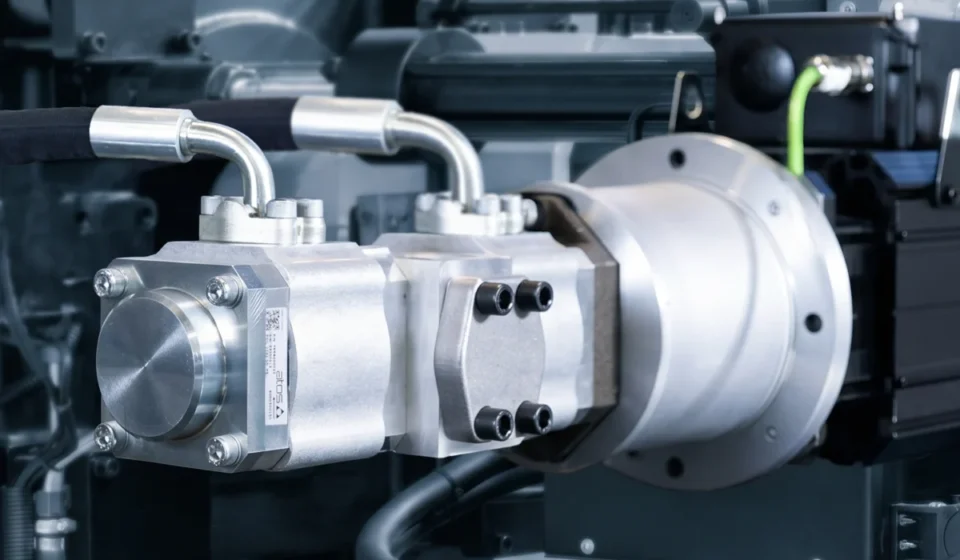
Leaders in the field, such as The Atos Group, have pioneered high-performance servopumps that act as the interface between electronics and fluid power. These systems replace traditional, energy-hungry throttling valves with direct electronic control over pump displacement and speed. The result is a highly responsive, precise, and significantly more efficient system that provides diagnostic feedback, enabling predictive maintenance rather than reactive repairs.
3. Energy Recovery and Regenerative Circuits
Modern design now considers the "return journey" of the fluid. In applications involving heavy lowering or rapid deceleration, traditional systems would dissipate the kinetic energy as heat. Regenerative circuits, often incorporating high-performance accumulators, capture this energy and store it, reintroducing it into the system during the next power stroke. This circular approach to energy management is a key contributor to reducing the total carbon footprint of heavy machinery.
Data-Driven Performance: The Role of Digitalization
Efficiency is no longer just about hardware; it is about data. The integration of sensors into hydraulic circuits allows for the continuous monitoring of fluid temperature, pressure, and viscosity.
By utilizing digital twin technology, engineers can simulate a machine’s workload before it is even built. This allows for the selection of the most efficient pump, motor, and actuator combinations, ensuring that the system is optimized for its specific duty cycle. Furthermore, IoT (Internet of Things) platforms enable facility managers to track energy consumption in real-time, identifying bottlenecks and inefficiencies that would otherwise remain hidden.
The Human Factor: Maintenance and Fluids
Despite technological leaps, the fundamental physics of the system remain governed by the quality of the fluid and the health of the components.
Advanced hydraulic fluids now feature synthetic base stocks that maintain stable viscosity across a wider temperature range. This stability is critical; if the fluid is too thick, internal friction increases; if it is too thin, internal leakage (volumetric loss) occurs. Proper filtration and scheduled fluid analysis are not just maintenance tasks—they are energy-saving strategies. A clean, well-maintained system requires less pressure to move fluid, directly reducing the load on the electric motor.
Implications for Industrial Policy and Strategy
The global push for "Green Industry" has made energy efficiency a top-tier procurement requirement. Regulatory frameworks, particularly in the European Union and North America, are increasingly mandating stricter energy performance standards for industrial equipment.
For corporations, this means that hydraulic efficiency is now a boardroom issue. Investing in modern, energy-efficient hydraulic architectures is no longer viewed solely as a capital expense, but as a strategic move to lower long-term operational costs and meet Environmental, Social, and Governance (ESG) targets.
Expert Perspective: Balancing Performance and Sustainability
Industry experts emphasize that the transition to "Green Hydraulics" is not about sacrificing performance. On the contrary, the precision offered by modern electrohydraulic systems often results in higher output quality, less material waste, and reduced cycle times.
"The goal is not to eliminate hydraulics," notes one industry analyst, "but to integrate them into a smarter, more connected industrial ecosystem." By combining the force-density of fluid power with the intelligence of modern software, hydraulics are proving to be as relevant today as they were during the industrial revolution.
Conclusion: The Future is Intelligent
As we look toward the next decade, the convergence of AI, predictive analytics, and high-efficiency fluid power will define the next generation of manufacturing. Machine learning algorithms will soon be capable of fine-tuning hydraulic systems on the fly, learning from daily operations to minimize energy consumption without human intervention.
The path forward is clear: the most successful industrial operations will be those that embrace this hybrid approach. By treating hydraulic systems as intelligent, integrated components rather than isolated mechanical workhorses, industry can maintain the robustness required for heavy-duty tasks while drastically reducing the environmental impact. The future of power is not just strong—it is smart, efficient, and increasingly sustainable.
This article is sponsored by The Atos Group, a leader in the development of advanced electrohydraulic technologies. For more information on optimizing your industrial systems, visit Atos.