

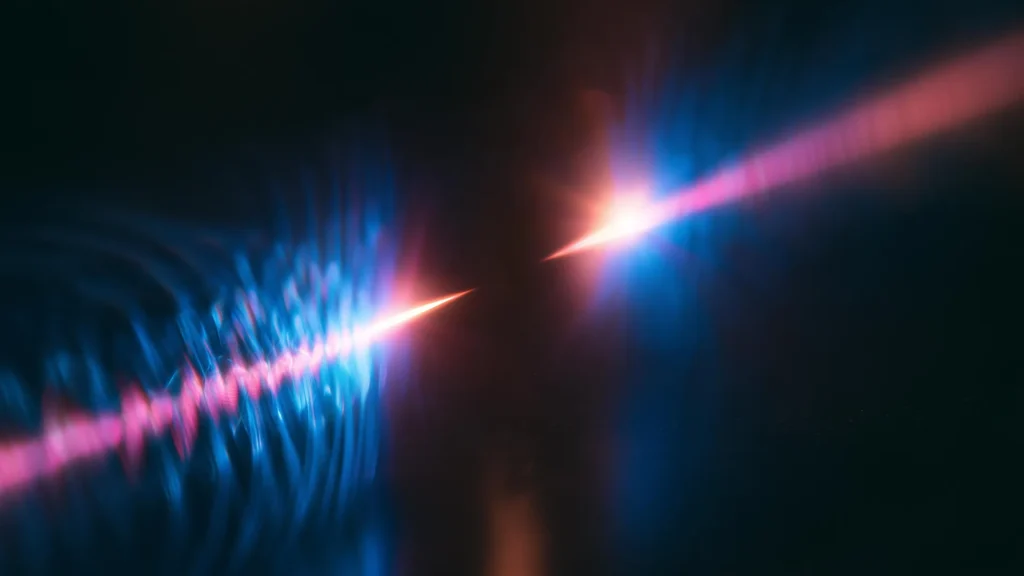

Every second of every day, a silent, invisible rain falls upon the Earth. Trillions of subatomic particles, forged in the hearts of dying stars and propelled across the vacuum of space at nearly the speed of light, collide with our atmosphere. They are the ghosts of the cosmos: undetectable by human senses, passing through solid rock, steel, and our own bodies without a whisper.
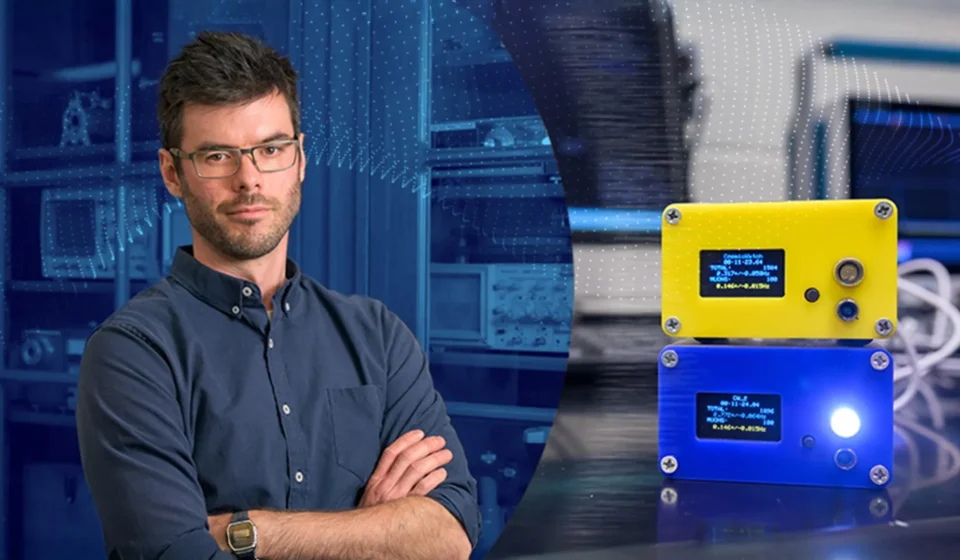
For decades, the study of these particles—specifically muons—was the exclusive domain of institutions with massive budgets and room-sized laboratories. Today, that barrier is crumbling. Thanks to "CosmicWatch," a palm-sized, $100 detector developed by University of Delaware physics professor Spencer Axani, the subatomic world is becoming accessible to everyone from high school students to top-tier international researchers.
The Physics of the Invisible: What are Muons?
To understand the impact of CosmicWatch, one must first understand the phenomenon it tracks. Cosmic rays are high-energy particles—mostly protons and atomic nuclei—that originate from violent celestial events, such as supernovae, gamma-ray bursts, and the gargantuan black holes at the centers of galaxies known as blazars.
When these cosmic rays slam into the upper reaches of Earth’s atmosphere, they shatter atoms, triggering a cascade of secondary particles. Among the most significant of these are muons. Muons are essentially "heavy" cousins of the electron; they are unstable, short-lived, and possess an uncanny ability to penetrate deep into the Earth’s crust.
Because they are so pervasive, muons serve as a cosmic probe. By measuring their flux—the number of particles hitting a specific area over time—scientists can reconstruct the history of the cosmic rays that birthed them. Furthermore, because muons pass through matter with relative ease while leaving a detectable energy trail, they act as nature’s X-ray machine. They have been used to peer inside the internal chambers of the Great Pyramid of Giza and to monitor the density of molten rock deep within active volcanoes.
Chronology: From Antarctic Ice to the Classroom
The journey of CosmicWatch is a testament to the power of "frugal innovation." The project’s origins date back to 2017, when Spencer Axani was a graduate student at the Massachusetts Institute of Technology (MIT). At the time, he was working on the IceCube Neutrino Observatory—a colossal array of sensors buried deep beneath the Antarctic ice.
The challenge for the IceCube team was distinguishing between elusive neutrinos and the "noise" created by atmospheric muons. Axani needed a portable, low-power detector to help calibrate the main array. He began prototyping a small device, roughly the size of a box of animal crackers, that could reliably count muon hits.
As the design matured, Axani had a realization: if he could build a high-performance muon detector for pennies on the dollar, it could serve as a bridge between professional research and the classroom. He began refining the device for educational use, aiming to replace the cumbersome, bookshelf-sized electronic racks typically used in undergraduate labs.
By 2022, Axani brought his project to the University of Delaware. In October 2023, his team published a detailed breakdown of the third iteration of the device in the Journal of Instrumentation. This latest model is not only more robust, capable of operating in high-radiation environments, but it also features advanced monitoring capabilities, allowing it to "see" its surroundings and transmit data with unprecedented speed.
Supporting Data: Democratizing Experimental Science
The significance of CosmicWatch lies in its ability to democratize "real" science. In traditional undergraduate physics, students are often relegated to simulated experiments or expensive, static equipment that offers little room for creativity. CosmicWatch flips this model.
"The students seem really excited about doing this thing that is more like what particle physicists and experimental physicists actually do," says Natasha Holmes, the Ann S. Bowers Associate Professor of Physics at Cornell University. In her courses, students build their own detectors from scratch. This involves not just assembly, but coding, troubleshooting, and the occasional—and educational—repair of broken hardware. "They get to learn some coding with it… we’ve had students say they’re doing ‘real science’ after using it."
The pedagogical value is matched by its scientific versatility. Doctoral student Musarate Shams, for instance, pushed the limits of the device by integrating custom pressure and temperature sensors. In May, he launched his modified CosmicWatch aboard a high-altitude balloon, reaching 100,000 feet near the edge of space. The data he gathered provided a rare, high-altitude perspective on how cosmic ray flux changes as one exits the dense lower atmosphere.
Official Perspectives: The Experts Speak
For the researchers in Axani’s lab, the project represents a rare opportunity to blend theory with physical application. "Even though I had studied cosmic rays, I didn’t fully appreciate the rich physics behind the working of these detectors to actually ‘see’ the world and atmospheric particle production," says Masooma Sarfraz, a doctoral student and primary author of the latest Journal of Instrumentation report. "For a student like me who has been working on theoretical ideas, this was a perfect opportunity to dive into the experimental side."
Axani himself views the growth of the project as a natural evolution of scientific inquiry. "CosmicWatch detectors allow us to do far more physics at a dramatically lower cost, in a compact and portable form, opening the door to many new kinds of experiments and outreach opportunities," he notes.
The professional community has taken notice. The device is currently being integrated into high-stakes research, including the NuDot experiment at the University of Delaware and the Coherent CAPTAIN-Mills (CCM) dark matter search in New Mexico. By using CosmicWatch to calibrate these massive, multi-million-dollar detectors, researchers are ensuring that their primary instruments remain precise and accurate.
Implications: The Future of Global Citizen Science
Looking ahead, the potential for CosmicWatch extends far beyond the university lab. Axani envisions a global network—a "citizen science" initiative where thousands of detectors are deployed across the planet. If amateur enthusiasts, schools, and independent researchers all contribute their muon count data to a centralized, open-access database, it would create a real-time, global map of particle activity.
This, however, is only the beginning. Axani is currently developing a version of the technology tailored for spaceflight. By placing these detectors on satellites, researchers could create a "sensor web" in orbit. Such a system could enable satellites to communicate with one another, creating a collective early-warning system for solar flares or other space weather events. If a satellite detects a surge in radiation, it could signal its neighbors to power down sensitive electronics, preventing catastrophic damage.
The Legacy of the $100 Detector
What began as a clever hack for an Antarctic project has transformed into a vital tool for modern physics. It has proven that scientific advancement does not always require the most expensive equipment—sometimes, it only requires the right perspective.
"Although it started as an educational program, it’s found a use in a lot of different areas of physics," Axani says. "It’s pretty cool."
As the CosmicWatch network grows, it is doing more than just counting particles. It is changing the narrative of physics education, shifting the focus from passive learning to active discovery. By putting the tools of the trade into the hands of students and citizen scientists, Axani is ensuring that the next generation of physicists will not just be observers of the invisible, but active participants in uncovering the mysteries of our universe. Whether it’s an undergraduate student at Cornell or a researcher in a New Mexico lab, the message is clear: the universe is speaking to us, and now, we finally have the means to listen.