
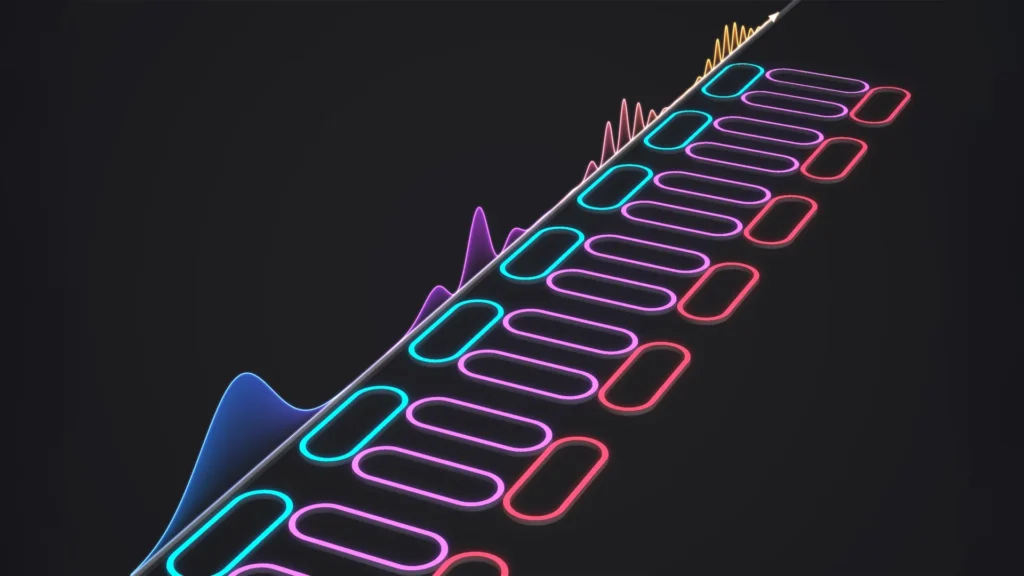







In a landmark achievement for both quantum computing and high-energy physics, a research team led by the Duke Quantum Center (DQC) has successfully utilized a trapped-ion quantum simulator to observe the complex, elusive process of "string breaking." This phenomenon, which serves as a cornerstone of our understanding of how matter forms, has long been theorized but remains nearly impossible to observe directly in nature. By successfully modeling this subatomic interaction, researchers have provided a compelling proof-of-concept that quantum computers are poised to become the most powerful "microscopes" for peering into the fundamental building blocks of the universe.
The study, published on September 23 in Nature Physics, represents an international collaborative effort involving the University of Maryland (UMD), Oxford University, the California Institute of Technology, Cornell University, and KU Leuven. As quantum technology matures, this experiment stands as a pivotal moment, bridging the gap between abstract theoretical physics and tangible, laboratory-controlled observation.
The Science of Confinement: Why Quarks Cannot Be Isolated
To understand the significance of the DQC experiment, one must first grasp the nature of quarks. Quarks are the fundamental constituents of protons and neutrons—the very particles that make up the nucleus of every atom in the observable universe. Despite their ubiquity, quarks are never found in isolation. They are governed by the strong nuclear force, which acts like a physical tether or "string" connecting them.
In standard physics, the relationship between quarks can be visualized through a simple, albeit extreme, analogy: imagine two charged particles held together by a rubber band. As you pull these particles apart, the tension in the rubber band increases, storing more and more energy. In the subatomic realm, this tension becomes so immense that it cannot be sustained indefinitely.
According to Einstein’s mass-energy equivalence principle, $E=mc^2$, energy can manifest as matter. Once the energy stored in the "string" between two quarks reaches a critical threshold, the system "breaks" the connection, and the stored energy is converted into a new pair of quark-antiquark particles. This process, known as string breaking, is the fundamental reason why we never see a single, lonely quark in the wild. It is a process that typically requires the extreme temperatures and densities of the early universe or the high-energy collisions generated by the Large Hadron Collider (LHC).
Chronology of a Breakthrough: From Theory to Laboratory
The road to observing string breaking in a quantum simulator was paved by decades of theoretical work in lattice gauge theory. However, the path to the recent Nature Physics publication followed a specific, rigorous trajectory:
- Conceptualization and Model Design: Researchers identified that trapped-ion systems—where individual charged atoms are suspended in electromagnetic fields and manipulated by lasers—offered the ideal architecture to mimic the gauge theories governing particle physics.
- The 13-Ion Simulation: The team encoded the string-breaking model into a chain of 13 trapped ions. This required a precise configuration where laser pulses were tuned to emulate the interactions of quarks within a simplified one-dimensional space.
- Initialization and Observation: The system was prepared in an "out-of-equilibrium" state—essentially a high-energy starting point—and allowed to evolve over time. By measuring the movement and interaction of the ions, the team could observe the emergence of effective charges, marking the precise moment of "string breaking."
- Verification: To ensure the validity of their quantum observation, the team ran a parallel simulation on a high-performance classical supercomputer. The results matched perfectly, confirming that the quantum simulator had accurately captured the physics of the system.
- Publication and Peer Benchmarking: The results were published alongside two other concurrent studies, one using superconducting circuits (led by Google) and another using neutral atom arrays (led by QuEra Computing). This triple-pronged release provided a robust benchmark for the field, demonstrating that string breaking can be observed across different hardware platforms.
Supporting Data: The Power of Quantum Simulation
The experiment utilized 13 trapped ions to simulate a gauge theory—a complex mathematical framework that describes how forces act on particles. While 13 ions may seem like a modest number, the computational complexity required to model their interactions is significant.
In this study, the researchers demonstrated that they could manipulate the energy landscape of the ion chain to simulate the stretching and breaking of the "string." By tracking the system’s state over time, the team observed the characteristic "popping" into existence of new particle pairs.
One of the most critical aspects of this research is the agreement between classical and quantum simulations. At this scale, classical computers are still capable of processing the data. However, as the complexity of these simulations increases—moving from 13 ions to hundreds or thousands—the computational burden on classical machines will grow exponentially. The experiment serves as a "calibration" phase; by proving that quantum simulators can get the right answer today, the researchers have built the confidence necessary to move into regimes of "quantum advantage," where quantum computers will solve problems that are mathematically impossible for even the most powerful classical supercomputers to calculate.
Official Responses: Insights from the Leaders
Christopher Monroe, the Gilhuly Family Presidential Distinguished Professor of Electrical and Computer Engineering and Physics at Duke, and the lead of the research, underscored the historical significance of the experiment. "Quantum computer simulations provide the best platform to investigate complex questions like matter formation, short of having witnessed the Big Bang itself," Monroe stated. He emphasized that these findings are not just a technical milestone but a fundamental shift in how physicists can engage with the nature of reality.
Arinjoy De, the first author on the paper and a former PhD student in Monroe’s lab, highlighted the excitement of the intersection between these two fields. "By simulating quark confinement and string-breaking phenomena in a controlled lab environment, we’re opening up new pathways for experimental investigations into the behavior of matter at its most fundamental level," De noted.
Zohreh Davoudi, an associate professor of physics at the University of Maryland and a key member of the team, reflected on the broader implications for cosmology. "As a physicist, it is incredibly exciting to investigate the conditions of the early universe in an atomic-level computing machine," she said. "Even the slightest insights from an out-of-equilibrium physics model will guide us in the future."
Implications: The Future of Quantum Physics
The successful simulation of string breaking is merely the opening chapter in a much larger narrative. The implications of this research are twofold:
1. A New Tool for High-Energy Physics
Traditionally, high-energy physics has been limited to two approaches: observing the cosmos through telescopes or smashing particles together in massive, multibillion-dollar colliders. Quantum simulation introduces a third, "synthetic" pillar. By creating "digital twins" of particle interactions, scientists can test theories of the early universe without the need for massive infrastructure, allowing for rapid iteration and testing of hypotheses that would otherwise remain purely mathematical.
2. The Path to Universal Quantum Computing
The fact that three different platforms—trapped ions, superconducting circuits, and neutral atoms—all successfully replicated this physics suggests that quantum hardware is reaching a level of maturity where it can be used for reliable scientific discovery. This "benchmark" serves as a signal to the scientific community that the era of quantum-aided discovery has arrived.
As researchers continue to scale these systems, the horizon for discovery expands. Future iterations could involve larger arrays of ions, allowing scientists to simulate higher-dimensional gauge theories, the dynamics of dark matter, or the complex phase transitions that occurred fractions of a second after the Big Bang.
In conclusion, the work led by the Duke Quantum Center has effectively turned a quantum computer into a window through time. By recreating the birth of particle pairs in a laboratory, the team has proven that the deepest secrets of our universe may eventually be decoded, one quantum bit at a time. As the technology scales, the mysteries of the early universe may move from the realm of the unknowable to the realm of the observable.