


Scaling Motion: Why Rack and Pinion Systems Dominate Long-Travel Industrial Applications

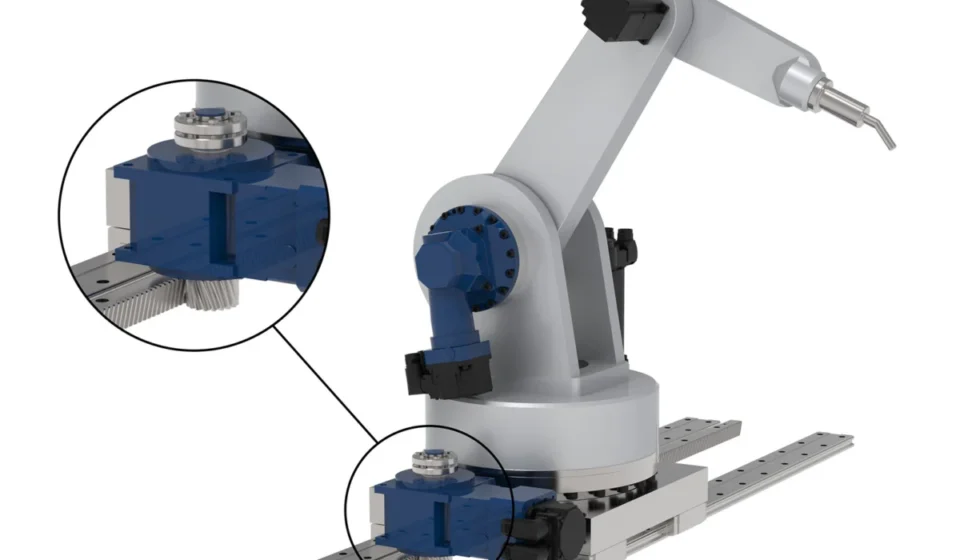
In the high-stakes world of industrial automation, the challenge of moving a load across a long distance is a fundamental engineering hurdle. Much like a tape measure that remains rigid when extended a few inches but inevitably buckles as it stretches, mechanical linear motion systems face physical limitations governed by geometry and material science. When designing for long-travel axes—such as those required for 7th-axis robot transfer units, gantry systems, or large-scale CNC machinery—engineers must choose between three primary technologies: ball screws, linear motors, and rack and pinion systems.
While each has its place, the rack and pinion system has emerged as the clear frontrunner for long-travel applications where cost-efficiency, stiffness, and structural scalability are paramount. This report explores the technical nuances of these systems, the limitations of competing technologies, and the strategic advantages of modular rack and pinion architectures.
The Fundamentals of Linear Motion
To understand the selection process, one must first distinguish the mechanical operating principles of these three motion technologies.
The Rack and Pinion System
A rack and pinion setup transforms rotary motion into linear motion by engaging a rotating gear (the pinion) against a toothed bar (the rack). This system is highly versatile: in some configurations, the rack remains stationary while the pinion assembly drives the load; in others, the pinion is fixed, and the rack travels. Because the rack is essentially a structural element, it offers a robust, mechanical linkage that does not rely on the tension or the structural integrity of a spinning rod.
The Ball Screw Mechanism
A ball screw functions as a precision-engineered threaded rod. A nut containing recirculating ball bearings rides along the threads. As the rod rotates, the nut moves linearly. It is the gold standard for high-precision, short-to-medium-length tasks. However, as the distance increases, the screw becomes susceptible to "whip"—a harmonic vibration similar to a jump rope—which compromises accuracy and can lead to catastrophic system failure.
The Linear Motor
Linear motors represent the high-tech alternative. By "unrolling" an electric motor into a flat plane, the system uses magnetic flux to move a load directly. One component holds permanent magnets, while the other houses electromagnets. Controlled by high-speed servo electronics, these systems offer unparalleled acceleration and speed. However, they are significantly more expensive and present challenges regarding magnetic interference and heat dissipation.
Chronology of Technological Adoption
The evolution of these systems mirrors the growth of modern manufacturing. In the early days of industrial automation, ball screws were the default choice due to their simplicity and high repeatability. As manufacturing moved toward smaller, more precise electronics, ball screws dominated because they could easily be integrated into compact, enclosed machine designs.
However, as the 1990s and 2000s ushered in the era of large-scale robotic integration—specifically the move toward 7th-axis robots that could travel along an entire assembly line—ball screws hit a physical wall. The "whip" phenomenon necessitated larger diameters and support bearings, which increased costs exponentially.
During this transition, linear motors gained significant traction in the semiconductor and laser-cutting industries. Their speed was transformative, allowing for throughputs previously deemed impossible. Yet, the cost of magnetic materials and the complexity of managing high-power consumption meant they remained niche for high-budget, high-precision applications.
In the last decade, the industry has seen a resurgence of the rack and pinion system. Advances in gear tooth grinding and heat-treatment technologies have enabled rack and pinion systems to achieve precision levels once reserved for ball screws. Today, they are the standard for long-travel, high-load applications, such as robotic transfer units in automotive manufacturing, where reliability and "infinite" scalability are required.
Supporting Data: Comparative Analysis
When evaluating these technologies, engineers generally weigh four critical factors: travel length, stiffness, maintenance, and total cost of ownership (TCO).
The "Whip" Limitation
The primary constraint of a ball screw is the "critical speed" and "buckling limit." For a typical ball screw, the safe operating limit is often restricted to approximately 2 to 3 meters. Beyond this, the rod must be thickened to maintain rigidity, which significantly increases the mass and the inertia of the system, eventually negating the efficiency gains of the motor.
Cost and Power Efficiency
Linear motors, while fast, are power-intensive. Because they are electromagnetic, they require continuous power to hold a static position unless a secondary brake is integrated. Furthermore, the cost of adding a linear motor to a 10-meter axis is nearly linear—every meter of travel requires a meter of expensive magnets.
In contrast, a rack and pinion system is modular. A manufacturer can install a 10-meter axis by joining standard one-meter rack segments. The structural rack acts as a load-bearing member, and the system can hold its position using a standard motor brake, resulting in zero power consumption when stationary.
Environmental Considerations
| Feature | Rack & Pinion | Ball Screw | Linear Motor |
|---|---|---|---|
| Scalability | Excellent | Limited | High Cost |
| Stiffness | Very High | Medium | Variable |
| Clean Room Suitability | Low (Requires Sealing) | Medium | Excellent |
| Initial Cost | Moderate | Moderate | High |
| Maintenance | Low (Lubrication) | Moderate | Very Low |
Expert Perspectives: Insights from GAM
Matt Ruggles, a senior design engineer at GAM, a leading manufacturer of motion control components, highlights the practical realities of system selection.
"As you get into longer distances with ball screws, there’s a phenomenon called whip," Ruggles explains. "Basically, the ball screw turns into a jump rope, and that can cause all sorts of problems in your system: premature wear, vibration, and sometimes catastrophic failure."
When addressing the scalability of rack and pinion, Ruggles notes, "The advantage is that the rack and pinion can basically scale infinitely. You can cut a piece of rack shorter or you can assemble multiple pieces of rack together to get a much longer travel."
Ruggles also warns against the hidden complications of linear motors. "I’ve had experiences where people doing installs find that their keys in their pockets become magnetized. It can be very awkward when all of a sudden a wristwatch starts collecting metal chips. That plays into the environment they’re working in; linear motors can collect conductive debris as they run along, which is a major failure risk."
Regarding the total cost of implementation, Ruggles notes that while the rack and pinion system requires more components (gearbox, motor, rack, and pinion), the overall package cost is consistently lower than the linear motor alternative while providing a much stiffer system capable of higher feed forces.
Implications for Future Machine Design
Precision vs. Environment
The selection of a motion system is no longer just about movement; it is about the environment. While rack and pinion systems are the workhorses of the factory floor, they do require lubrication. In clean rooms or medical environments where contaminants are prohibited, linear motors remain the superior choice due to their lack of exposed moving parts.
Installation Matters
A recurring theme in the engineering community is that system performance is heavily dependent on installation quality. A high-end ball screw poorly installed will perform worse than a standard rack and pinion system that is laser-aligned and properly mounted. As Ruggles aptly puts it, "You get out of it what you put into it. If you take your time and install precisely, you’ll get a very well-operating system. If you slap things together, you will have problems regardless of the technology."
The Road Ahead
For engineers tasked with designing the next generation of automation, the trend is clear: modularity is king. As machines get larger—think of 20-meter gantry systems for large-format 3D printing or long-reach robotic cells—the ability to daisy-chain rack segments provides an engineering flexibility that both ball screws and linear motors struggle to match at a competitive price point.
As industrial automation continues to evolve toward "Industry 4.0" standards, the focus will remain on systems that balance high throughput with energy efficiency and low maintenance. While linear motors will continue to own the high-speed, precision-niche market, the rack and pinion system remains the bedrock of heavy-duty, long-distance industrial motion. By understanding the mechanical limits of each, engineers can ensure their systems remain rigid, reliable, and cost-effective for the duration of their operational life.