




Resilience Amid Transition: General Motors Defies Market Headwinds with 30% Q2 EBIT Surge

Main Facts: A Strong Quarter Powered by Premium Mix and Cost Discipline
General Motors (GM) has delivered a robust second-quarter financial performance, defying challenging global economic conditions and demonstrating structural resilience. The Detroit-based automotive giant reported a substantial 30% year-over-year increase in Earnings Before Interest and Taxes (EBIT-adjusted), significantly outperforming Wall Street expectations. This financial triumph comes despite flat sales volumes in its core United States market and a continuing, structural decline in its Chinese operations.
The company’s ability to expand profitability in a stagnant volume environment highlights the success of its high-margin product strategy and aggressive fixed-cost reduction programs. While GM’s first-quarter earnings were heavily supported by a one-off tariff refund, the second-quarter results point to genuine operational improvements. The automaker appears to have successfully navigated the fallout from its expensive electric vehicle (EV) asset write-downs at the end of 2025, charting a more disciplined, margin-focused path forward.
Key Takeaways from the Q2 Report:
- EBIT-Adjusted Growth: Adjusted EBIT surged by approximately 30%, driven by robust pricing power and an advantageous product mix.
- U.S. Performance: Unit sales remained flat, but profitability was sustained by high demand for premium internal combustion engine (ICE) vehicles, including full-size pickup trucks and large SUVs.
- China Contraction: Market share and joint-venture income in China continued to deteriorate under intense competition from domestic electric vehicle manufacturers.
- EV Stabilization: Following significant asset write-downs at the end of 2025, GM’s EV division showed signs of stabilizing production costs and improving battery manufacturing efficiency.
Chronology: From EV Write-downs to Financial Recovery
To understand the significance of GM’s Q2 performance, it is essential to trace the company’s financial and strategic trajectory over the preceding quarters. The current success is the result of a deliberate pivot from aggressive volume-chasing in the EV space to capital preservation and operational efficiency.
[Late 2025] ──> Heavy EV asset write-downs; restructuring of battery plans.
     │
[Q1 2026]   ──> Financials stabilized by a major, one-off tariff refund.
     │
[Q2 2026]   ──> EBIT surges 30% on organic operational strength and premium ICE sales.
Late 2025: The EV Reality Check and Asset Write-downs
During the final quarter of 2025, General Motors faced a critical inflection point. Slower-than-anticipated consumer adoption of electric vehicles, combined with early-stage production bottlenecks on the Ultium battery platform, forced the company to take substantial asset write-downs. GM adjusted its near-term EV production targets downward, choosing to focus on capital conservation rather than accumulating unsold EV inventory. This period was marked by high capital expenditures and margin compression, sparking skepticism among institutional investors regarding GM’s dual-track (ICE and EV) strategy.
Q1 2026: The Tariff Lifeline
The first quarter of 2026 offered a reprieve, though one largely driven by external factors. GM’s Q1 profitability was significantly elevated by a one-off tariff refund. While the bottom-line figures looked healthy, analysts cautioned that the underlying automotive business was still recovering from the previous year’s write-downs. However, beneath the surface, there were nascent signs of recovery: battery cell manufacturing costs began to decrease, and dealer inventories of ICE vehicles remained tightly managed.
Q2 2026: Organic Operational Acceleration
The second quarter proved to be the true test of GM’s structural health. Free from the distorting effects of major one-off windfalls, the automaker achieved a 30% surge in adjusted EBIT. This milestone was reached through a combination of sustained demand for highly profitable ICE models, the execution of a multibillion-dollar fixed-cost reduction program, and a more calculated, demand-driven approach to EV manufacturing.
Supporting Data: Dissecting the Financials
A closer examination of the financial metrics reveals how GM managed to generate higher profits from a flat volume base.
North American Pricing and Product Mix
In the United States, GM’s primary profit engine, sales volume was virtually unchanged compared to the same period in the prior year. However, the Average Transaction Price (ATP) for GM vehicles remained near-record highs, hovering above $50,000.
| Metric | Q2 Previous Year | Q2 Current Year | Year-over-Year Change |
|---|---|---|---|
| EBIT-Adjusted | $3.20 Billion | $4.16 Billion | +30.0% |
| Revenue | $44.7 Billion | $48.2 Billion | +7.8% |
| U.S. Retail Sales (Units) | ~691,000 | ~690,000 | -0.1% |
| U.S. Average Transaction Price | $49,200 | $50,800 | +3.2% |
| China Joint-Venture Income | $150 Million | $25 Million | -83.3% |
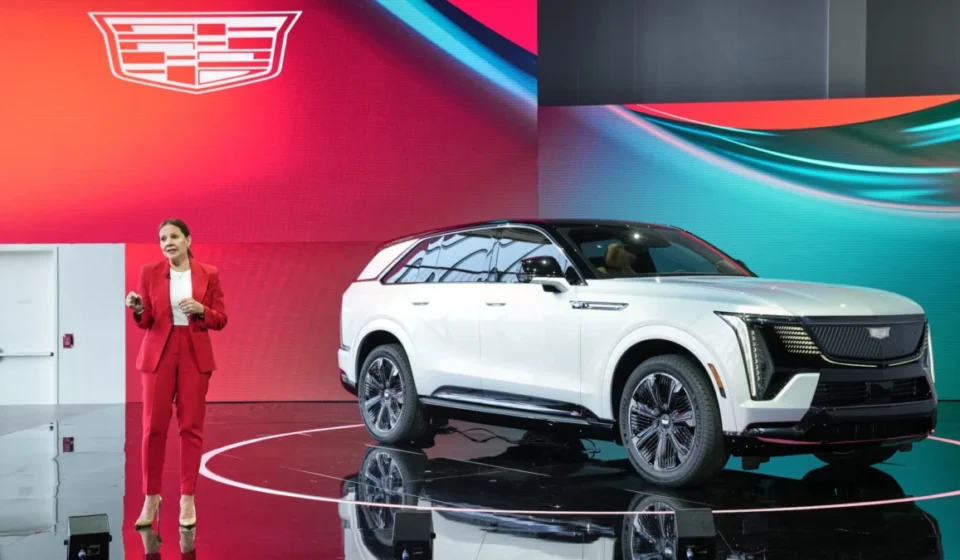
This pricing resilience was driven by the company’s dominant position in the full-size pickup truck and large SUV segments. High-margin models such as the Chevrolet Silverado, GMC Sierra, Chevrolet Tahoe, and Cadillac Escalade accounted for a disproportionate share of the sales mix. This offset the rising costs associated with promotional incentives on smaller, less profitable passenger cars.
The China Headwind
In stark contrast to North America, GM’s operations in China continued their downward trend. The SAIC-GM joint venture, once a reliable source of equity income for the Detroit automaker, saw its profitability erode to near-break-even levels. This decline was driven by a brutal price war initiated by domestic Chinese New Energy Vehicle (NEV) manufacturers, such as BYD and Geely, alongside a rapid consumer shift away from traditional legacy foreign brands.
EV Cost Optimization
On the EV front, while volume growth remained moderate, the financial drag of the electric portfolio lessened. GM benefited from falling battery raw material prices—particularly lithium and nickel—and increased capacity utilization at its domestic Ultium Cells LLC joint-venture battery plants. Consequently, the cost per kilowatt-hour at the pack level declined, bringing GM closer to its goal of achieving positive variable margins on its EV portfolio.
Official Responses: Leadership Focuses on Capital Discipline
General Motors’ executive leadership used the Q2 earnings release to reinforce their commitment to a balanced, highly disciplined capital allocation strategy.
Mary Barra, Chair and CEO
CEO Mary Barra emphasized that GM’s ability to deliver strong financial results in a volatile market vindicates the company’s flexible manufacturing strategy.
"Our second-quarter performance demonstrates that our team is executing at a very high level. We are winning with simplicity, reducing our fixed costs, and matching our production precisely with market demand. While we remain fully committed to our all-electric future, we will not chase unprofitable volume. Our strong ICE portfolio continues to fund our transition, and we are seeing clear benefits from our disciplined approach to EV scaling."
Paul Jacobson, Chief Financial Officer
CFO Paul Jacobson highlighted the progress made on the company’s ongoing cost-reduction initiatives, which target billions in structural cost savings.
"The 30% increase in our adjusted EBIT is a direct result of our focus on margin expansion and cost control. We have successfully taken out structural costs across our engineering, manufacturing, and administrative operations. This discipline, combined with robust pricing power in North America, allows us to offset the headwinds we are experiencing in China and continue returning capital to our shareholders."
Wall Street and Industry Analyst Perspectives
Independent automotive analysts reacted favorably to the earnings beat, though many voiced ongoing concerns regarding GM’s long-term strategy in Asia.
- Dan Ives, Senior Equity Analyst at Wedbush Securities: "GM’s Q2 numbers show that the ICE cash machine is still running hot. This gives Mary Barra the runway she needs to fix the EV strategy. The 30% EBIT beat is a clear signal that the cost-cutting measures are hitting the bottom line faster than expected."
- Stephanie Brinley, Principal Automotive Analyst at S&P Global Mobility: "The contrast between GM’s North American strength and its Chinese decline has never been sharper. GM is successfully defending its home turf with premium trucks, but the structural decline in China is a long-term challenge that cannot be solved by cost-cutting alone."
Implications: Navigating the Legacy-to-Electric Chasm
The implications of GM’s Q2 financial performance extend far beyond a single quarter’s earnings sheet. They highlight the delicate balancing act legacy automakers must perform as they transition from internal combustion engines to electric propulsion.
1. The Primacy of the "ICE Engine"
GM’s results prove that the demise of the internal combustion engine has been overstated in the medium term. The massive cash flows generated by V8-powered trucks and SUVs remain the lifeblood of the corporation. Without these profits, the capital-intensive transition to software-defined vehicles and electric platforms would be financially unsustainable. This reality will likely encourage GM to prolong the lifecycles of its highly profitable ICE architectures while scaling back near-term EV capital expenditures.
2. Restructuring the China Footprint
The continuous deterioration of GM’s position in China suggests that a fundamental restructuring of its Asian operations is inevitable. Legacy joint-venture models are no longer sufficient to compete against vertically integrated Chinese EV giants. GM may be forced to write down further Chinese assets, reduce its manufacturing footprint in the region, or pivot toward a premium import-only strategy, utilizing specialized brands like its "Durant Guild" platform to sell low-volume, high-margin American icons like the Corvette and GMC Hummer EV.
3. A New Blueprint for EV Transitions
Having survived the expensive write-downs of late 2025, GM is establishing a more pragmatic blueprint for electrification. Rather than aiming for arbitrary EV volume targets that lead to discounting and margin erosion, GM is focusing on modular manufacturing flexibility. By utilizing the Ultium platform across a broad spectrum of vehicles—from the Chevrolet Equinox EV to the Cadillac Lyriq—and adjusting assembly line speeds to match real-time retail demand, the company is prioritizing unit profitability over market share.
Ultimately, General Motors’ Q2 performance demonstrates that structural agility and financial discipline can overcome stagnant volume growth. By leveraging its highly profitable truck franchise to fund a more measured, cost-optimized EV transition, GM has positioned itself to navigate the volatile automotive landscape of the late 2020s with greater resilience than many of its global peers.