

The Silicon Sun: How Maximo’s AI-Enabled Robotics are Rewriting the Rules of Solar Construction

The global transition toward renewable energy is no longer a matter of policy debate but a race against the clock. As nations strive to meet aggressive decarbonization targets by 2030 and 2050, the primary bottleneck has shifted from the cost of photovoltaic (PV) cells to the sheer physical challenge of installing them. In a landscape defined by labor shortages, extreme environments, and the need for unprecedented scale, a new technological frontier is emerging.
At the center of this revolution is Maximo, an AI-enabled robotics startup born from the innovation labs of global energy giant The AES Corporation. Led by founder Deise Yumi Asami, Maximo represents a paradigm shift in utility-scale solar construction. By integrating advanced computer vision, autonomous mobility, and "Physical AI," the startup is transforming the labor-intensive process of solar installation into a high-tech, automated assembly line in the field.
Main Facts: Automating the Renewable Frontier
The core problem Maximo addresses is the "last mile" of solar deployment. While solar panels have become significantly cheaper over the last decade, the cost of installing them—particularly the manual labor involved in lifting, positioning, and securing thousands of modules—has remained stubbornly high.
The Maximo Solution
Maximo is a robotic platform designed to operate in the rugged, unpredictable environments of utility-scale solar farms. Unlike factory robots that work in controlled settings, Maximo utilizes AI-based vision systems to navigate uneven terrain, identify structural components, and precisely place solar modules.
Key features of the technology include:
- AI-Enabled Vision: Sophisticated algorithms allow the robot to "see" and interpret its surroundings in real-time, accounting for variables like dust, glare, and shifting shadows.
- Precision Deployment: The system automates the mechanical installation of solar modules, reducing the physical strain on human workers and accelerating the construction timeline.
- Smart Field Integration: Maximo does not operate in a vacuum; it is part of a digital ecosystem that tracks progress and optimizes workflows across the entire construction site.
The Incubation Model
Maximo is a unique example of "corporate intrapreneurship." While it operates with the agility of a Silicon Valley startup, it was incubated within The AES Corporation (AES). This relationship has allowed Maximo to leverage AES’s massive global footprint and industry expertise while maintaining the creative freedom necessary to disrupt traditional construction methods.
Chronology: From Electrical Engineering to Robotic Innovation
The story of Maximo is inextricably linked to the career of its founder, Deise Yumi Asami. Her journey reflects a broader trend in the energy sector: the shift from traditional electrical engineering to the integration of software and hardware automation.
2000s–2015: Foundations in Energy
With a B.S. in Electrical Engineering and a Lean Design Master Certification, Asami spent over 15 years developing a deep understanding of energy infrastructure. Her early career focused on the fundamental challenges of power distribution and system reliability.
2016: Joining AES Brazil
Asami joined AES Brazil in 2016, a move that placed her at the forefront of the renewable energy transition in South America. During this period, she led several pioneering projects, including the development of microgrid software and the implementation of Brazil’s first utility-scale lithium-ion battery energy storage system (BESS). These projects were critical in proving that intermittent renewable sources could be stabilized at scale.

2020–2023: The Birth of Maximo
Recognizing that the speed of solar deployment was being hindered by manual construction methods, Asami moved into a leadership role within AES’s innovation group. The objective was clear: create a tool that could do for solar construction what the assembly line did for the automotive industry.
Under her guidance, the team moved from conceptual sketches to functional prototypes. Maximo was developed as a "force multiplier," designed to work alongside human crews to handle the most repetitive and dangerous aspects of the job.
2024 and Beyond: Scaling the Vision
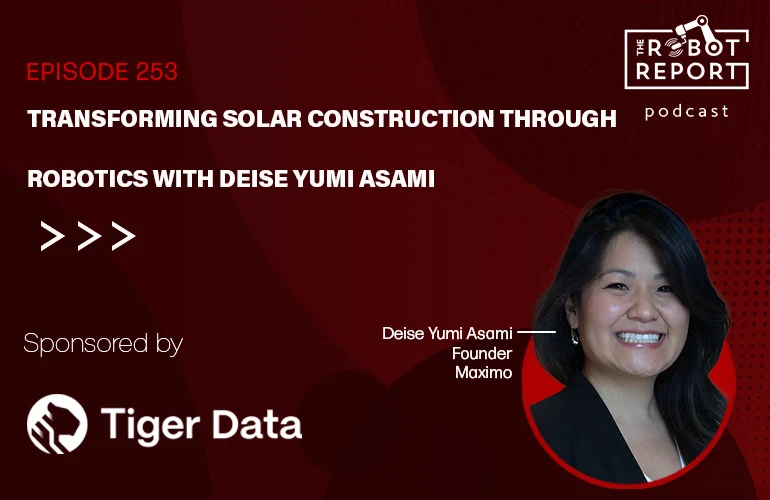
Currently, Maximo is transitioning from pilot programs to broader field deployment. As featured in Episode 253 of The Robot Report Podcast, Asami is now focused on scaling the technology and refining the AI vision systems to handle increasingly complex environmental conditions.
Supporting Data: The Economic and Safety Imperatives
The move toward robotics in solar construction is driven by hard data. The solar industry is currently facing a "perfect storm" of high demand and low labor availability.
The Labor Shortage
According to the Interstate Renewable Energy Council (IREC), the U.S. solar industry will need to reach nearly 535,000 solar workers by 2030 to meet clean energy goals. However, the industry is struggling to recruit and retain workers for field roles that involve heavy lifting in extreme heat. Robotics like Maximo can fill this gap, allowing the existing workforce to focus on high-level technical tasks while the machines handle the "dull, dirty, and dangerous" work.
Efficiency Gains
Manual solar installation is prone to human error and physical fatigue. Internal data from robotics firms suggests that automated systems can:
- Increase Speed: Automated placement can be up to 2–3 times faster than manual crews in certain conditions.
- Reduce Injury: Musculoskeletal injuries are common in solar construction due to the repetitive lifting of 40- to 60-pound panels. Maximo eliminates this risk.
- Improve Precision: AI-driven placement ensures that panels are aligned to sub-centimeter accuracy, which improves the long-term structural integrity and energy yield of the farm.
Market Context: The "Physical AI" Trend
Maximo enters a market where "Physical AI"—AI that interacts with the real world—is seeing massive investment. In 2023 and 2024, venture capital interest shifted from purely generative AI (like LLMs) toward robotics that can solve labor issues in construction, agriculture, and logistics.
Official Responses: Perspectives from the Frontlines
In her discussion on The Robot Report Podcast, Deise Yumi Asami provided deep insights into the philosophy behind Maximo and the culture of innovation at AES.
On Innovation Culture
Asami emphasizes that Maximo’s success is due in part to the "safe harbor" provided by AES. "Learn how a large organization can encourage and celebrate innovation," she noted, highlighting that AES organized its innovation group specifically to allow for experimentation without the immediate pressure of quarterly earnings. This allowed the Maximo team to fail fast, iterate, and eventually produce a viable product.

On the Human-Robot Collaboration
Asami is quick to dispel the myth that robotics will eliminate jobs. Instead, she views Maximo as a tool for empowerment. "We are making solar panel installation faster, safer, and more efficient," she stated. The goal is to "reshape the future of renewable energy infrastructure," which requires a hybrid workforce where humans manage the robotic fleets.
Technical Challenges
During her technical briefings, Asami has often discussed the difficulty of "unstructured environments." A solar farm is not a clean warehouse; it is a field with mud, rocks, and unpredictable weather. The AI vision developed for Maximo is designed to be "resilient," meaning it can interpret data from cameras and sensors even when those sensors are obscured by dust or affected by the harsh glare of the sun.
Implications: The Future of Energy Infrastructure
The emergence of Maximo has profound implications for the global energy landscape, the labor market, and the future of AI.
1. Accelerating the Energy Transition
The primary barrier to meeting the Paris Agreement goals is the "speed of deployment." If robotics can reduce the time it takes to build a utility-scale solar farm by 30% or 40%, it could mean the difference between hitting climate targets and missing them. Maximo represents a technological "accelerant" for the entire renewable sector.
2. The Evolution of the "Solar Worker"
As robotics become standard, the role of the solar installer will evolve. We will see the rise of the "Robotics Technician" on construction sites—workers who are trained to deploy, monitor, and maintain AI systems. This transition offers a path toward higher-paying, less physically taxing careers in the renewable sector.
3. Corporate Innovation as a Blueprint
The Maximo/AES model serves as a blueprint for other Fortune 500 companies. It demonstrates that internal innovation groups, when given the right resources and autonomy, can produce disruptive technologies that might otherwise be developed by outside competitors. This "incubation" strategy allows the parent company to future-proof its business model while providing startups with the capital and testing grounds they need to succeed.
4. The Advancement of Outdoor AI
The lessons learned by Maximo in the field will contribute to the broader field of robotics. Navigating a solar farm is a "high-stakes" environment for AI. The advancements made in Maximo’s computer vision and path-planning algorithms will likely find applications in other outdoor industries, such as autonomous farming, disaster response, and planetary exploration.
Conclusion
Maximo is more than just a robot; it is a testament to the power of combining deep industry expertise with cutting-edge technology. Under Deise Yumi Asami’s leadership, the startup is proving that the future of energy is not just about cleaner fuel, but about smarter ways to build the world around us. As the sun rises on a new era of automated construction, Maximo stands at the forefront, ensuring that the transition to a sustainable future is as efficient as the energy it seeks to harness.