


Driving the Future of E-Mobility: How Pressure-Sensitive Adhesives are Transforming Electric Vehicle Battery Assembly

BIRMINGHAM, Mich. — As the global automotive industry accelerates its transition toward full electrification, manufacturing floors are undergoing a quiet revolution. Amid the high-tech robotics, massive stamping presses, and intricate wiring harnesses, a deceptively simple material is quietly taking on a mission-critical role: pressure-sensitive adhesive (PSA) tapes.
Once viewed primarily as basic holding or packaging solutions, PSAs are now integral to the high-stakes world of electric vehicle (EV) battery assembly. Modern battery packs demand materials that deliver exceptional, long-term structural and thermal bonds while seamlessly integrating into high-speed, automated production lines.
According to industry experts, balancing these two rigorous demands requires a fundamental shift in engineering philosophy. Max van Rapphorst, marketing manager focused on e-mobility and energy storage at Avery Dennison, emphasizes that material science and automated manufacturing can no longer be treated as separate silos.
"Always think about the design for manufacturing concurrently with whatever material properties you’re looking for, because it makes or breaks projects," van Rapphorst warns.
Achieving this delicate balance means that selecting an adhesive can no longer be based solely on final bond strength. Engineers must holistically evaluate how tapes are converted, handled, detected by machine vision systems, positioned, and ultimately applied across fast-paced automated assembly lines.
Main Facts: The Intersection of Chemistry and Automation
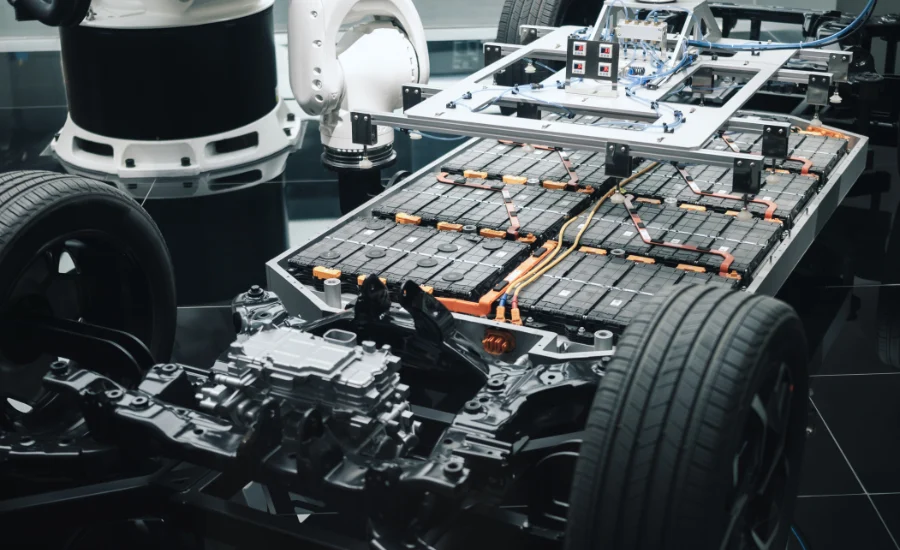
The modern EV battery pack is an engineering marvel, combining thermal barriers, delicate module housings, electronic components, and heavy structural housings. As automotive original equipment manufacturers (OEMs) scale up production to meet surging consumer demand, cycle times are shrinking, and the margin for error is razor-thin.
PSA tapes offer distinct manufacturing advantages in this environment, but only if they are engineered from the ground up for the production floor. Key insights from industry practice highlight several foundational realities:
- Beyond Final Strength: While peel strength and shear resistance matter, the physical handling characteristics of a tape—such as how cleanly it dies-cuts or how easily its release liner strips away—are often the primary determinants of line efficiency.
- The Danger of Overengineering: Specifying an overly thick or hyper-aggressive adhesive to maximize safety margins often backfires. Excess adhesive bleeds during converting and die-cutting, causing residue buildup on tooling that forces frequent, costly line stoppages.
- Complex Substrates: EV packs incorporate diverse and challenging materials, ranging from low-surface-energy plastics (like polypropylene and polyethylene) to inert silicone foams and fragile inorganic thermal barriers.
- The "Unsung Hero" of Liners: Release liners and their specific chemical coatings dictate the release force required for robotic grippers, making them critical components of high-speed automation.
Chronology: From Late-Stage Band-Aids to Proactive Integration
The evolution of adhesive integration in automotive manufacturing follows a distinct timeline, one that suppliers like Avery Dennison are actively trying to rewrite.
Phase 1: The Reactive "Band-Aid" Approach (Historical Standard)
Historically, adhesives were treated as an afterthought. Vehicle architectures, structural housings, and cell layouts were finalized well in advance. Adhesives were often selected late in the product development lifecycle—essentially chosen as a quick fix to resolve an unexpected vibration, gap-filling, or thermal management issue.
These late-stage integrations frequently led to manufacturing bottlenecks. Tapes that performed well in laboratory settings struggled when exposed to real-world factory floor contaminants, such as residual stamping lubricants on sheet metal, or when forced through automated dispensing equipment that had not been calibrated for specific liner release forces.
Phase 2: Concurrent Engineering and Roll-to-Roll Lessons
Recognizing these recurring pitfalls, forward-thinking manufacturers began shifting adhesive selection upstream into the initial design phase. Drawing heavy inspiration from high-speed roll-to-roll manufacturing and labeling industries—where production lines routinely churn out upwards of 100 million parts annually with near-zero downtime—adhesive developers began optimizing chemistries for continuous, error-free automated processing.
This phase saw the introduction of specialized tool-clean adhesive formulations designed to minimize residue buildup, thereby extending preventive maintenance intervals for die-cutters and applicators.
Phase 3: The Modern EV Production Ecosystem (Present Day)
Today, adhesive manufacturers collaborate with automotive engineers years before a new battery platform hits the production line. By engaging early in the design cycle, suppliers can fine-tune roughly 30 distinct variables—ranging from carrier film ductility to pigment-infused liners—ensuring that the adhesive acts as an enabler of high-speed automation rather than a liability.
"Oftentimes, we will get projects super late—scrambling, and they just need Band-Aids," van Rapphorst observes. "Whereas we could have been much more proactive in the design cycle and save a considerable amount of headache."
Supporting Data: Testing Real-World Conditions and Complex Geometries
Laboratory conditions rarely mirror the chaotic reality of a high-volume manufacturing plant. To bridge this gap, advanced testing protocols are required to evaluate how PSAs behave under stress, environmental exposure, and geometric deformation.
1. Embracing Real-World Substrate Conditions
A tape is only as effective as the surface it adheres to. Factory environments are rarely pristine; incoming sheet metal components frequently retain microscopic traces of stamping lubricants or protective oils.
Rather than testing solely on perfectly degreased, laboratory-clean coupons, materials are evaluated in the "as-received" condition. This rigorous approach helps engineering teams determine whether an adhesive can power through minor surface contamination or if an additional cleaning and pre-treatment step must be integrated into the assembly workflow.
2. Geometry and Residual Stress
Component geometry introduces another layer of complexity. A tape that exhibits stellar peel strength on a flat test panel may behave entirely differently when wrapped tightly around a sharp 90-degree corner or applied to a contoured, multi-axial surface.
If a tape lacks adequate conformability, residual elastic stresses build up within the material. Over time, particularly when subjected to aggressive thermal cycling in environmental test chambers, these stresses can cause the tape to lift, threatening the structural or electrical integrity of the battery pack.
3. Rethinking Technical Data Sheets (PET vs. Ductile Films)
Engineers often fall into the trap of over-relying on standard technical data sheets. For instance, high-strength Polyethylene Terephthalate (PET) films are frequently selected for dielectric isolation applications due to their impressive tensile strength and electrical properties.
However, once a microscopic tear or nick initiates in a PET film—especially near sharp metallic battery components—the material is prone to rapid splitting. In many demanding applications, a material with lower initial tensile strength but significantly greater elongation and ductility yields far superior long-term performance.
"You don’t need something to be stiffer and stronger," van Rapphorst advises. "You want it to be more ductile and more conformable."
To validate these characteristics, materials are subjected to punishing environmental regimes—including extreme temperature fluctuations, high humidity, and accelerated thermal cycling—scaling up from tiny exploratory samples to massive, full-scale prototype assemblies.
Official Responses and Expert Insights
Industry leaders stress that the physical properties of the adhesive are only half the equation; the equipment applying the adhesive must understand what it is touching.
To optimize pick-and-place robotics and automated optical inspection systems, adhesive developers are incorporating advanced visual aids directly into the tape architecture.
"We’ll often look at pigmenting adhesives or some of the films or printing on them so that things can be caught by vision systems, and vision systems can help with the placement and accuracy of these materials," van Rapphorst explains.
Furthermore, machine vision systems rely on clear visual contrast. By engineering specific colors into adhesives or release liners, manufacturers make it infinitely easier for automated optical systems to verify that a component has been picked, oriented, and placed with microscopic precision.
When dealing with fragile components—such as delicate inorganic thermal barriers designed to prevent thermal runaway between battery cells—automated handling poses a severe risk of destruction. Robotic systems must strip away release liners and position these delicate components without inducing micro-cracks. Extensive pre-testing of robotic release-liner removal ensures these fragile media survive high-speed automation intact.
Implications: Reshaping Vehicle Architecture and Assembly Lines
The manufacturing advantages provided by advanced PSA tapes are becoming even more pronounced as the automotive industry radically rethinks traditional vehicle assembly architectures.
Modern EV design trends are rapidly shifting toward structural battery packs—where the battery housing forms an integral part of the vehicle’s chassis—and novel modular manufacturing workflows. In these environments, speed and pre-application capabilities are paramount.
One of the defining operational benefits of PSA technology is its ability to be deployed out-of-sequence. Tapes can be pre-applied to components upstream, long before those parts reach the primary final assembly line.
"You can pre-apply them," notes van Rapphorst. "And then when you’re ready to stick the two things together, you take off the release liner and then you stick them together and they have that instant grab of a PSA. So then you can move parts down your assembly line very quickly."
This "pre-apply and activate" methodology slashes cycle times, reduces floor space requirements by eliminating wet-dispense curing stations, and drastically minimizes the risk of liquid adhesive spills or volatile organic compound (VOC) emissions on the factory floor.
The Bottom Line for EV Manufacturers
As automakers continue to push the boundaries of battery energy density, fast-charging capabilities, and structural integration, manufacturing processes must evolve in parallel.
For engineers and tier-one suppliers, the core question has permanently shifted. It is no longer simply asking whether a specific adhesive chemistry can achieve the required bond. The critical challenge is whether that bond can be executed reliably, repeatedly, cleanly, and at lightning speed to support the gigafactory output volumes of tomorrow.
By embracing concurrent design, treating the humble release liner as a precision engineering component, and aligning material science directly with automation capabilities, the automotive industry is laying a secure foundation for the future of e-mobility.