
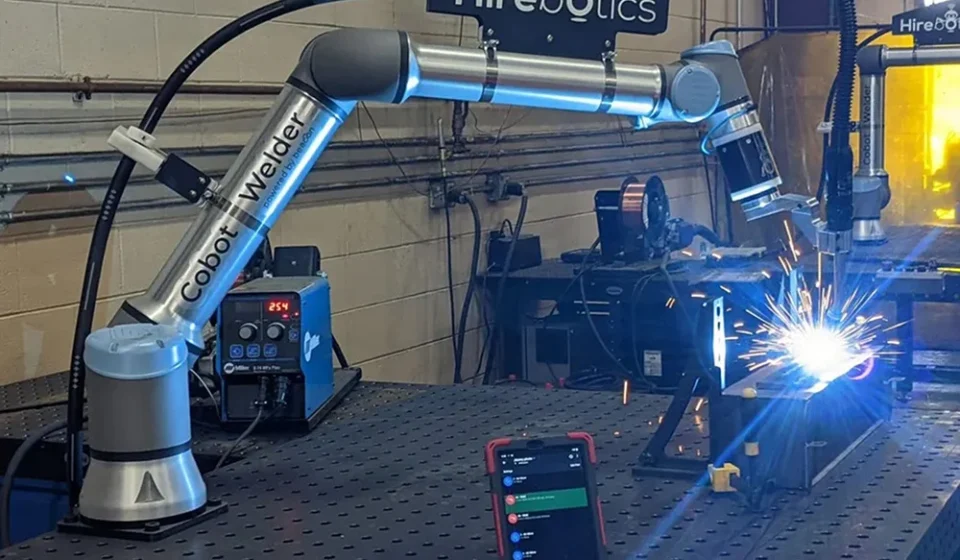
Hirebotics Redefines Manufacturing Flexibility with New Linear Rail and Line Tracking Capabilities

In a significant move to democratize industrial automation, Nashville-based Hirebotics LLC has unveiled two transformative additions to its collaborative robot (cobot) ecosystem: advanced line-tracking technology and modular linear rail systems. Announced at the International Manufacturing Technology Show (IMTS) 2026 in Chicago, these innovations are designed to dismantle the barriers that have historically limited cobots to small, stationary work cells. By enabling robots to paint moving parts on a conveyor and travel along the length of oversized assemblies, Hirebotics is effectively expanding the reach and utility of collaborative automation for heavy industry.
The Evolution of the Collaborative Workspace
For years, the primary constraint of cobot deployment has been the "fixed work envelope." While cobots offer a safer, more user-friendly alternative to traditional industrial robots, their utility has been largely tethered to a static reach—typically capping out at around 68.9 inches (175 cm). This limitation forced manufacturers to choose between shrinking their parts to fit the robot or investing in highly complex, custom-engineered automation cells.
Hirebotics, founded in 2015, has built its reputation on the "Beacon" platform—a cloud-based, no-code environment that allows fabricators to deploy welding, plasma cutting, and painting systems without requiring an in-house team of robotics engineers. By integrating these new hardware extensions into the Beacon ecosystem, Hirebotics is signaling a shift toward a more fluid, modular approach to factory floor automation.
Chronology of Innovation: From Static Cells to Dynamic Flow
The development of these capabilities did not emerge in a vacuum; it was a direct response to the "creative engineering" Hirebotics observed among its client base. Over the past several years, manufacturers in sectors like shipbuilding, heavy equipment manufacturing, and structural steel fabrication had been experimenting with improvised solutions.
- 2015–2022: Hirebotics establishes itself by standardizing the "turnkey" cobot cell, simplifying the deployment of MIG welding and plasma cutting systems.
- 2023–2025: As adoption grew, customers began requesting solutions for larger workpieces, leading to the use of magnetic Magswitch mounting, inverted configurations, and specialized positioners.
- 2026 (Q1–Q3): Recognizing the limitations of manual re-positioning, Hirebotics internal engineering teams fast-tracked the development of a standardized linear rail and integrated line-tracking sensors.
- September 2026: Official unveiling at IMTS 2026, marking the transition from "workpiece-to-robot" to "robot-to-workpiece" mobility.
Addressing the Moving Target: Line Tracking
Perhaps the most significant challenge in automated finishing is the "stop-and-start" bottleneck. In many traditional manufacturing environments, production lines must be halted so that a stationary robot can access a part, or parts must be removed from a conveyor and placed in a dedicated robotic cell. This manual intervention is the antithesis of lean manufacturing.
Hirebotics’ new line-tracking capability, now available for the Cobot Painter, solves this by allowing the robotic arm to synchronize its movements with the speed of a conveyor belt. A sensor positioned at the head of the line detects an incoming component, triggers the software, and initiates the painting or coating sequence. Because the robot "tracks" the part as it glides past, the conveyor never needs to stop.
By housing this logic within the no-code Beacon platform, Hirebotics has eliminated the need for complex PLC (Programmable Logic Controller) programming, which is usually required for such dynamic tracking operations. The result is a seamless, continuous flow that increases throughput while minimizing human touchpoints.
Scaling Up: The Linear Rail Solution
While line tracking addresses the issue of moving parts, the new modular linear rail system addresses the problem of sheer physical scale. For industries producing 12-foot frames, 20-foot structural assemblies, or massive tanks and vessels, a single 68-inch reach is insufficient.
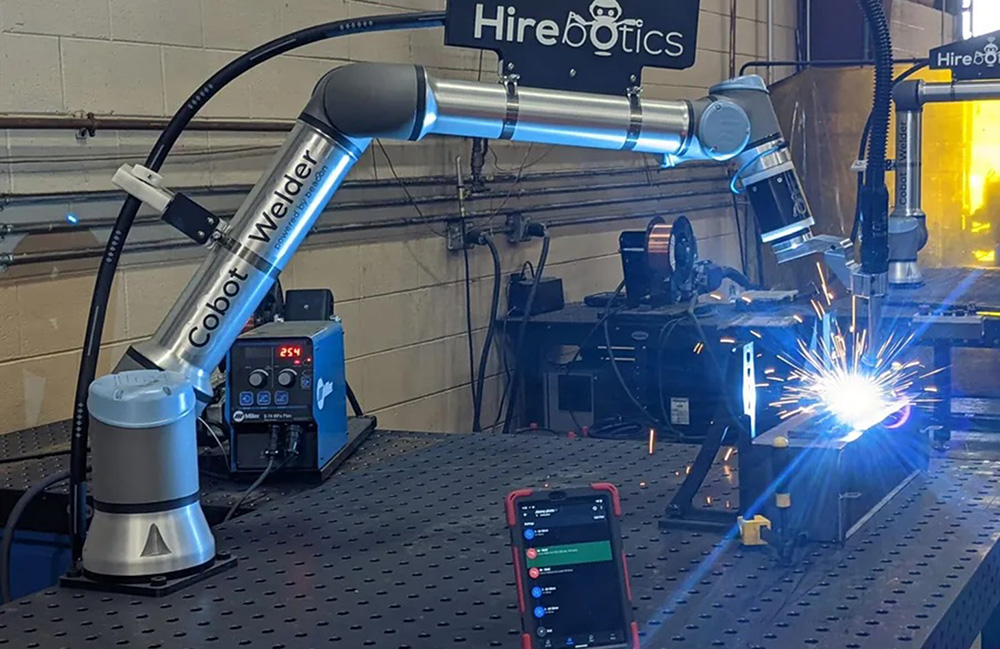
The linear rail system, available in 5-foot increments or custom lengths, allows the cobot to travel along the length of a workpiece. This is a critical development for large-scale fabricators who previously had to break down large welds into smaller sub-assemblies or manually move heavy components through a series of workstations.
Operational Benefits of the Linear Rail:
- Elimination of Repositioning: By moving the robot along the rail, the system can reach every inch of a long structure, ensuring consistency across the entire weld or paint path.
- Enhanced A/B Workflows: Manufacturers can utilize the rail to service two workstations simultaneously. While the cobot performs a task on side "A," an operator can prep and unload a part on side "B," significantly reducing idle time.
- Modular Scalability: Because the rails are modular, the system can be expanded or reconfigured as a facility’s product mix changes, protecting the initial capital investment.
Official Perspective: The CEO’s Vision
Matthew Bush, CEO of Hirebotics, framed these updates as a necessity born from the "two directions" of manufacturing constraints.
"Both capabilities come out of the same problem, from two directions," Bush noted during his presentation at IMTS. "The work doesn’t fit inside a fixed work envelope. One is about how big or awkward the part is. The other is about the part not holding still. We wanted to turn customer ingenuity into a standard, repeatable Hirebotics offering."
Bush emphasized that the goal is not to force manufacturers to adopt more complex technology, but rather to make advanced automation feel like a natural extension of their current workflow. "We don’t want each addition to create another operating model their team has to learn," he added. "The larger goal is to make automation applicable to more of the work manufacturers already do without requiring them to build a robotics department around it."
Implications for the Manufacturing Landscape
The implications of these advancements are profound, particularly for Small and Medium-sized Enterprises (SMEs) that have historically struggled to justify the high costs of custom automation.
1. The Death of the "Robotics Department"
By integrating linear travel and line tracking into the Beacon software platform, Hirebotics is effectively lowering the barrier to entry. Companies that previously relied on specialized integrators for complex motion systems can now manage these processes in-house. As the software evolves—with Hirebotics planning to release a fully automated version of the seventh-axis rail by the end of 2026—the technical burden on the operator will continue to decrease.
2. Industry-Specific Transformations
- Shipbuilding and Marine Fabrication: These industries deal with massive, non-uniform parts that are notoriously difficult to automate. The rail system provides the range necessary to tackle large hull sections.
- Agricultural and Construction Equipment: Long, structural frames for trailers or tractors can now be welded or painted in a single, continuous pass.
- Finishing Operations: In automotive parts manufacturing, line tracking will significantly reduce cycle times for spray-painting applications, leading to higher quality finishes with less material waste.
3. Future-Proofing the Factory
The roadmap outlined by Bush—where the Beacon platform moves from simple "pause and prompt" logic to full, autonomous control of the seventh axis—suggests that Hirebotics is positioning itself as the "operating system" of the smart factory. By keeping the interface consistent, they are ensuring that as a factory adds more robots or more sophisticated hardware, the learning curve remains flat.
Conclusion: A Shift Toward Fluid Automation
The introduction of line tracking and linear rail capabilities marks a maturation point for Hirebotics. It represents a transition from a company that sells "robot cells" to one that provides "automation infrastructure."
As global manufacturing faces ongoing labor shortages and the relentless pressure to increase efficiency, tools that allow existing workforces to handle larger, more complex, and faster-moving parts are invaluable. By enabling the cobot to follow the part or travel with the task, Hirebotics has successfully moved the needle on what is possible in the collaborative space, proving that the future of manufacturing isn’t just about robots—it’s about the mobility and intelligence of the systems that control them.
As the company looks toward the end of 2026, the industry will be watching closely to see how effectively the "automated seventh axis" is received. If the adoption of the current manual rails is any indication, Hirebotics is well on its way to making the "fixed work envelope" a relic of the past.