



The Architecture of Growth: Why Every Newcomer—Human or Humanoid—Starts Small

By Ahmed Rezika, SimpleWays OU
Published June 9, 2026
In the specialized environment of a brake repair shop, the journey toward mastery begins with the mundane. It starts with the removal of bolts, the methodical cleaning of calipers, and the silent observation of experienced hands as they navigate the complexities of hydraulic systems. A newcomer does not arrive with a master’s intuition; they arrive with a blank slate. Over time, the repetition of these tasks transitions from mechanical compliance to genuine awareness. Judgment—the ability to diagnose a problem rather than just follow a manual—follows much later.

This trajectory is not unique to automotive repair. In multi-brand workshops, software development houses, and high-tech manufacturing, the path to proficiency is wide but consistently gradual. No one begins with full ownership of a system. Whether you are a junior engineer at a tech giant like Meta or a technician in a heavy industrial plant, you begin by fixing small things. You learn the system piece by piece. Your horizon expands only as your mental model of the ecosystem matures.
This is the natural order of professional development. No one absorbs the full complexity of a corporate or mechanical system in a few weeks or even months. Yet, a persistent problem plagues modern organizations: many newcomers remain "small." They learn the task but fail to grasp the connections. They become highly efficient within a narrow silo but remain disconnected from the wider organizational system. This is rarely a failure of capability; it is a failure of design. If the system does not help the newcomer see beyond the immediate task, they will never progress beyond it.
The Chronology of Competence: From Novice to Expert
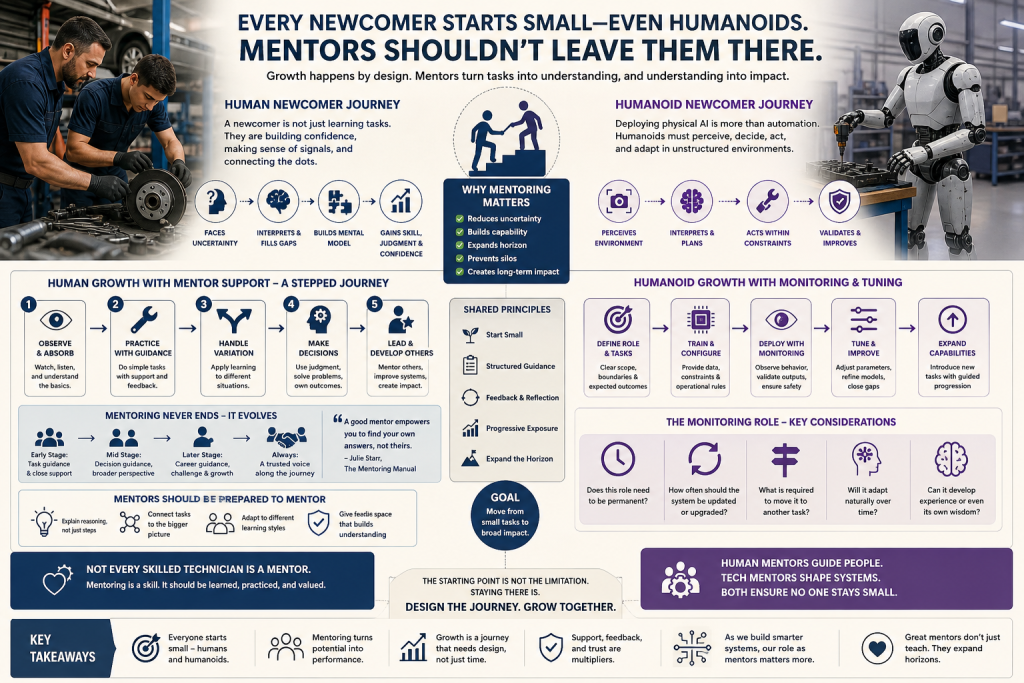
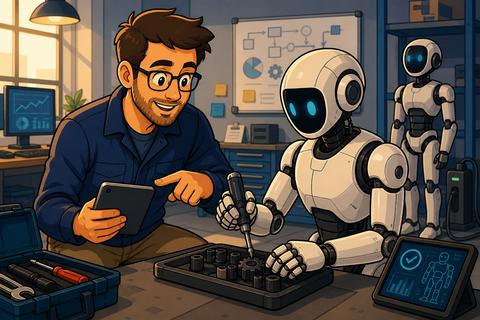
The progression of a newcomer—be it a human recruit or a newly deployed humanoid—follows a predictable chronology. Understanding this cycle is vital for leadership, particularly as we stand on the precipice of an era where "robot colleagues" are entering real-world environments.
Phase 1: The Phase of Guided Exposure
In the early days, the focus is purely on safety and basic execution. The newcomer is tasked with limited-scope activities. For a human, this involves shadowing and basic instruction. For a humanoid, this involves defining constraints, expected outputs, and rigorous validation steps. At this stage, the risk of failure is high, and the tolerance for error is low.

Phase 2: The Phase of Contextualization
As the newcomer gains comfort with the "how," they begin to grapple with the "why." This is where the gap between those who "pick it up" and those who struggle becomes apparent. Without proper guidance, the newcomer begins to form assumptions. In humans, these assumptions can lead to "execution drift"—the subtle degradation of quality over time. In machines, these assumptions appear as logic errors or an inability to handle the variability of the physical world.
Phase 3: The Phase of Autonomy and Adaptation
The final stage is reached when the newcomer can handle anomalies without direct supervision. They have built a robust mental model that allows them to predict outcomes and troubleshoot issues. However, reaching this stage is not a passive event. It is the result of a structured journey that prevents the newcomer from remaining stuck in the "small task" trap.
The Weight of Starting Small: Educational and Industrial Foundations
Every newcomer carries an invisible load on day one: the burden of making sense of a complex, often ambiguous environment.
The Zone of Proximal Development
To understand this, we must look to the work of Soviet psychologist Lev Vygotsky. His concept of the "Zone of Proximal Development" (ZPD) suggests that learning occurs most effectively when a task is just beyond the learner’s current independent capability but achievable with guidance. When an organization provides too little support, the newcomer fails; when they provide too much, they stifle the learner’s potential for growth.

Communities of Practice
Etienne Wenger’s research on "Communities of Practice" further illustrates that learning is not a solitary act. It is a process of participation. A newcomer learns by engaging with a community, observing, asking questions, and gradually internalizing the norms of the practice. If an organization fails to integrate the newcomer into this social fabric, they remain an outsider, regardless of their technical skill.
The Human Burden: Sense-Making Under Uncertainty
A human newcomer enters a system filled with unspoken signals. Instructions are often incomplete, and expectations are implied. This creates a high cognitive load, as described by John Sweller. When the brain is occupied with simply trying to understand the environment, it has less capacity for actual skill development.
This is why psychological safety—as researched by Amy Edmondson—is so critical. When a newcomer feels safe to ask "stupid" questions, they learn faster. When they fear judgment, they remain silent. That silence is frequently misinterpreted by management as competence, leading to a dangerous gap in the organization’s collective knowledge.
The Humanoid Burden: Operating Without Assumptions
As we integrate humanoids into the workforce, we are forced to confront the limitations of our own "intuitive" training methods. Unlike humans, a humanoid cannot rely on intuition. It cannot "guess" what the mentor meant by a vague instruction. It requires explicit, structured programming.
Leaders like Jensen Huang of NVIDIA have noted that physical AI is vastly more complex than digital intelligence. A humanoid must navigate spatial relationships, handle unpredictable tool placements, and interact with human colleagues safely. As we saw in the 2004 vision of I, Robot, the goal of 2035 is closer than we think. We are moving toward a future where humanoids will share our workplaces, yet they will only be as effective as the "mentoring" (or programming) we provide them.
If we do not design explicit, measurable, and continuous training systems for these machines, we will face the same problems we face with human employees: inefficiency, accidents, and siloed execution. The humanoid effectively forces us to become better managers of humans by demanding the clarity we should have been providing all along.

The Role of the Mentor: More Than a Task-Master
Mentoring is the bridge between the individual and the organization. A mentor is not merely a trainer who shows someone which button to press; they are an architect of understanding.
Activating Curiosity
Not every newcomer arrives with the same level of intellectual fire. A skilled mentor reads the individual. They know when to push, when to explain, and when to create a "safe space" for failure. By framing mistakes as data points rather than failures, they nurture a growth mindset—a concept pioneered by Carol Dweck. This keeps curiosity alive, transforming a "task-doer" into an "owner of the process."

Designing for Humanoids
For humanoids, the "mentor" role shifts to the engineer or the system designer. Since the humanoid cannot learn through natural reflection, it must learn through feedback loops. Yann LeCun and Demis Hassabis have both emphasized that capable AI requires environments where systems can test, fail, and refine their behavior continuously. We are moving from the era of "fixed programming" to "engineered mentoring," where the quality of the system is a direct reflection of the quality of its training environment.
Implications for the Future of Work
The rise of AI and humanoid labor does not render human mentoring obsolete; it makes it more critical. As we automate the "small tasks," the value of the human worker will shift toward judgment, complex troubleshooting, and the ability to adapt to unprecedented situations.

The Institutional Shift
Organizations must move away from the assumption that people will simply "pick it up" through osmosis. Instead, they must institutionalize the mentoring process:
- Define Roles Explicitly: Clear expectations reduce cognitive load.
- Build Feedback Loops: Ensure that every task is followed by reflection and validation.
- Foster Psychological Safety: Create an environment where questions are the primary tool of progress.
- Train the Mentors: Being a subject matter expert does not make one a teacher. Mentorship is a distinct skill that requires training.
Conclusion: The Choice of Design
The starting point for every newcomer is, and will always be, "small." We all begin as novices, overwhelmed by the complexity of our surroundings. Whether that newcomer is a young apprentice in a repair shop or a humanoid unit on a factory floor, the limitation is not the starting point—it is the decision to stay there.

If we continue to treat onboarding as a one-time administrative hurdle rather than a continuous, intentional design process, we will continue to suffer from the "silo effect." If, however, we embrace the responsibility of the mentor—to connect the dots, to translate experience into meaning, and to design for growth—we can unlock the full potential of both our human and robotic workforce.
Growth does not happen by accident. It happens by design. And as we look toward the future of industry, the most important question is not how fast our machines can learn, but how well we can teach them—and each other—to navigate the complexity of the world around us.
Must-Know Jargon
- Mentoring: A structured relationship guiding professional growth through perspective, not just instruction.
- Cognitive Load: The mental processing power required for learning; managing this is key to efficient training.
- Zone of Proximal Development (ZPD): The optimal "learning zone" where a task is achievable only with guidance.
- Experiential Learning: The cycle of doing, reflecting, and adjusting, which is the cornerstone of mastery.
- Psychological Safety: The belief that one can take risks and ask questions without fear of retribution.
- Human-in-the-Loop: A design philosophy where human oversight validates and guides autonomous systems.
- On-boarding: The critical process of integrating new entities—human or AI—into a safe, productive workflow.