As meteorological anomalies mount across the globe, business leaders are increasingly forced to look past traditional economic indicators and turn their attention toward the Pacific Ocean. El Niño—historically viewed primarily as a meteorological event—has cemented its status as a potent business-disruption trigger. With the 2026–2027 event intensifying at a historic pace, organizations worldwide face an urgent operational imperative: are your enterprise operations, workforce protocols, and supply chains truly prepared for climate-driven disruption?
Far more than a simple weather cycle, El Niño touches nearly every critical pillar of modern industry. From worker safety and electricity reliability to water availability, global logistics, commodity pricing, and manufacturing quality assurance, the cascading impacts of this climate phenomenon threaten to test the resilience of enterprises across sectors. For complex, highly integrated industries—such as electronics and semiconductor manufacturing, where production relies on pristine utility stability, ultra-pure water, and geographically concentrated supply webs—climate stress can rapidly transform into an existential crisis of production continuity and compliance.
The Anatomy of a Super El Niño: Main Facts and Drivers
To understand the scale of the impending disruption, businesses must first understand the mechanism. El Niño is a naturally occurring climate pattern characterized by unusually warm sea-surface temperatures (SSTs) in the central and eastern equatorial Pacific Ocean. It represents the warm phase of the broader El Niño–Southern Oscillation (ENSO) cycle, which oscillates between El Niño, its cooler counterpart La Niña, and neutral conditions.
During an El Niño event, shifts in tropical Pacific trade winds and ocean circulation fundamentally alter the distribution of ocean heat. This thermodynamic shift radically influences global atmospheric circulation, displacing traditional rainfall and temperature belts. The resulting impacts vary widely depending on geography, season, and the intensity of the specific event, frequently triggering extreme heatwaves, prolonged droughts, catastrophic rainfall, or severe flooding.
For commercial enterprises, the fallout goes well beyond physical property damage. Extreme ambient heat threatens workforce health, safety, and productivity while driving up commercial cooling demands. Concurrent droughts constrain vital municipal and industrial water supplies, impair hydropower generation, and cripple inland and oceanic shipping lanes. Meanwhile, localized flooding and rainfall extremes disrupt agricultural outputs, skew commodity markets, and break supplier reliability.
Chronology of an Escalating Crisis: Key Milestones and Forecasts
The trajectory of the 2026–2027 El Niño has alarmed international meteorological bodies, setting a timeline of escalating alerts that corporate risk managers cannot afford to ignore.
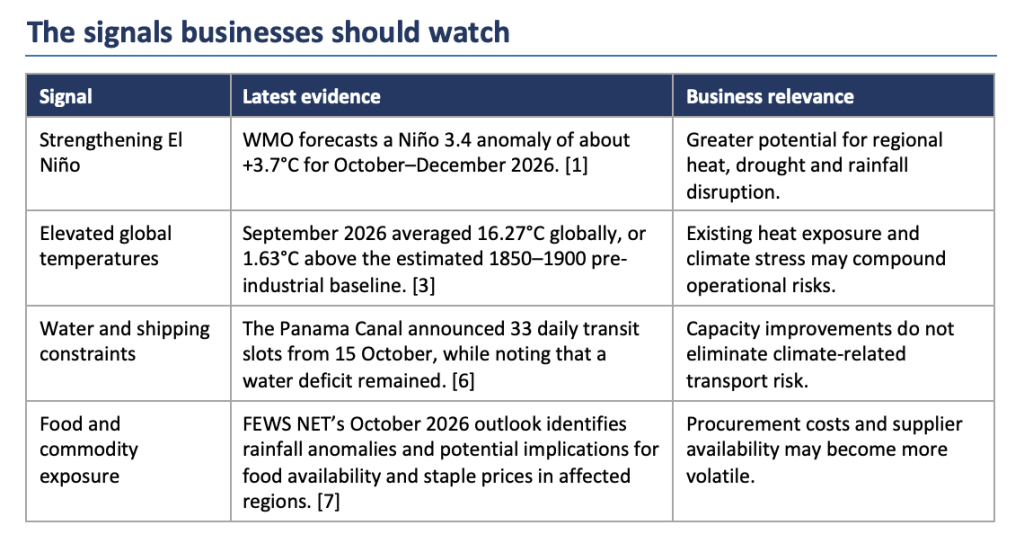
September 2026: The Copernicus Climate Change Service reported September as the second-warmest September on record, marking the second consecutive month in 2026 where global monthly temperatures hovered above the critical 1.5°C threshold relative to pre-industrial levels. (Note: Climatologists emphasize this metric reflects a monthly global anomaly rather than a permanent breach of the Paris Agreement’s long-term warming ceiling).
28 September 2026: Recognizing improving yet delicate watershed conditions, the Panama Canal Authority announced an increase in daily transit capacity to 33 slots beginning October 15, alongside a maximum authorized draft of 14.94 meters (49 feet) for Neopanamax vessels. However, officials cautioned that a structural water deficit persisted, signaling that logistical vulnerability remains high.
6 October 2026: FEWS NET released its comprehensive global outlook, identifying acute El Niño-related rainfall deficits across East Africa, the Sahel, Latin America, the Caribbean, and Pakistan, while warning of elevated flood risks in parts of the eastern Horn of Africa.
8 October 2026: In a landmark advisory, the World Meteorological Organization (WMO) forecast that sea-surface temperature anomalies in the central and eastern tropical Pacific could reach approximately +3.7°C above normal between October and December 2026. This projection easily eclipses the previous Niño 3.4 peak of +2.6°C recorded during the historic 2015–2016 event. WMO models indicated a near-100% probability that the phenomenon will persist through February 2027, positioning it as one of the strongest events recorded since 1950.
8 October 2026 (Parallel NOAA Update): The National Oceanic and Atmospheric Administration (NOAA) Climate Prediction Center released diagnostic data indicating an 83% probability of a historic-strength event during the final quarter of 2026, with an equally high probability of strong-to-very-strong conditions persisting through January–March 2027. (Scientists note that NOAA utilizes distinct metrics, such as the Relative Oceanic Niño Index, which should be evaluated independently from WMO Niño 3.4 values).
16 September 2026: Amid these compounding environmental shifts, the International Organization for Standardization published ISO 9001:2026, explicitly updating quality management standards to reinforce organizational resilience, supply chain visibility, and climate-risk adaptation.
Supporting Data and Quantitative Risk Metrics
Translating meteorological forecasts into financial and operational risk requires hard data. Predictive models and historical benchmarks highlight the sheer magnitude of vulnerability facing global enterprises:
+3.7°C SST Anomalies: The projected peak in equatorial Pacific sea-surface temperatures illustrates the sheer energy driving atmospheric changes through late 2026 and early 2027.
451,000 Excess Heat-Related Deaths: According to rigorous modeling projections released by the Climate Impact Lab in September 2026, cumulative global excess heat-related deaths are projected to reach 451,000 between June 2026 and February 2027 relative to a baseline normal year—underscoring severe risks to the global labor force.
Macroeconomic Power Deficits (Historical Benchmark): Highlighting the danger of grid instability during climate extremes, World Bank assessments of Northern Vietnam’s 2023 power shortages revealed a 5.4 GW supply deficit in May alone, driving estimated economic losses of roughly $1.4 billion (0.3% of national GDP) and up to 10% revenue losses among surveyed industrial operators.
Logistical Bottlenecks: Historical precedents—such as the severe 2021 Taiwanese drought that forced semiconductor foundries to commission emergency water trucks—demonstrate how rapidly regional water stress can constrain high-tech manufacturing outputs.
Seven Core Business Risks and Strategic Corporate Responses
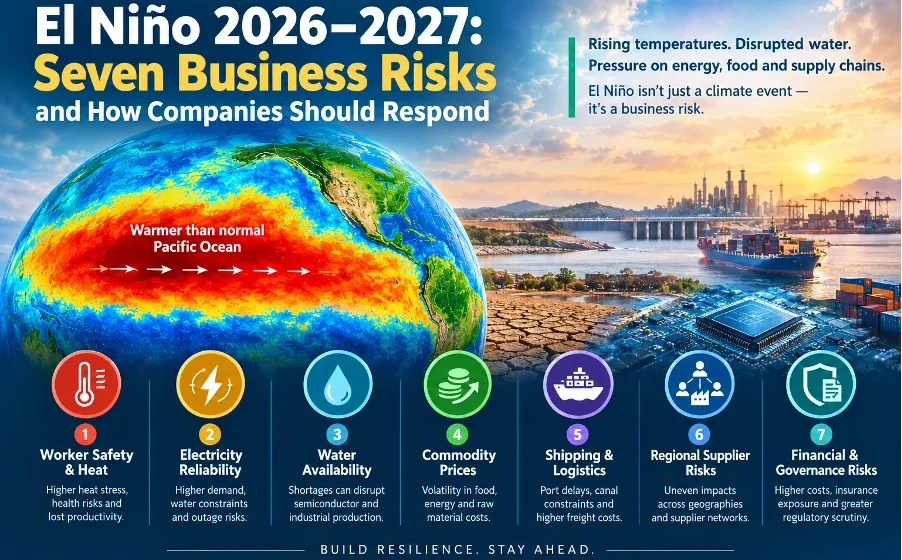
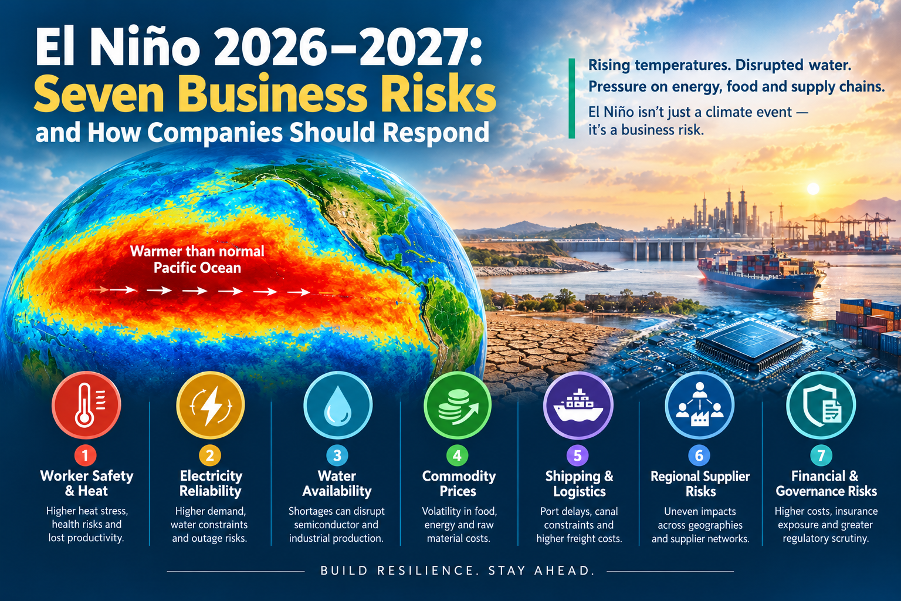
To safeguard operations, business leaders must deconstruct El Niño into seven distinct risk vectors and implement proactive countermeasures.
1. Extreme Heat and Workforce Safety
Extreme ambient temperatures directly compromise human physiology, escalating the incidence of heat illness, cognitive fatigue, human error, and workforce absenteeism. These vulnerabilities are especially pronounced in heavy manufacturing plants, industrial warehouses, outdoor logistics yards, construction sites, and poorly ventilated facilities.
Corporate Response: Organizations must overhaul heat-illness prevention programs. Key steps include implementing mandatory hydration protocols, redesigning shift schedules to avoid peak solar radiation hours, upgrading facility ventilation and local spot-cooling, and training floor supervisors to recognize early symptoms of heat stress.
2. Power Grid Instability and Energy Constraints
Surging cooling demands strain electrical grids, while concurrent droughts reduce hydroelectric output. In regions with fragile power infrastructure, industrial manufacturers face rolling blackouts, escalating energy tariffs, or mandatory load-shedding directives.
Corporate Response: Facilities must audit their emergency power architecture. Enterprises should invest in on-site backup generation, establish interruptible power agreements with local utilities, explore microgrid integration, and audit energy-intensive machinery to optimize baseline power efficiency.
3. Water Scarcity and Industrial Production Bottlenecks
Water is a non-negotiable input for chemical processing, equipment cooling, surface cleaning, and semiconductor fabrication. Prolonged drought conditions threaten to starve industrial clusters of the ultra-pure water required for complex manufacturing.
Corporate Response: Industrial operators must implement closed-loop cooling systems, deploy advanced greywater recycling technologies, map local watershed dependencies, and secure secondary water-hauling agreements well in advance of municipal rationing.
4. Commodity Price Volatility and Procurement Pressures
El Niño-driven droughts and floods disrupt agricultural yields, mining operations, and raw material extraction. While market prices also react to fuel costs, fertilizer availability, and geopolitical factors, climate shocks inject severe volatility into raw material procurement.
Corporate Response: Supply chain teams should diversify material sourcing, expand supplier geographic footprints, utilize financial hedging instruments for critical inputs, and build predictive procurement buffers to cushion against sudden price spikes.
5. Supply Chain and Logistics Fractures
Inland waterway navigation depends heavily on consistent rainfall. Droughts choke vital trade arteries—such as the Panama Canal or major European and Asian riverways—while extreme weather damages ports, rail networks, and highways, extending lead times and driving up freight expenditures.
Corporate Response: Logistics managers must multimodal their freight strategies, transition away from single-route dependencies, increase safety stock holdings for critical components near primary assembly hubs, and leverage real-time visibility software to track transit disruptions dynamically.
6. Regional Heterogeneity and Localized Supplier Risk
National-level meteorological forecasts frequently obscure hyper-local vulnerabilities. Because El Niño produces radically divergent outcomes across regions—simultaneously causing drought in one agricultural belt and catastrophic flooding in an adjacent province—broad national risk assessments can leave individual supplier nodes dangerously exposed.
Corporate Response: Procurement organizations must map their supply chains down to Tier-2 and Tier-3 sub-suppliers. Enterprises should execute granular, site-specific risk assessments rather than relying on blunt national forecasts.
7. Financial, Insurance, and Regulatory Governance Exposures
Climate-induced operational interruptions impair revenue streams, inflate commercial insurance premiums, drain working capital, and breach customer delivery SLAs. Furthermore, these events expose critical deficiencies in enterprise risk management (ERM) and sustainability compliance.
Corporate Response: Organizations must align their reporting mechanisms with evolving regulatory frameworks.
IFRS S2 sets the gold standard for climate-related financial disclosures.
In India, regulatory bodies like SEBI enforce strict ESG disclosures for value chains under BRSR guidelines.
In the European Union, recent legislative updates—including Directive (EU) 2026/470 on corporate sustainability due diligence, alongside Delegated Regulations (EU) 2026/1560 and (EU) 2026/1563—mandate rigorous value-chain transparency and sustainability reporting. Companies must confirm their specific jurisdictional obligations immediately.
When Climate Disruption Becomes a Quality Failure
Operational resilience is intimately tied to product quality. When environmental stress introduces heat, humidity spikes, water contamination, or sudden power fluctuations into a manufacturing environment, the downstream result is often material degradation, equipment drift, and catastrophic quality defects.
To prevent climate-driven operational stress from translating into product failure, quality assurance teams must enforce five non-negotiable controls:
Strict Environmental Monitoring: Maintain tightly controlled cleanroom and shop-floor parameters for temperature and relative humidity.
Robust Change Control: Subject any emergency substitutions of raw materials, chemicals, or component parts to rigorous engineering validation.
Enhanced Incoming Inspection: Increase sampling frequencies and analytical testing for raw materials arriving from drought- or flood-affected supplier regions.
Traceability Audits: Ensure comprehensive documentation of all alternative component batches to maintain end-to-end product genealogy.
Regulatory Compliance Verification: In electronics manufacturing, emergency component substitutions can inadvertently violate environmental directives such as RoHS, REACH, or POPs regulations. Compliance teams must pre-verify chemical and material declarations before substituting alternative parts.
The Evolution of Quality Standards: ISO 9001:2026
Publishing on 16 September 2026, the newly released ISO 9001:2026 officially carries forward and hardens the requirement—originally introduced via the 2024 amendment to ISO 9001:2015—for organizations to formally consider whether climate change is a relevant issue for their Quality Management System (QMS).
While organizations must evaluate the specific relevance of climate risk to their unique operational context rather than executing blanket initiatives, the standard underscores that environmental resilience is now a core component of certified quality governance.
Transition Deadlines Warning: Organizations navigating the transition to ISO 9001:2026 should note minor discrepancies in published transition guidelines. While official ISO/TC 176 guidance points to 30 September 2029, leading certification bodies such as TÜV SÜD have cited 15 September 2029. Enterprises are strongly advised to confirm their exact transition deadline directly with their accredited certification body.
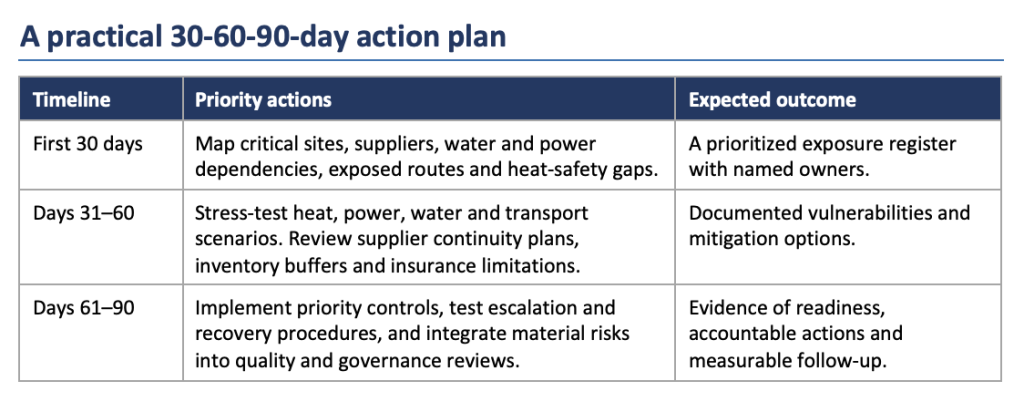
Conclusion: The 30-60-90 Day Action Plan
The 2026–2027 Super El Niño is a definitive stress test for global commercial resilience. For advanced manufacturing, electronics, and global supply chains, vulnerability rarely sits exclusively within factory walls; it lurks within the extended web of utilities, watersheds, and logistical corridors upon which continuous production depends.
Business leaders do not need a crystal ball to predict every localized storm or heatwave. Instead, they must systematically identify where climate stress threatens human capital, raw materials, manufacturing processes, and delivery timelines, establishing rigorous controls before vulnerabilities transform into catastrophic financial failures.
Next 30 Days: Map enterprise exposure, audit high-risk Tier-1 and Tier-2 supplier locations against WMO and NOAA forecasts, and review worker heat-safety protocols.
Next 60 Days: Stress-test business continuity and disaster recovery plans, secure secondary water and power contingencies, and evaluate QMS alignment with ISO 9001:2026 requirements.
Next 90 Days: Formalize climate-risk integration into enterprise governance, update supplier quality agreements, and ensure full compliance with emerging international reporting frameworks (IFRS S2, EU CSDDD mandates).
The operational mandate is clear: map exposure, protect your workforce, test business continuity, and inextricably link climate risk to supplier quality and enterprise governance.
References & Regulatory Citations
World Meteorological Organization (8 October 2026).Sea-surface temperatures reflect strengthening El Niño.Link
NOAA Climate Prediction Center (8 October 2026).ENSO Diagnostic Discussion.Link
Copernicus Climate Change Service (12 October 2026).Copernicus: Second warmest September as global temperatures stay above 1.5°C.Link
Climate Impact Lab (September 2026).451,000 at Risk: Where Action Can Save Lives During the Super El Niño.Link
SEBI (28 March 2025).Measures to facilitate ease of doing business regarding framework for assurance, ESG disclosures for value chains. Circular SEBI/HO/CFD/CFD-PoD-1/P/CIR/2025/42. Link
European Union (24 February 2026).Directive (EU) 2026/470 on corporate sustainability reporting and due-diligence.Link
European Commission (3 July 2026).Delegated Regulation (EU) 2026/1560 establishing voluntary sustainability reporting standards.Link
European Commission (3 July 2026).Delegated Regulation (EU) 2026/1563 simplifying sustainability reporting standards.Link
International Organization for Standardization.ISO 9001:2026: What businesses need to know.Link
ISO/TC 176.ISO 9001:2026 revision and transition guidance.Link
TÜV SÜD.ISO 9001:2026: Everything you need to know about the new revision.Link
Reuters (24 February 2021).Chipmakers in drought-hit Taiwan order water trucks to prepare for ‘the worst’.Link