



Water is the lifeblood of our planet, covering over 70% of the Earth’s surface and sustaining every biological process known to science. Yet, despite its ubiquity, it remains one of the most enigmatic substances in the natural world. Unlike almost every other liquid, water defies standard physical expectations—most notably by expanding when it freezes. For decades, the scientific community has been locked in a quest to understand why water behaves so differently at the molecular level, particularly in its "supercooled" state. Now, a groundbreaking study from the University of Osaka has introduced an Artificial Intelligence (AI) framework that promises to reconcile decades of conflicting theories, offering a unified language for the hidden structure of H2O.
The Anomalous Nature of H2O
To the average observer, water is a simple compound: two hydrogen atoms bonded to a single oxygen atom. However, this simplicity masks a chaotic and complex reality. Water’s primary anomaly lies in its density. While most liquids contract as they cool, reaching their maximum density just before solidification, water reaches its maximum density at 4°C. As it cools further, it begins to expand, causing ice to float—a quirk that is essential for the survival of aquatic life during winter.
Scientists have long hypothesized that these strange behaviors are rooted in the microscopic choreography of water molecules. As temperature and pressure fluctuate, the hydrogen-bonded networks that define water’s liquid structure undergo rapid, invisible shifts. However, for years, researchers have been hampered by a lack of a standardized method to quantify these shifts. Different laboratories have utilized disparate metrics—such as tetrahedral bond order or local density—to describe the same phenomenon, leading to a fragmented understanding of water’s "hidden" structure.
Chronology of the Scientific Quest
The history of this research is a testament to the persistence of modern physical chemistry.
The Era of Theoretical Discovery (1970s–1990s)
Early research into water’s anomalies focused on the "two-state" hypothesis. Scientists proposed that liquid water exists as a fluctuating mixture of two distinct structures: a high-density liquid (HDL) and a low-density liquid (LDL). Under normal conditions, these forms interconvert so rapidly that they are indistinguishable. However, theorists suggested that if one could cool water below its freezing point without letting it crystallize, these two forms might become more apparent.
The Challenge of Supercooling (2000s–2015)
The main obstacle to studying these states was the "freezing barrier." In typical environments, water requires a nucleation site—a microscopic impurity, a bubble, or a scratch on a container—to transition into ice. By removing these impurities, scientists began to master the state of "supercooled water," where the liquid remains fluid well below 0°C. Despite this success, the tools used to characterize the molecular arrangements remained subjective, based on varying mathematical models that were often incompatible.
The AI Breakthrough (2020–Present)
By 2023, the sheer volume of data produced by molecular dynamics simulations became too vast for human interpretation. Researchers at the University of Osaka recognized that the problem was no longer a lack of data, but a lack of a universal translator. Led by Kang Kim and Nobuyuki Matubayasi, the team began training neural networks to process these simulations, effectively teaching an AI to "see" the structural differences that had eluded human researchers for years.
Supporting Data: Decoding the Molecular Dance
The core of the Osaka study involved a comparative analysis of 16 different structural descriptors. These descriptors are essentially mathematical snapshots of how water molecules arrange themselves in three-dimensional space.
The Neural Network Architecture
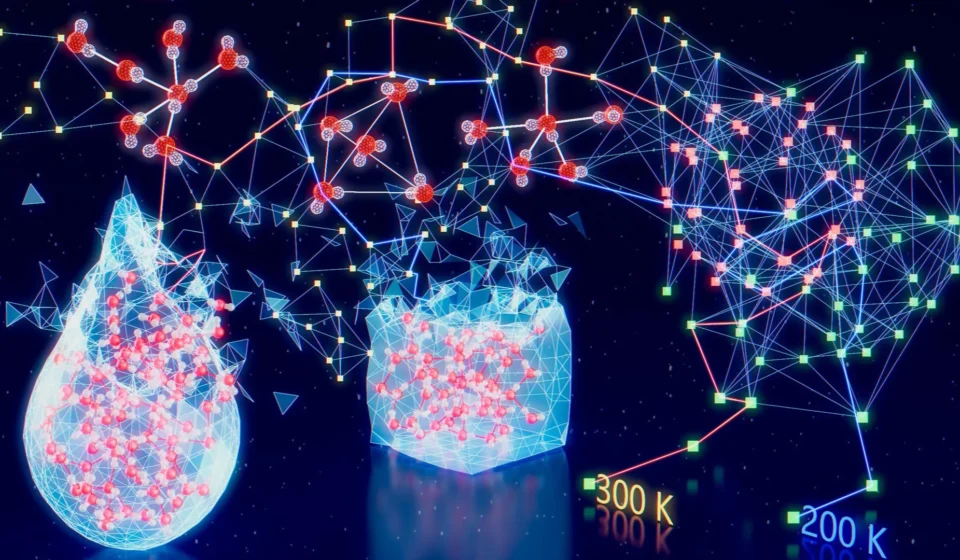
The researchers employed a deep-learning neural network designed to simulate human cognition. By feeding the system massive datasets generated from molecular dynamics simulations of supercooled water, the AI was tasked with identifying the "signature" of HDL versus LDL.
- Training Phase: The model was exposed to thousands of simulated configurations of water molecules at various temperatures.
- Pattern Recognition: Through trial and error, the system identified which specific geometric parameters (like the distance between oxygen atoms or the angles of hydrogen bonds) were most predictive of the state of the liquid.
- The Result: The AI successfully ranked the 16 descriptors, revealing that some traditional metrics were far more accurate at capturing the fundamental "switch" between high and low density than others.
This ranking system provides the first objective, data-driven standard for structural analysis in liquid chemistry. By effectively "filtering out the noise" of less relevant metrics, the AI has provided a clear roadmap for future researchers to follow.
Official Perspectives: Insights from the Researchers
The research, published in Communications Chemistry, marks a shift in how scientists approach fluid dynamics. Kang Kim, the corresponding author of the study, emphasized that the goal was not just to use AI as a black box, but to gain insight into the underlying physical reality.
"Past studies have shown that using machine learning to classify and understand structural data is effective," Kim stated during a press briefing. "We specifically wanted to incorporate a neural network model into this study to evaluate how accurate the descriptors were at capturing key structural information, in a way that is like human cognition."
This "cognitive" approach was crucial. By mimicking the human ability to prioritize relevant information while ignoring extraneous variables, the neural network could synthesize a vast array of conflicting data points into a cohesive whole.
Nobuyuki Matubayasi, the senior author of the paper, highlighted the practical outcome of this endeavor: "The network used what it had learned to compare how 16 descriptors differentiated between LDL and HDL structures at different temperatures. In this way, we determined the most efficient descriptors." This consensus, he argues, is the first step toward a grand unified theory of water’s thermodynamics.
The Broader Implications: Why It Matters
The implications of this research extend far beyond the laboratory. If we can accurately predict and describe the structural transitions of water, we unlock a deeper understanding of chemical reactions that occur in aqueous environments—which is essentially all biological processes.
Advancing Material Science
Understanding how water molecules transition between high and low-density states can inform the development of new materials, particularly in cryopreservation. If we understand exactly how water behaves as it nears the freezing point, we can develop better cryoprotectants that prevent the damage caused by ice crystals in biological tissues.
Climate Modeling
Water’s unusual properties play a vital role in global climate systems. From the way heat is stored in the oceans to the formation of clouds and ice caps, the microscopic structure of water has macroscopic consequences. A more refined model of water’s molecular transitions could lead to more accurate climate simulations, providing better data for predicting sea-level changes and weather patterns.
The Future of AI in Basic Science
Perhaps most importantly, the Osaka study demonstrates that AI is a powerful tool for foundational discovery, not just for practical engineering. By using machine learning to reconcile conflicting scientific theories, researchers have shown that AI can act as an arbiter of scientific truth, helping to consolidate decades of research into a more rigorous and reliable framework.
Conclusion: A New Lens on an Ancient Mystery
The mystery of water is far from fully solved, but the barrier between the human mind and the microscopic dance of molecules has been significantly lowered. By integrating artificial intelligence into the heart of molecular dynamics, the University of Osaka team has provided a new lens through which to view one of nature’s most complex substances.
As the scientific community adopts this new framework, we can expect a wave of discoveries that build upon this unified understanding. We are moving closer to a future where the "anomalies" of water are no longer seen as mysteries, but as predictable, measurable consequences of a fascinatingly complex molecular architecture. In the process, we are not only learning more about the water we drink but gaining a deeper appreciation for the intricate, invisible balance that makes life on Earth possible.