

The Nervous System of Automation: How Time-Series Databases are Revolutionizing Robotics

In the rapidly evolving landscape of industrial automation, the challenge has shifted from making machines move to making machines "think" and "remember" in real-time. As robots become more autonomous and sensor-dense, the volume of data they generate has reached a breaking point for traditional data architectures.
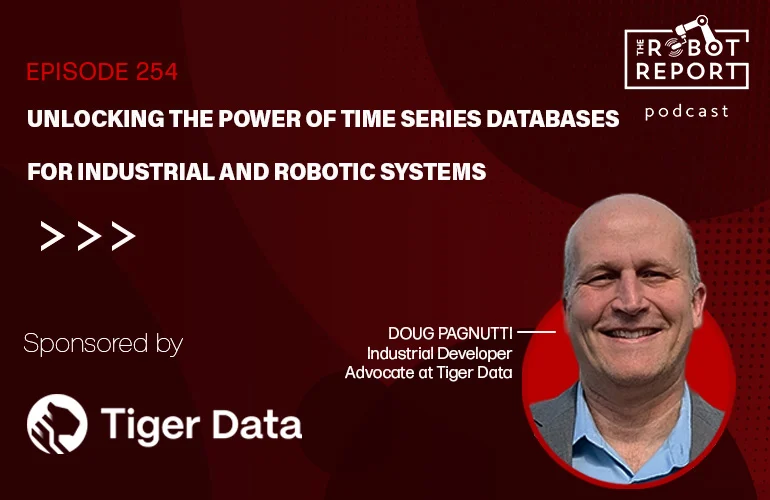
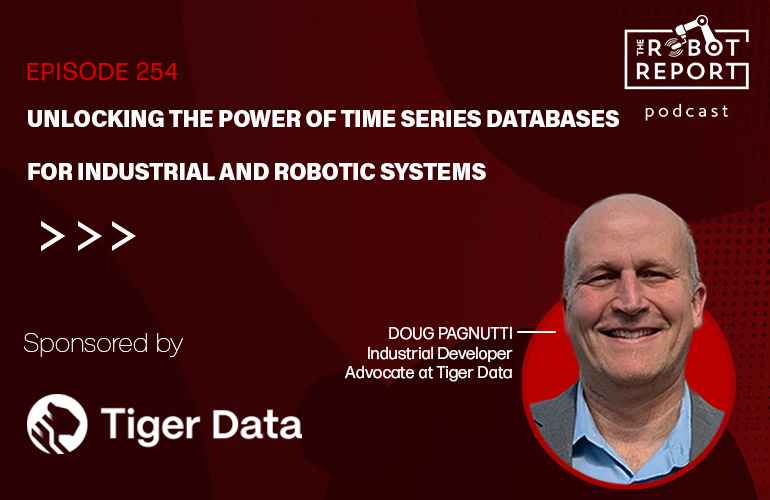
In Episode 254 of The Robot Report Podcast, Mike Oitzman sat down with Doug Pagnutti, an industrial developer advocate at Tiger Data, to explore the critical role of time-series databases in the modern robotics stack. The discussion highlighted a fundamental shift in the industry: the move away from siloed, legacy systems toward integrated, high-performance data infrastructures like TimescaleDB that can handle the rigors of the Industrial Internet of Things (IIoT).
Main Facts: The Intersection of Time and Motion
The core premise of Pagnutti’s insights is that robotics is, at its heart, a time-series problem. Every movement of a robotic arm, every calculation by an Autonomous Mobile Robot (AMR) navigating a warehouse, and every temperature fluctuation in a CNC machine is a data point anchored to a specific millisecond.
The Problem: The "Database Wall"
Most industrial systems initially rely on standard relational databases (like standard Postgres or MySQL). However, as the number of sensors grows—incorporating Lidar, IMU (Inertial Measurement Units), motor encoders, and vision systems—these databases eventually hit a "wall." Queries that took milliseconds start taking seconds; dashboards lag, and the system becomes incapable of providing the real-time feedback necessary for safety-critical robotic operations.
The Solution: Optimized Time-Series Architecture
Tiger Data, the creators of TimescaleDB, addresses this by extending PostgreSQL with specialized "primitives" designed for time-series workloads. This includes:
- Columnar Storage: Allowing for massive compression of historical data.
- Automatic Partitioning: Organizing data by time intervals to ensure query speeds remain constant even as the dataset grows into the terabytes.
- Edge-to-Cloud Flexibility: Enabling robots to process data locally (on the edge) while syncing critical insights to the cloud for fleet-wide analysis.
Chronology: From the Oil Field to the Data Center
To understand the current state of industrial data, one must look at the career trajectory of experts like Doug Pagnutti, whose professional journey mirrors the evolution of the industry itself.
The Legacy Era (2000s – 2010s)
Pagnutti spent over 12 years in the oil and gas and manufacturing sectors. This era was defined by Operational Technology (OT). Data lived in Programmable Logic Controllers (PLCs) and Supervisory Control and Data Acquisition (SCADA) systems. In this environment, data was often trapped in "on-prem" silos, used primarily for immediate tactical control rather than long-term strategic analysis.
The Integration Era (Mid-2010s)
As the industry moved toward Industry 4.0, Pagnutti transitioned into industrial software development at major firms like Dell EMC and VTScada. This period marked the beginning of the "OT/IT Gap." Information Technology (IT) professionals wanted data in the cloud for AI and analytics, while OT engineers needed to ensure the physical robot didn’t crash into a wall. Bridging this gap became the primary challenge for automation engineers.
The Real-Time Era (Present Day)
Now at Tiger Data, Pagnutti’s work represents the culmination of these two worlds. The current era is defined by the democratization of high-performance data tools. Automation engineers are no longer just "ladder logic" programmers; they are becoming data architects who must manage IIoT deployments at a massive scale. Pagnutti’s role as a developer advocate is to provide the bridge, helping teams use familiar SQL-based tools to solve complex, high-velocity data problems.
Supporting Data: The Scale of the Robotics Data Explosion
The necessity for specialized databases is driven by the sheer physics of modern sensor arrays. To provide context for why traditional databases fail, we must look at the data output of a typical industrial robot.
Sensor Density and Frequency
A modern AMR (Autonomous Mobile Robot) might feature:
- Lidar Scanners: Generating thousands of points per second to create a 3D map.
- Motor Encoders: Tracking position, velocity, and torque at frequencies of 1kHz (1,000 readings per second).
- Environmental Sensors: Monitoring temperature, humidity, and vibration to predict mechanical failure.
If a single robot generates 5,000 data points per second, a fleet of 50 robots produces 250,000 points per second. Over a 24-hour shift, this results in over 21 billion data points. A standard relational database attempting to index this much information in real-time will eventually suffer from "index bloat," leading to catastrophic performance degradation.
The Efficiency of TimescaleDB
According to technical benchmarks often cited by Tiger Data, TimescaleDB can achieve:
- 90%+ Compression: By using columnar storage, time-series data—which is often repetitive—can be shrunk significantly, reducing storage costs on edge devices with limited disk space.
- 10x-100x Faster Queries: By utilizing "Hypertables" (automatic partitioning), the database only searches the relevant time buckets rather than scanning the entire dataset.
Official Responses: Insights from the Podcast
During the interview on The Robot Report Podcast, Pagnutti shared several key philosophies regarding the integration of AI and robotics with data infrastructure.
On Bridging the OT/IT Gap
Pagnutti emphasized that the "language barrier" between maintenance technicians and software engineers is one of the biggest hurdles in robotics. "I help automation engineers tackle time-series data infrastructure for IIoT," Pagnutti noted. By using a Postgres-based system, teams can use a language (SQL) that is widely understood across both the IT and OT domains, reducing the friction of digital transformation.
On Cloud vs. Edge Optimization
One of the most pressing questions in robotics is where the data should live. Pagnutti argues for a hybrid approach. For real-time collision avoidance, data must be processed at the edge (on the robot). However, for predictive maintenance—calculating when a joint might fail based on six months of vibration data—the cloud is superior. Tiger Data’s approach allows for seamless movement between these two environments without the need for complex data pipelines.

On the "No Migration" Philosophy
A significant point of discussion was the cost of complexity. Many companies try to solve their data problems by adding a second "NoSQL" database or a specialized time-series tool that requires learning a new query language. Pagnutti highlighted that Tiger Data’s philosophy is "Just Postgres." By extending a trusted, 30-year-old database rather than replacing it, companies can scale their robotics applications without the risk of a massive migration project.
Implications: The Future of "Physical AI"
The shift toward robust time-series databases has profound implications for the future of the robotics industry, particularly in the realm of Artificial Intelligence.
Enabling Predictive Maintenance (PdM)
The holy grail of industrial automation is zero unplanned downtime. By having a performant time-series database, AI models can "listen" to the heartbeat of a robot. When a motor starts drawing 5% more current than its historical average for that specific movement, the system can flag a bearing failure before it happens. This is only possible if the historical data is easily accessible and queryable.
The Rise of Physical AI
As we move toward "Physical AI"—where AI models are trained on physical interactions rather than just text or images—the data requirements will escalate. Training a foundation model for robotics requires trillions of tokens of "proprioceptive" data (the robot’s sense of its own movement). Time-series databases will serve as the "memory" for these models, storing the vast amounts of trial-and-error data needed for reinforcement learning.
Democratization of Advanced Automation
Perhaps the most significant implication is the democratization of these capabilities. Previously, only tech giants with massive engineering teams could build custom data infrastructures to handle fleet-scale robotics. Tools like TimescaleDB allow smaller startups and mid-sized manufacturers to deploy sophisticated, data-driven robotics programs with a much smaller footprint.
Conclusion
The conversation between Mike Oitzman and Doug Pagnutti underscores a pivotal truth: the future of robotics is not just in better hardware, but in better data management. As industrial systems transition from simple automation to intelligent, self-correcting entities, the ability to ingest, store, and analyze time-stamped data at scale will be the primary differentiator between success and failure.
By bridging the gap between the rugged world of the factory floor and the sophisticated world of data science, Tiger Data and Doug Pagnutti are providing the foundational tools necessary for the next generation of autonomous systems. For the robotics industry, time is no longer just a variable—it is the most valuable asset they have.
For more insights into the world of robotics and to hear the full interview with Doug Pagnutti, listen to Episode 254 of The Robot Report Podcast. For those interested in testing the capabilities of TimescaleDB for their own industrial applications, Tiger Data offers trials and resources at tigerdata.com.