
Combating the Invisible Threat: Managing Oxygen and Carbonic Acid Corrosion in Industrial Water Systems

By Brad Buecker, SAMCO Technologies
Published August 11, 2026
Introduction: The Complex Threat of Industrial Corrosion
Industrial water system corrosion remains one of the most pervasive, complex, and costly challenges facing manufacturing and power-generation facilities worldwide. Throughout this ongoing technical series, we have methodically broken down the primary mechanisms driving structural degradation in industrial networks, starting with general corrosion, moving into microbiologically influenced corrosion (MIC), and exploring the distinct mechanics of pitting.
While general uniform corrosion thins metal steadily over large surface areas, localized degradation mechanisms—such as MIC and pitting—pose immediate, catastrophic risks. These forms of damage can cause rapid, unexpected pipe or vessel failures that abruptly shut down entire unit processes and, in worst-case scenarios, severely jeopardize employee safety.
Building upon these foundational principles, this installment and the next focus on oxygen-induced corrosion within boiler feedwater and condensate return systems during both active operation and idle layup periods. Particular emphasis is placed on carbon steel—the undisputed workhorse alloy of industrial plants—and the engineering strategies required to control its degradation.
Carbon Steel: The Industrial Workhorse Under Siege
Mild carbon steel is the ubiquitous material of choice for condensate piping, boiler waterwall tubes, and auxiliary water system components across power plants and industrial processing facilities. Its widespread adoption is driven by an optimal balance of high tensile strength and relatively low cost compared to exotic metal alloys. However, carbon steel’s metallurgical vulnerability to oxygen-induced degradation is a persistent engineering challenge.
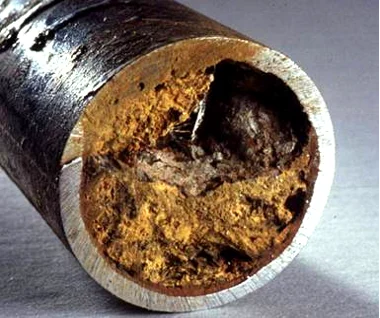
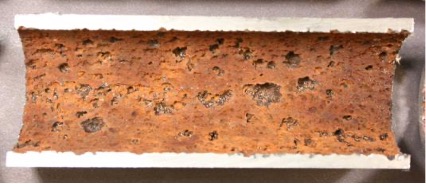
The fundamental reaction of iron with dissolved oxygen (D.O.) is an electrochemical process familiar to anyone who has observed outdoor infrastructure rusting over time. In closed industrial water networks, however, oxygen attack induces localized pitting that can rapidly generate through-wall penetrations in pipes, tubes, and pressure vessels.
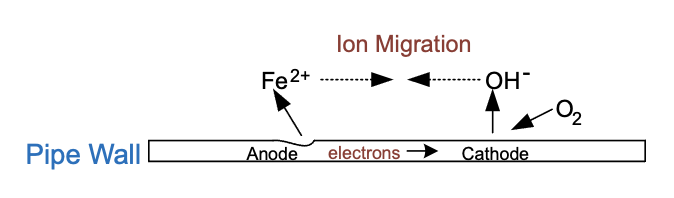
Anodic Reaction:    Fe → Fe²⁺ + 2e⁻
Cathodic Reaction:  ½O₂ + H₂O + 2e⁻ → 2OH⁻
Net Result:         Fe²⁺ + 2OH⁻ → Fe(OH)₂ (Ferrous Hydroxide)
Subsequent Oxidation: 4Fe(OH)₂ + O₂ + xH₂O → 2Fe₂O₃·xH₂O (Rust)
In operational water networks, this rust frequently accumulates at active corrosion sites, forming hard, dome-like structures known as tubercles. These tubercles severely restrict fluid flow and create oxygen concentration cells underneath the deposits, which exponentially accelerate localized corrosion rates until catastrophic wall failure occurs.
Oxygen Corrosion Control in Boiler Feedwater Systems
Preventing dissolved oxygen attack requires a multi-layered defense strategy. The primary, most direct approach is to completely eliminate air ingress into the steam and condensate network. Yet, given the miles of interconnected piping, thousands of mechanical joints, and the frequent use of atmospherically vented condensate storage tanks, completely preventing air infiltration is practically impossible. Consequently, industrial plants rely on a combination of mechanical deaeration and chemical conditioning.

Mechanical Deaeration
The cornerstone of any industrial boiler feedwater protection program is the mechanical deaerator. Makeup water and return condensate enter near the top of the deaerating compartment, where a series of distribution headers and spray nozzles atomize the water, spraying it counter-currently against high-velocity steam injected from below. Many deaerator designs incorporate internal trays to maximize gas-liquid contact time and thermal transfer.
Typically mounted high above the boiler feed pumps to provide adequate net positive suction head (NPSH) and prevent pump cavitation, a properly functioning deaerator raises the water temperature to within a few degrees of saturation. This process reliably reduces dissolved oxygen concentrations down to a target threshold of 7 parts per billion (ppb) in the storage tank.

Chemical Oxygen Scavengers and Reducing Agents
Because mechanical deaeration alone cannot achieve absolute zero oxygen, supplemental chemical reducing agents—commonly referred to as oxygen scavengers—are continuously fed into the feedwater to mop up residual D.O. and passivate exposed metal surfaces. Common compounds include:
- Catalyzed Sodium Sulfide ($textNa_2textSO_3$): Inexpensive and non-toxic, but adds total dissolved solids (TDS) to boiler water and decomposes at pressures above 600 psi into corrosive sulfur dioxide ($textSO_2$) and hydrogen sulfide ($textH_2textS$).
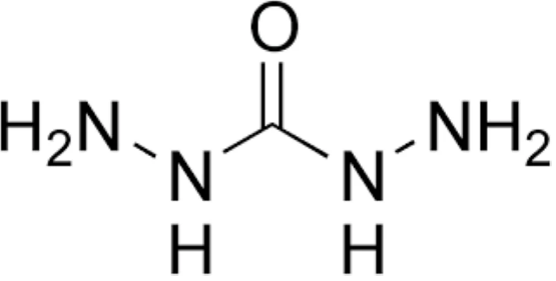
- Carbohydrazide $[(textNH_2textNH)_2textCO]$: Developed as a safe, non-carcinogenic replacement for hydrazine ($textN_2textH_4$). It is a volatile compound that safely breaks down into nitrogen and ammonia with rising feedwater temperatures.
- DEHA [Diethylhydroxylamine, $(textC_2textH_5)_2textNOH$]: Provides effective oxygen scavenging while simultaneously contributing to the passivation of carbon steel surfaces.
- Erythorbate: Structurally nearly identical to Vitamin C (ascorbic acid), this compound is utilized extensively in food and beverage processing plants where traditional chemical additives are strictly prohibited.
pH Conditioning via Alkalizing Amines
Alongside oxygen scavenging, maintaining feedwater pH in a moderately alkaline range (typically upper-8 to mid-10, adjusted for specific metallurgy and operating pressures) is vital for preventing general corrosion. Alkalizing (neutralizing) amines—small-chain organic molecules containing ammonia functional groups—are standard for this application. Selecting the appropriate amine requires evaluating parameters such as thermal stability, basicity, and distribution ratio, ensuring that both the liquid water and high-pressure steam phases receive adequate chemical protection without risking thermal decomposition in superheaters or contaminating consumer-bound steam.
The Wild Card: Carbonic Acid and Condensate Return Networks
While boiler feedwater systems benefit from rigorous mechanical and chemical oversight, industrial plants often operate extensive miles of carbon steel condensate return piping that remain vulnerable to a secondary threat: carbonic acid corrosion.
Carbon dioxide ($textCO_2$) entering the system via air leakage or chemical carryover from boiler water carbonates dissolves readily into returning condensate, forming weak carbonic acid ($textH_2textCO_3$). Although carbonic acid is a weak acid, continuous exposure leads to characteristic metal grooving and thinning along pipe bottoms and bends. Furthermore, carbonic acid aggressively accelerates the destructive impact of any residual dissolved oxygen present in the condensate.

Neutralizing Amines and Film-Forming Products
To combat carbonic acid, plants inject neutralizing amines directly into the steam headers to neutralize acidity and elevate the condensate pH. However, an industry-wide renaissance is underway regarding the deployment of film-forming products (FFPs).
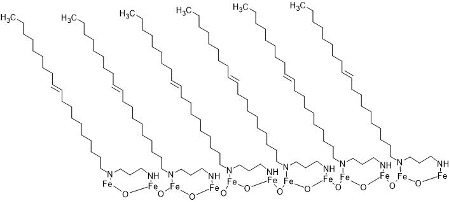
Modern film-forming amines feature dual nitrogen-active functional groups that chemisorb directly onto carbon steel surfaces. While the polar head anchors firmly to the metal, the hydrophobic hydrocarbon tail extends outward, creating a microscopic, water-repellent barrier that isolates the pipe wall from corrosive agents like dissolved oxygen and carbon dioxide. Successful implementation requires precise chemical feed monitoring; otherwise, under- or over-dosing can lead to localized fouling or incomplete surface coverage.
Metallurgical Interactions and Flow-Accelerated Corrosion
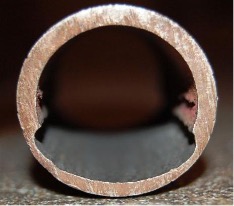
Industrial steam and condensate networks frequently feature mixed metallurgies, with copper-alloy tubes commonly utilized in heat exchangers and condensers. Dissolved oxygen, particularly when interacting with residual ammonia concentrations, can trigger severe stress corrosion cracking and general metal loss in copper components.
To track system health proactively, plant engineering teams increasingly install online corrosion product samplers on condensate and feedwater lines. Continuous tracking of dissolved iron and copper concentrations allows operators to evaluate the real-time efficacy of chemical treatment regimens and make immediate adjustments.
Unchecked chemical imbalances or poor thermal design can ultimately lead to more insidious phenomena, such as flow-accelerated corrosion (FAC)—a destructive mechanism where liquid flow continuously dissolves the protective oxide layer on carbon steel, particularly downstream of high-turbulence regions like elbows and reducer fittings. FAC has historically presented severe engineering challenges across both traditional and nuclear power generation industries, demanding rigorous water chemistry controls.
Conclusion and Industry Best Practices
Dissolved oxygen and carbonic acid corrosion represent constant threats to the operational integrity of industrial boiler feedwater and condensate systems. While mechanical deaeration, targeted oxygen scavengers, alkalizing amines, and modern film-forming technologies provide robust defense lines, their success hinges on meticulous monitoring, precise chemical dosing, and adherence to established engineering standards.

As emphasized by technical authorities such as the Association for Materials Protection and Performance (AMPP, formerly NACE), plant personnel must continually consult with water treatment specialists to align chemical programs with the specific metallurgy, operational pressures, and duty cycles of their facilities.
In the next installment of this series, we will examine the severe corrosion mechanisms that occur during equipment shutdowns, idle standby periods, and wet/dry layup scenarios.