

Optimizing Industrial Material Handling: An In-Depth Look at EXAIR’s Compressed-Air-Powered Line Vac Conveyors

By Puja Mitra | Adapted for Industrial Technology Review
Main Facts: The Engineering and Architecture of EXAIR’s Line Vac Conveyors
In modern manufacturing, processing, and packaging environments, the efficient and safe transport of materials is a critical operational bottleneck. Traditional mechanical conveyors often rely on complex networks of moving components—such as motorized belts, rotating screws, augers, and bucket elevators—which inherently introduce risks of jamming, high maintenance overhead, and elevated energy consumption.
Enter EXAIR’s Line Vac series: a family of compressed-air-powered, in-line material-conveying systems designed to integrate directly into standard industrial hoses, tubes, and pipes. By harnessing the principles of fluid dynamics and pneumatic amplification, these compact units transform standard plant compressed air into high-performance material-moving power.
At the core of the standard Line Vac design is an absence of moving parts. Instead of mechanical drive systems, the unit utilizes strategically positioned, directed nozzles to channel compressed air through the device. This action generates a powerful, continuous vacuum at the intake, smoothly drawing raw materials, parts, waste, or bulk supplies into the conveying line. Material flow rates are easily controlled and fine-tuned simply by regulating the compressed-air supply pressure via a standard regulator.
Furthermore, EXAIR engineers have designed the product line with large internal throat diameters. This geometric advantage directly supports higher volumetric material flow rates, preventing bottlenecks at the intake stage. Because there are no internal flappers, impellers, or motors to obstruct the path, items pass cleanly through the core of the conveyor. This drastically reduces mechanical wear and tear, lowers maintenance intervals, and mitigates unexpected production downtime across factory floors.
Chronology: The Evolution of Industrial Pneumatic Conveying
To fully appreciate the significance of EXAIR’s contemporary Line Vac portfolio, it is helpful to examine the chronological progression of material handling technologies within industrial automation.
- Early Industrial Era (Late 19th to Mid-20th Century): Industrial material transport was heavily reliant on mechanical systems. Conveyor belts, bucket systems, and screw augers dominated factories. While effective for moving high tonnages over short distances, these systems were notoriously rigid, difficult to reconfigure, and hazardous due to exposed moving parts.
- The Advent of Pneumatics (Mid-20th Century): The introduction of positive-pressure and negative-pressure vacuum systems revolutionized powder and bulk handling. However, early pneumatic blowers and industrial vacuum pumps were bulky, loud, and required dedicated, high-horsepower electrical motors, limiting their placement flexibility.
- The Rise of Compressed-Air Amplification (Late 20th Century): As manufacturing plants standardized around centralized compressed-air networks, engineers sought ways to leverage this ubiquitous utility. The development of annular air amplifiers and basic venturi-based vacuum generators laid the groundwork for point-of-use material conveyance.
- EXAIR’s Line Vac Innovation: EXAIR entered the market by refining the venturi principle into robust, modular, industrial-grade in-line conveyors. Over successive product cycles, the company expanded the lineup from light-duty general applications to specialized iterations capable of handling heavy abrasives, sharp edges, and delicate sanitary environments.
- Current Iteration (Present Day): The modern Line Vac portfolio—encompassing Standard, Heavy Duty, Ultra Duty, Threaded, Sanitary Flange, and Light Duty models—represents a comprehensive toolbox for plant engineers looking to eliminate mechanical conveyors in favor of clean, easily controllable pneumatic transport.
Supporting Data: Specifications, Models, and Promotional Initiatives
The versatility of the EXAIR Line Vac family lies in its extensive range of specialized models, each engineered to address specific industrial challenges, material densities, and environmental constraints.
1. Standard Line Vac
- Best Suited For: General-purpose material transport, scrap removal, and fluid/part transfer.
- Key Feature: Compact footprint with large throat diameters, easily adaptable to standard hoses and pipes.
2. Heavy Duty Line Vac
- Best Suited For: Bulky, heavy, or abrasive materials that typically degrade standard aluminum or plastic conduits quickly.
- Key Feature: Constructed from hardened alloys capable of withstanding high-impact wear and engineered for extended-distance material transport.
3. Ultra Duty Line Vac
- Best Suited For: Extreme applications involving highly abrasive media such as industrial sand, specialized blasting media, and dense powders.
- Key Feature: Integrates robust hardened-alloy architecture with a dedicated ceramic insert, making it exceptionally resilient against aggressive, high-velocity particulate flow across both vertical and horizontal trajectories.
4. Alternative Specialized Models
- Threaded Line Vac: Designed for secure, leak-proof integration into existing rigid threaded pipe networks.
- Sanitary Flange Line Vac: Tailored for food, pharmaceutical, and chemical processing facilities where quick disassembly, hygiene, and contamination prevention are paramount.
- Light Duty Line Vac: An economical solution for lighter material loads, scrap trim removal, and less demanding factory environments.
Current Promotional Offering
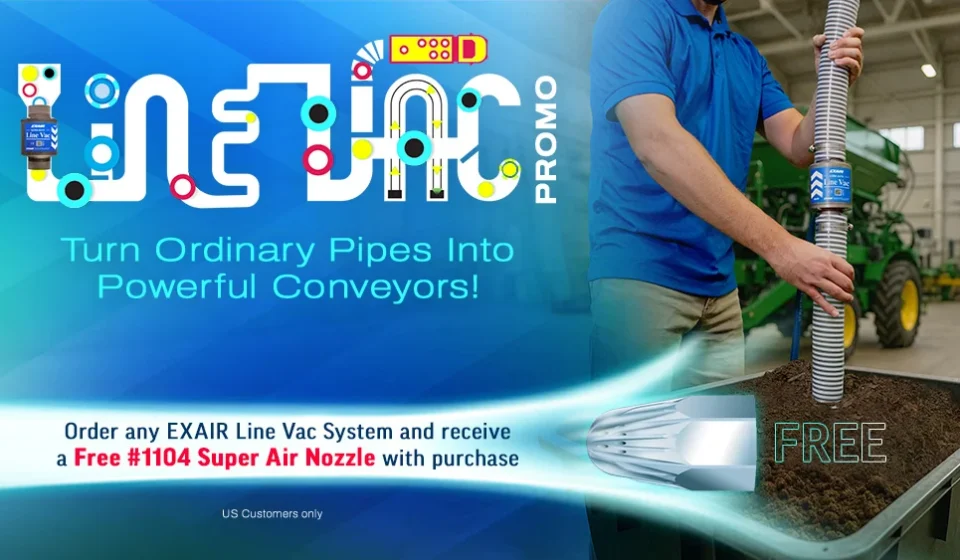
To incentivize factory optimization, EXAIR is currently running a limited-time promotional campaign. With the purchase of any Line Vac model, customers receive a complimentary Model 1104 3/8 FNPT Large Super Air Nozzle. This addition provides engineers with an extra tool for targeted blow-off, cooling, or drying applications within their facilities.
Official Responses and Industry Perspectives
Industrial engineering experts and operations managers have increasingly advocated for the replacement of traditional belt and screw conveyors with pneumatic alternatives, particularly in applications involving hazardous waste or fine particulates.

According to application engineers within EXAIR’s technical support division, the primary driver for transitioning to a Line Vac system is safety and simplicity. In official product briefings, representatives emphasize that the total cost of ownership for a mechanical conveyor—factoring in replacement belts, gearboxes, alignment calibration, and safety guarding—often eclipses the energy costs associated with running a compressed-air-driven vacuum system.
"When you remove moving parts from the equation, you fundamentally change the risk profile of the equipment," notes an EXAIR technical advisor. "There are no pinch points, no motor burnouts to worry about, and no complex synchronizations required. Plant personnel can simply adjust a regulator to increase or decrease the feed rate instantaneously, matching the exact pace of downstream processing machinery."
Furthermore, processing industry stakeholders highlight the hygienic advantages of pneumatic conveyance. In environments where dust containment or sterility is mandatory, enclosed hoses powered by sanitary flange Line Vacs prevent the accumulation of fugitive dust and eliminate the grease and lubricant contamination risks commonly associated with traditional roller bearings and electric drives.
Implications: Operational Efficiency, Maintenance, and Future Outlook
The broader implementation of compressed-air-operated conveyors like the EXAIR Line Vac carries significant implications for modern manufacturing plants striving toward Lean manufacturing principles, reduced downtime, and enhanced workplace safety.
Impact on Maintenance and Downtime
In heavy manufacturing and recycling facilities, conveyor jams are a frequent source of frustration. Clearing a jammed mechanical belt or auger often requires lockout/tagout (LOTO) procedures, partial disassembly of machinery, and hours of lost production. Because Line Vac units feature a smooth, open-throat design with no internal obstructions, the likelihood of clogging is dramatically reduced. If a blockage does occur due to oversized debris, clearing the line is typically faster and safer due to the modular nature of the hose connections.
Energy Management and Plant Infrastructure
Critics of compressed-air systems often point to the inherent energy costs of compressed air compared to direct electric motor drives. However, EXAIR addresses this by designing high-efficiency amplification nozzles that maximize the vacuum-to-air-consumption ratio. For intermittent operations—such as scrap trim removal, cycling parts feeding, or batch transfer of powders—the ability to instantly turn the system on and off via a solenoid valve ensures that energy is consumed only when active material transfer is occurring. This contrasts sharply with electric motors that may idle continuously, drawing phantom power.
Versatility in Facility Retrofitting
Factory floors are notoriously space-constrained. Retrofitting a traditional mechanical conveyor system often requires structural modifications, custom mounting brackets, and significant floor-space allocation. In contrast, the compact, lightweight nature of the Line Vac allows it to be suspended directly inline, supported entirely by the rigid or flexible piping it connects to. This flexibility empowers plant floor managers to reconfigure assembly lines, waste evacuation routes, and material supply chains over a weekend rather than during a scheduled plant shutdown.
Conclusion
As industries continue to prioritize operational agility, minimized maintenance footprints, and worker safety, auxiliary equipment like EXAIR’s Line Vac conveyors bridges the gap between raw plant utilities and complex material handling demands. By eliminating moving parts, expanding material compatibility through specialized alloys and ceramics, and offering scalable flow rates, these pneumatic devices represent a streamlined paradigm shift in how industrial facilities move goods from point A to point B.