





Beyond Compliance: Why Most ISO Corrective Actions Fail—and How Data-Driven Root Cause Analysis Can Transform Your Business

EXECUTIVE SUMMARY: Across industries and continents, ISO Management System Standards (MSS) are heralded as the gold standard for operational excellence. Yet, ask any seasoned auditor or quality director which process delivers the most untapped business value, and the answer is almost universally unanimous: the Nonconformity and Corrective Action (NC-CAR) process. When executed properly, NC-CAR acts as an organizational mirror, forcing companies to halt, examine operational missteps, and institutionalize profound learnings. However, for most enterprises, this mechanism has degraded into a superficial compliance exercise—a paperwork graveyard where recurring problems are routinely resurrected every six months.
Main Facts: The Illusion of Corrective Action
To the uninitiated, the lifecycle of a nonconformity appears straightforward: a deviation is detected, an investigation is launched, a corrective action is implemented, and the record is formally closed.
Yet, quality professionals recognize a much darker, recurring reality. Six months after a corrective action is signed off, the exact same failure reappears on the shop floor, in the customer service queue, or within the software deployment pipeline. When leadership demands an explanation, the investigation concludes with tired, evasive tropes:
- "Outdated procedure."
- "Deficient training."
- Or the ultimate corporate scapegoat: "Human error."
If corrective actions are explicitly designed to prevent recurrence, why do systemic failures stubbornly persist?
According to extensive operational auditing across global manufacturing, aerospace, and service sectors, organizations do not suffer from a lack of sophisticated Root Cause Analysis (RCA) tools. They do not need another complex methodology, a new software module, or a more convoluted fishbone diagram. Instead, organizations face an acute investigator competence crisis and a data management failure.
Without rectifying these two foundational flaws, ISO management systems will remain expensive, paper-shuffling exercises rather than engines of continuous improvement.
Chronology: The Anatomy of a Loophole
To understand how organizations routinely fail their own quality management systems, one must trace the typical lifecycle of an internal nonconformity investigation—a timeline characterized by good intentions followed by rapid operational decay.
Phase 1: Detection and Panic (Days 1–3)
A defect is identified. Whether it is a faulty part on an assembly test stand or a critical software bug, panic ensues. The primary objective for operational teams is rarely deep introspection; it is containment. Teams want to clear the immediate backlog, satisfy the customer, and ensure the auditor doesn’t write up a major nonconformance during the upcoming surveillance audit.
Phase 2: The Superficial Investigation (Days 4–7)
Tasked with finding the root cause, a frontline supervisor or department manager opens the NC-CAR report. Because they have never received formal training in failure analysis, they instinctively default to the path of least resistance. They look at what happened, attribute it to human carelessness or an ambiguous instruction manual, and draft a quick preventative measure: "Retrained employee on WI-106" or "Updated paragraph 4.2 of the procedure."
Phase 3: Closure and Amnesia (Months 1–6)
The quality assurance department reviews the paperwork, checks the compliance box, and closes the ticket. For a brief window, leadership breathes a sigh of relief. The system looks healthy on paper.
Phase 4: The Inevitable Recurrence (Months 6–12)
Because the true systemic flaw—perhaps an uncalibrated piece of tooling or an ambiguous engineering specification—was never identified, the exact same failure manifests again. The organization has learned nothing. It has simply documented its own amnesia.

Supporting Data: The Two Core Failures of Modern Quality Management
A rigorous breakdown of audit findings reveals that the structural failure of NC-CAR processes can be traced directly to two systemic bottlenecks.
Problem #1: Expecting Untrained Personnel to Perform High-Level Forensic Analysis
Most ISO Management System Standards—such as ISO 9001, ISO 14001, or ISO 45001—mandate that organizations ensure the competence of their personnel. Companies eagerly invest in training internal auditors, safety inspectors, and machine operators. Yet, when it comes to investigating the organization’s most significant operational failures, companies routinely hand the task to employees who have received zero formal training in Root Cause Analysis.
Root cause analysis is not merely asking the question "Why?" five times in succession. True forensic investigation requires:
- The intellectual discipline to distinguish transient symptoms from systemic causes.
- A deep understanding of how complex, cross-functional processes interact.
- The courage to challenge institutional assumptions and sacred cows.
- A psychological framework that resists the lazy temptation to blame individual people instead of flawed processes.
When untrained investigators are handed complex problems, they inevitably stop at surface-level conclusions. They confuse what happened with why it happened. Without competent investigators steering the ship, even the most advanced problem-solving methodologies will yield garbage results.
Problem #2: Documenting Root Causes as Narratives Instead of Data
Consider a typical scenario in a manufacturing plant. The quality manager is asked a straightforward question during an executive review: "What were our five most frequent root causes over the past four quarters?"
In a shocking number of enterprises, the quality manager cannot answer that question within five minutes—or even five days.
Consider this real-world root cause narrative pulled from an ISO 9001-compliant enterprise:
"While examining the failure on assembly test stand #3, it was determined that when the assembler inserted the bearing, he used the AS-17015 press to secure it. The operator stated the bearing appeared inserted correctly, and he confirmed he followed instruction WI-106, Rev. 5 to the letter."
Can anyone identify the root cause from this paragraph? Absolutely not. It could be a failing press, a dimensional defect in the bearing batch, ergonomic stress on the operator, a poorly written work instruction, or fluctuating voltage in the facility.
The organization has successfully accumulated hundreds of such anecdotal "stories" inside its quality database, but it has generated zero usable management intelligence.
Official Perspectives and Industry Insights
Quality management experts and standards bodies have long debated the efficacy of corrective action frameworks. While international standards provide the structural scaffolding, implementation is entirely dictated by corporate culture.

According to leading quality assurance strategists, the shift from compliance to performance requires moving away from qualitative storytelling and toward structured taxonomies.
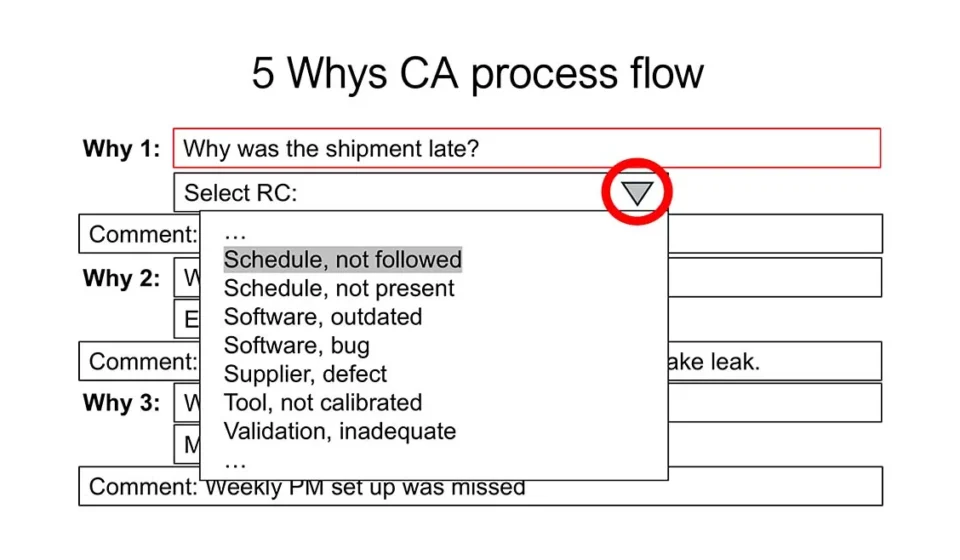
- The Shift to Categorization: Industry leaders are increasingly enforcing mandatory categorization rules within their Corrective Action Software (CAS). While investigators are still encouraged to write detailed descriptions of the event’s operational context, they are strictly prohibited from submitting free-text narratives as "root causes."
- Standardized Taxonomies: Instead, root causes must be selected from a standardized, hierarchical drop-down menu. Categories typically include:
- Design & Engineering: Specification ambiguity, tolerance stack-up, material selection error.
- Equipment & Tooling: Calibration drift, preventative maintenance failure, tooling wear.
- Human Factors: Cognitive overload, ergonomic mismatch, lack of operational feedback (explicitly distinct from negligent "human error").
- Methodology: Conflicting procedures, obsolete work instructions, inadequate change management.
By enforcing these standardized categories at the point of data entry, organizations transform unstructured text into immediate business intelligence. Leadership can instantly query the system and generate automated Pareto charts answering critical questions:
- Which specific equipment assets generate the highest volume of recurring electrical failures?
- Are our design-related nonconformities concentrated in a single engineering product line?
- Is our training failure rate decreasing following our recent onboarding overhaul?
Instead of wading through hundreds of dense, conflicting investigation reports, executive leadership can identify macro-patterns in minutes.
Broader Implications: Turning Compliance Records into Organizational Knowledge
The implications of overhauling the NC-CAR process extend far beyond passing the next registrar audit. They strike at the very heart of corporate agility and profitability.
1. From Cost Center to Strategic Asset
In many companies, the quality department is viewed as an administrative overhead cost—a necessary evil required to keep customers happy and regulators at bay. By transforming corrective actions into data-driven analytical engines, quality teams transition into strategic partners. They provide executive management with predictive insights regarding operational risk, supplier reliability, and design vulnerabilities.
2. Cultural Transformation and Psychological Safety
When organizations abandon the lazy catch-all of "human error," they inadvertently foster a culture of psychological safety. Employees stop fearing nonconformities and instead view them as diagnostic signals. When a frontline worker knows that an investigation will examine the system—the tooling, the environment, the process design—rather than hunting for someone to blame, transparency replaces defensiveness.
3. Sustainable Continuous Improvement
Ultimately, the core philosophy of ISO management systems is captured by the Plan-Do-Check-Act (PDCA) cycle. The "Act" phase—corrective action—is where lasting value is realized.
To unlock this value, organizations must stop searching for silver-bullet problem-solving tools and address the foundational blocks:
- Invest in Investigator Competence: Provide formal, rigorous training in root cause analysis to the individuals tasked with solving your organization’s greatest failures.
- Standardize Your Data: Eliminate narrative storytelling in root cause fields and enforce structured, categorical data entry to unlock true business intelligence.
When companies make this pivot, corrective actions cease to be static, lifeless compliance records. They evolve into dynamic, living repositories of organizational knowledge—ensuring that when a mistake happens once, it never gets the chance to happen twice.