


Beyond the Singlet: Unlocking the Quantum Mechanics of Proton-Shuttle Triplet Energy Transfer

In the intricate dance of subatomic particles, the coordinated motion of protons and electrons acts as the heartbeat of life. From the complex machinery of cellular respiration to the industrial efficiency of nitrogen fixation, these coupled movements—collectively known as Proton-Coupled Electron Transfer (PCET)—are the primary drivers of energy conversion in nature. Yet, as science peers deeper into the quantum landscape, it has discovered that the story of energy transfer is far more nuanced than previously understood.
A team of researchers led by Professor Kaifeng Wu at the Dalian Institute of Chemical Physics (DICP) of the Chinese Academy of Sciences has recently unveiled a breakthrough discovery: a novel mechanism termed "Proton Shuttle-Assisted Triplet Energy Transfer" (PS-TET). Published in the journal Nature Materials, this research transcends traditional understandings of energy movement, revealing how the subtle, rapid motion of a proton can catalyze the transfer of spin-triplet energy, opening a new frontier in materials science and quantum engineering.
The Evolution of Energy Transfer: From Singlet to Triplet
To understand the significance of the PS-TET discovery, one must first recognize the historical context of energy transfer studies. For decades, the scientific community has focused on singlet energy transfer—the migration of energy between molecules where the electron spins remain paired. Recently, the discovery of proton-coupled singlet energy transfer (PCEnT) expanded this field, showing that protons could act as "mediators" to facilitate the movement of energy.
However, triplet energy transfer (TET) represents a more complex challenge. In a triplet state, electrons are unpaired, making the energy migration process fundamentally different from its singlet counterpart. While TET is a cornerstone of both biological processes and synthetic molecular systems, controlling it has historically proven difficult. The ability to dictate where and when energy flows in a triplet state is the "holy grail" of photochemistry, particularly for the development of advanced solar cells, organic lasers, and high-efficiency catalysts.
By investigating the link between proton movement and triplet energy, Professor Wu’s team has effectively bridged a gap in molecular physics, demonstrating that the proton does not merely observe the energy transfer—it acts as an active shuttle, significantly enhancing the kinetics and efficiency of the entire process.
Chronology of a Discovery: Mapping the PS-TET Mechanism
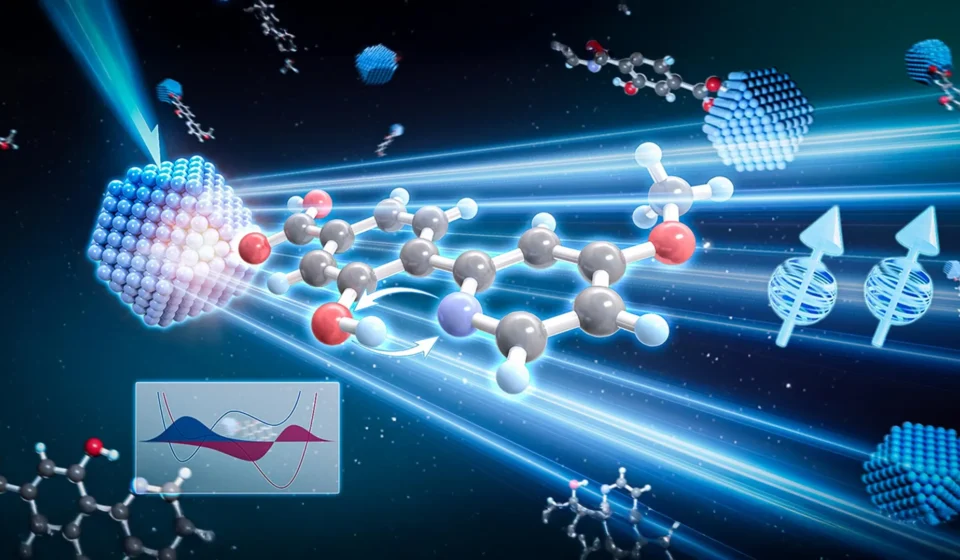
The investigation, conducted by the team at DICP, utilized sophisticated spectroscopic techniques to track energy as it migrated from ZnSe-based colloidal quantum dots (QDs) to specifically engineered phenol-pyridine dyadic acceptors. The experimental journey can be broken down into a precise, multi-step sequence:
1. Excitation and Initiation
The process begins when the ZnSe quantum dots absorb incident light, pushing them into an excited state. This state is highly unstable and seeks to release its excess energy.
2. The Simultaneous Exchange
As the QD reaches its excited state, a hole—a positive charge carrier—transfers from the quantum dot to the phenol molecule. Concurrently, a proton performs a "leap," shifting from the phenol to the pyridine molecule. This synchronized exchange is the birth of the shuttle mechanism.
3. The Return and Energy Release
In the final act of this molecular play, an electron transfers from the ZnSe quantum dot to the phenoxyl radical. Simultaneously, the proton "shuttles" back from the pyridinium to its original location on the phenol. It is this linked, dual-step movement that enables the efficient, long-range transfer of spin-triplet energy from the quantum dot to the phenol-pyridine dyad.
The most striking observation was that the proton ends exactly where it began. It acts as a transient catalyst, lowering the energy barriers that would otherwise hinder the transfer. When researchers compared this system to a methylated analog lacking the proton-shuttle component, the difference was stark: the PS-TET mechanism operated with significantly higher velocity and efficiency.
Supporting Data: Quantum Tunneling at Room Temperature
One of the most profound findings in the study is the role of quantum mechanics in facilitating this transfer. Conventional chemical processes are typically driven by heat; as temperature increases, the rate of reaction usually accelerates. However, the researchers observed that the rate of PS-TET remained largely unaffected by temperature variations.
This temperature independence is a classic hallmark of quantum tunneling—a phenomenon where a particle (in this case, a proton) traverses an energy barrier rather than climbing over it. Using advanced calculations of proton vibrational wavefunction overlap integrals, the team confirmed that the system favors excited-state relaxation pathways that are not dictated by thermal energy, but by the probability of the proton appearing on the other side of the potential barrier.
This confirms that even at room temperature, complex molecular systems can be engineered to exploit quantum effects. The proton’s wave-like behavior allows it to "teleport" through energy constraints, facilitating the triplet energy transfer with a precision that classical mechanics cannot explain.
Official Perspectives: Implications for Modern Technology
The implications of PS-TET are broad, touching on everything from sustainable energy to high-end electronics. Professor Kaifeng Wu emphasized the potential for this mechanism to reshape our approach to molecular technology:
"The discovery of the PS-TET mechanism has profound implications for many modern molecular technologies involving the spin-triplet excited states of molecules," Wu stated. He noted that the ability to control this mechanism offers a "dual-use" potential for researchers.
Enhancing Photoredox and Catalysis
In the realm of environmental chemistry and synthetic catalysis, triplet states are often the desired goal. By utilizing a proton shuttle, scientists can effectively "pump" energy into specific states, increasing the efficiency of photoredox reactions. This could lead to more effective water splitting, CO2 reduction, or the synthesis of complex pharmaceuticals, where precise energy control is required to break and form chemical bonds.
Suppressing Unwanted States in Optoelectronics
Conversely, in the world of organic optoelectronics—such as OLED screens, solar cells, and organic lasers—the formation of triplet states can be detrimental. Triplets can act as energy sinks, leading to "triplet-triplet annihilation" or unwanted quenching, which reduces the lifespan and efficiency of the device. The PS-TET study suggests that by designing materials that deliberately omit the proton shuttle, engineers can effectively suppress triplet formation, thereby extending the longevity and brightness of next-generation electronic displays.
A Future Defined by Quantum Control
The work of Professor Wu and his colleagues represents a shift in how we conceive of molecular design. By treating the proton not just as a structural element, but as a dynamic component of an energy-transfer circuit, researchers have opened the door to a "modular" approach to chemistry.
In the future, we may see the development of "smart" materials where energy flow is governed by the presence or absence of a proton-shuttle group. This could lead to self-regulating materials that adjust their energy states in response to their environment or external stimuli. Furthermore, the ability to utilize quantum tunneling at room temperature suggests that the barrier between "quantum computing" and "classical chemistry" is becoming increasingly porous.
As the scientific community continues to digest these findings, the focus will likely shift to synthesizing more robust proton-shuttle systems and exploring how these mechanisms perform in increasingly complex, real-world environments. The PS-TET discovery serves as a reminder that the most significant technological breakthroughs often come from observing the smallest movements in nature—and learning how to choreograph them to our advantage.
In summary, the research from the Dalian Institute of Chemical Physics provides a rigorous framework for understanding how we might harness the power of spin-triplet states. By mastering the quantum shuttle of the proton, humanity gains a new tool in its effort to design the energy-efficient technologies of tomorrow.