






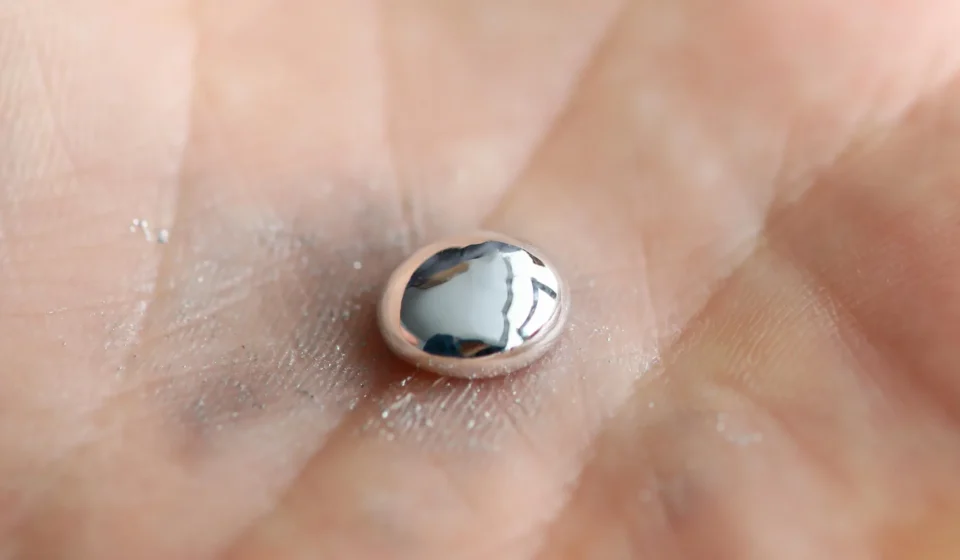

Nearly 150 years after it was first slotted into the periodic table, gallium—a metal famously capable of liquefying in the palm of a human hand—has revealed a profound new secret. Researchers at the University of Auckland have overturned decades of established scientific consensus, uncovering previously unknown details about the metal’s atomic architecture that challenge our fundamental understanding of how liquids behave.
The Anomaly of the Elements: A Brief Chronology of Gallium
The story of gallium is one of the most compelling narratives in the history of chemistry. Long before it was ever touched or measured, its existence was predicted. In 1871, the Russian chemist Dmitri Mendeleev, while constructing the first iteration of the periodic table, realized that several elements were missing. He left intentional gaps in his table, predicting the properties of the "unknown" elements that would eventually fill them. One such gap was for "eka-aluminum," which would later be identified as gallium.
In 1875, the French chemist Paul-Émile Lecoq de Boisbaudran finally isolated the element, naming it after "Gaul," the ancient Latin name for France, in a nod to his own heritage. Since its discovery, gallium has moved from a laboratory curiosity to a cornerstone of the modern world. It is extracted from bauxite and other ores, as it does not occur in a pure state in nature. Today, it is an industrial titan, indispensable in the manufacture of semiconductors, high-performance computing components, laser diodes, LEDs, and sophisticated telecommunications hardware.
Yet, despite its ubiquity, gallium has always been an oddity. Its remarkably low melting point—just 29.76°C (85.57°F)—is the stuff of classroom demonstrations, where a spoon made of the metal dissolves into a cup of hot tea. Furthermore, it shares a rare trait with water: it is one of the few substances that is less dense as a solid than as a liquid, causing the solid form to float in its own melt.
The Atomic Riddle: Breaking the Scientific Dogma
For decades, scientists believed they had a firm grasp on why gallium behaved this way. The prevailing theory centered on the metal’s unique atomic structure. Unlike most metals, gallium atoms naturally pair up into "dimers"—bonded couples—within the solid crystal lattice. Furthermore, these atoms engage in "covalent bonding," a type of electron-sharing more commonly associated with nonmetals like oxygen or carbon.
The long-held scientific assumption was that these covalent bonds were responsible for the metal’s strange structural properties, but that they were essentially "sacrificed" or destroyed the moment the metal transitioned into a liquid state.
However, a groundbreaking study published in Materials Horizons, titled "Resolving Decades of Debate: The Surprising Role of High-Temperature Covalency in the Structure of Liquid Gallium," has effectively dismantled this narrative. Led by Dr. Steph Lambie—then a PhD candidate at the University of Auckland and the MacDiarmid Institute—alongside Professor Nicola Gaston and Dr. Krista Steenbergen of Victoria University of Wellington, the team utilized advanced data analysis to revisit decades of published measurements.
By synthesizing data collected across a vast temperature gradient, the researchers discovered something startling: while the covalent bonds do indeed vanish at the melting point, they unexpectedly reappear when the liquid is heated to higher temperatures.
"Thirty years of literature on the structure of liquid gallium has had a fundamental assumption that is evidently not true," says Professor Nicola Gaston. The team proposes that the breaking of these bonds at the melting point triggers an increase in entropy—the measure of disorder in a system—which effectively frees the atoms and facilitates the melting process. This realization provides a much-needed explanation for why gallium’s melting point is so exceptionally low compared to other metals.
Supporting Data and the Mechanics of "Self-Assembly"
The implications of this research extend far beyond mere theoretical physics. Understanding the temperature-dependent phase changes of gallium is critical for the burgeoning field of nanotechnology. Because gallium can act as a solvent for other metals, it is a potent tool for creating "self-assembling structures."
In these processes, researchers use liquid gallium to act as a template or catalyst, allowing disordered materials to spontaneously organize into highly ordered, complex geometric forms. In a previous project, the research team demonstrated this capability by using liquid gallium to crystallize zinc into intricate, snowflake-like structures.
The ability to control these atomic transitions could lead to the development of novel materials with specialized electrical, thermal, or structural properties. By manipulating the "covalent memory" of the liquid metal, scientists may soon be able to print or "grow" microscopic electronic components with unprecedented precision.
Official Responses and the Broader Scientific Impact
The academic community has reacted to the findings with significant interest, as the research highlights a common pitfall in material science: the tendency for a "fundamental" assumption to persist in the literature long after the data has outgrown it.
Dr. Steph Lambie, who is now a postdoctoral researcher at the Max Planck Institute for Solid State Research in Germany, spent years painstakingly assembling the complete picture of gallium’s behavior. Her work underscores the importance of meta-analysis in fields where experimental data is gathered sporadically over decades. By comparing disparate measurements taken by different labs over the last thirty years, Lambie was able to spot the trend that others had missed.
The collaborative nature of the study, spanning the University of Auckland, Victoria University of Wellington, and the MacDiarmid Institute, serves as a model for interdisciplinary research. The researchers are now looking toward the future, exploring how these atomic behaviors might be leveraged in even more exotic environments.
Implications: From Martian Soil to Aerospace Engineering
The versatility of gallium continues to surprise researchers. Beyond its role in the electronics that power our modern lives, the metal is being evaluated for its potential in planetary science. Scientists at the University of Auckland’s School of Environment and the Te Ao Mārama – Centre for Fundamental Inquiry are currently investigating whether gallium can be used to identify signs of ancient life on Mars.
The hypothesis is that gallium, due to its unique chemical properties, may be capable of preserving the chemical "fingerprints" of past microbial life within rock formations. If successful, this would provide a new tool in the search for extraterrestrial biology, turning a common semiconductor material into a high-stakes tool for planetary exploration.
Furthermore, as industries push toward higher performance in aerospace and defense, the demand for materials that can withstand extreme conditions while remaining tunable at the atomic level is skyrocketing. Gallium’s ability to transition between these strange bonded states makes it an ideal candidate for next-generation cooling systems, thermal interface materials, and advanced sensors.
A Future Forged in the Lab
The discovery by the Auckland team is a reminder that the periodic table is not a static document, but a living map of the universe’s building blocks. Even elements that have been studied for 150 years can still hold surprises for those willing to challenge the status quo.
As the world continues to move toward a future defined by nanotechnology and quantum computing, our relationship with gallium is likely to deepen. We have moved far past the days when this metal was merely a party trick used to melt spoons; we are now entering an era where we can harness its internal, atomic "dancing" to build the technology of tomorrow.
The "strange metal" of the 19th century has become the "smart material" of the 21st, proving that in the world of science, there is always more to learn—even from the elements we thought we knew by heart.