




Decoding the Invisible Enemy: How Metal Stress and Atomic-Level Fractures Drive Industrial Equipment Failure

By Mike Sondalini, PWW EAM System Consultant
(With permission from the BIN95 Business Industrial Network)
Executive Summary: The Root Cause of Mechanical Breakdowns
In the high-stakes environment of modern industrial manufacturing, heavy processing, and energy generation, unexpected equipment failure is the ultimate adversary. Facility managers invest millions in predictive maintenance, vibration analysis, and lubrication programs, yet catastrophic mechanical breakdowns still occur. Often, the culprit is not poor maintenance or substandard operational handling, but a fundamental, invisible force acting at the molecular level: metal stress.
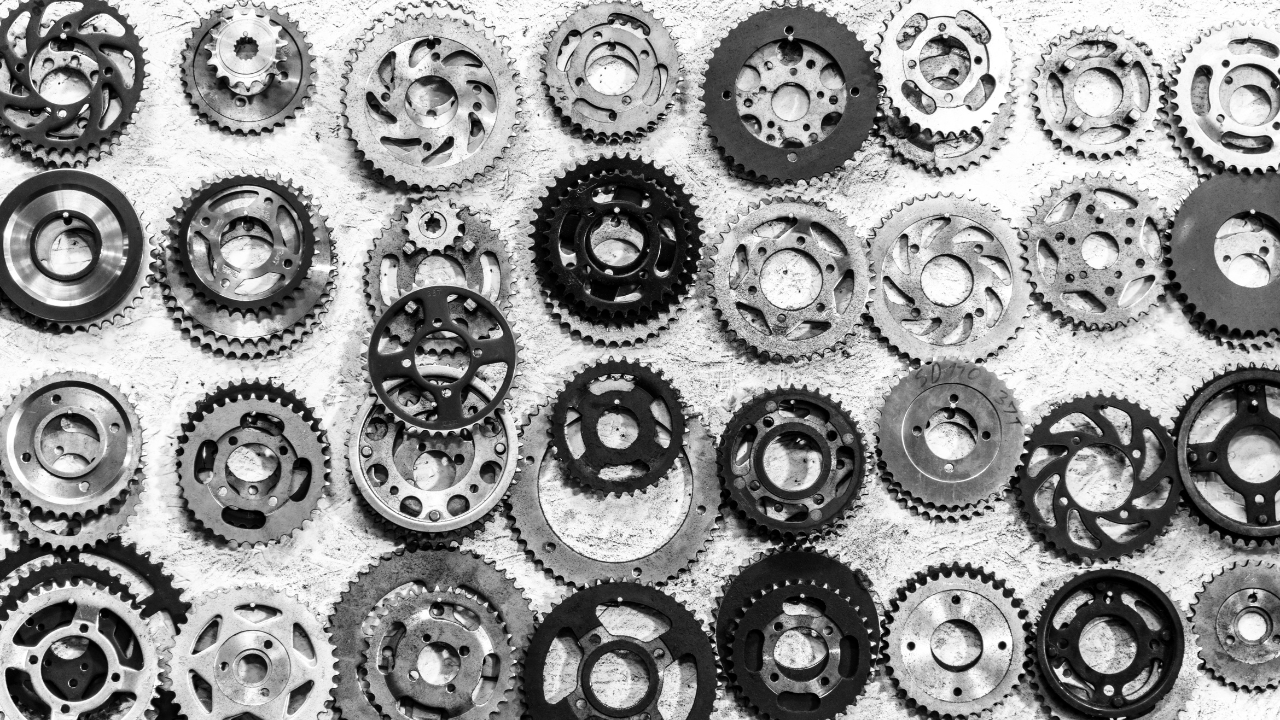
Every metallic component—from massive turbine shafts and high-pressure valves to simple gear sprockets—lives under a constant burden of physical forces. When these forces exceed the material’s structural capacity, or when cyclic loading induces progressive fatigue, disaster strikes.

To bridge the gap between microscopic material science and macro-level plant reliability, engineering and maintenance professionals must look past the surface of broken machinery. By understanding how stress, strain, atomic lattices, and crystal imperfections interact, organizations can move from reactive firefighting to true precision reliability.
Chronology of a Failure: From Applied Load to Microscopic Rupture
To fully grasp why machinery breaks down, one must trace the chronological sequence of structural degradation, which begins the moment a component is put into service.
1. The Initial Load Phase
When equipment is energized, operational loads are transferred through its physical framework. Forces push, pull, twist, and bend structural metals. Initially, the material responds elastically, absorbing the energy like a microscopic spring. If the load is removed, the metal springs back to its exact original dimensions with zero permanent damage.

2. The Strain and Yield Threshold
As operational demands increase—whether through thermal expansion, overloading, or high-speed vibration—the applied force surpasses the material’s elastic limit. The metal enters its plastic deformation zone. At this stage, the distortion becomes permanent. The atoms within the metallic lattice are permanently displaced relative to one another.
3. The Genesis of Microscopic Cracks
Under continued or repeated high stress, molecular-level discontinuities begin to coalesce. What starts as a localized shift in atomic bonds quickly turns into microscopic fissures. In cyclic loading scenarios (fatigue), these tiny cracks open and close with every revolution or thermal cycle, slowly propagating through the cross-section of the metal.
4. Catastrophic Parting
Once a microscopic crack grows beyond a critical threshold, the remaining intact cross-sectional area of the metal can no longer support the load. The stress concentrates heavily at the tip of the crack, causing it to tear through the remaining material in a fraction of a second. The result is a sudden, often catastrophic mechanical failure.
Supporting Data & Mechanical Principles: Stress, Strain, and Hooke’s Law
To manage and prevent these failures, maintenance teams must master the fundamental mathematical relationships governing material behavior under load.
Defining Stress and Strain
-
Stress ($sigma$): This is the internal resistance offered by a material to an externally applied force, measured as the force applied per unit of cross-sectional area perpendicular to the force.
$$textStress (sigma) = fractextForcetextArea$$
Units: Metric system = Newtons per square meter ($textN/m^2$ or Pascals); Imperial system = Pounds per square inch ($textpsi$). -
Strain ($epsilon$): This represents the proportional amount of deformation a material undergoes relative to its original, unloaded state when a force is applied.
$$textStrain (epsilon) = fractextChange in LengthtextOriginal Length$$
Note: Because strain is a ratio of length divided by length, it is a dimensionless quantity representing proportional size change.
Hooke’s Law and the Elastic Region
According to Hooke’s Law, within a material’s elastic region, stress and strain share a linear, proportional relationship. On a stress-strain graph, this appears as a straight diagonal line. The steeper the slope, the more rigid the metal.
Stress
  ^
  |          / (Plastic Region - Yielding)
  |         /
  |        /  (Elastic Region - Hooke's Law)
  |       /
  |      /
  |     /
  +------------------> Strain
If the load pushes the metal beyond its yield point, the material either yields gradually (common in ductile metals like low-carbon steel) or fails suddenly (common in brittle materials like cast iron). A primary objective of modern metallurgy is to engineer alloys with higher yield points, allowing manufacturers to use thinner, lighter, and more cost-effective metal components without sacrificing safety.
Deep Dive: What Happens at the Atomic Level?
Macroscopic mechanical properties are entirely dictated by microscopic atomic structures. Metals are crystalline solids composed of atoms arranged in repeating three-dimensional grids known as crystal lattices.

The Atomic Spring Model
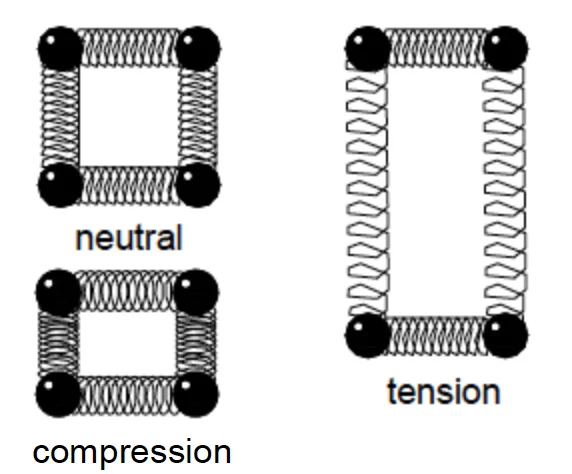
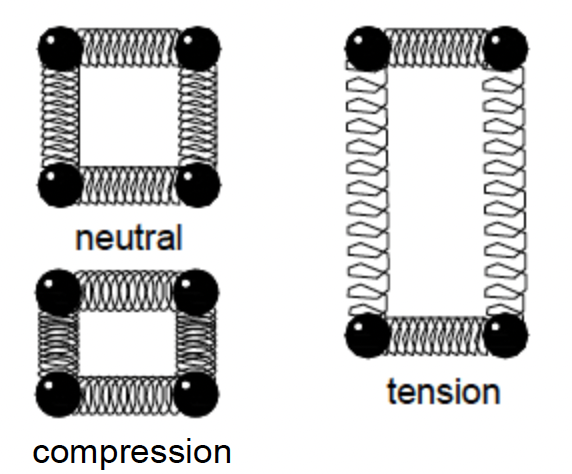
We can visualize atomic bonds as microscopic springs holding individual atoms in place. When a metal experiences compression, these atomic springs are squeezed together; when subjected to tension, they are pulled apart. The distance an atom shifts from its resting neighbor directly constitutes the localized strain.
The Paradox of Low Metal Strength
If metals are held together by immense electromagnetic atomic bonds, why do they fail at loads far below their theoretical maximum strength?
The answer lies in imperfections. Perfect crystal lattices are exceedingly rare. In real-world metals, atomic rows often terminate prematurely mid-crystal, creating gaps and irregularities in the lattice structure. These imperfections are known as dislocations.

When a mechanical load is applied, force is transmitted along the crystal’s atomic rows. Because dislocations concentrate the force onto a drastically smaller number of neighboring atomic bonds, those specific bonds bear a disproportionate share of the load.
As the external force increases, these overloaded atomic bonds break and instantly reform with the next adjacent atom. This causes the dislocation to "walk" or migrate through the crystal lattice. When millions of these dislocations accumulate at a crystal’s boundary, the entire crystal shears away from its neighbor, manifesting as macroscopic yielding and eventual cracking.
Industry Perspectives & Expert Insights
Industry leaders and reliability experts emphasize that understanding material stress is no longer just an academic exercise for metallurgists—it is a core competency for modern enterprise asset management (EAM).
"Managing metal stress is ultimately about protecting the integrity and service life of the equipment. Proper material selection, sound design, appropriate operating conditions, and maintenance practices that identify and address excessive loading can all help prevent small defects from becoming major failures." — Mike Sondalini, Senior EAM Consultant.
The Shift Toward Precision Reliability
Forward-thinking manufacturing and processing facilities are changing how they approach asset health. Rather than simply replacing components after they break, world-class reliability teams focus on:
- Eliminating Root Causes: Monitoring operating environments to ensure machinery never experiences loads or vibrations exceeding design thresholds.
- Optimizing Fit and Tolerance: Ensuring tight mechanical tolerances, proper shaft alignments, and correct clearances to prevent secondary stress concentrations.
- Advanced Condition Monitoring: Utilizing high-frequency wireless sensors and RPM-linked vibration analysis to detect early-stage mechanical stress before micro-cracks propagate.
Implications for Maintenance and Asset Management
The implications of material stress physics on industrial operations are profound. Failure to account for stress concentrations, improper load distribution, or cyclical fatigue leads directly to unplanned downtime, exorbitant repair costs, and severe safety hazards.
To counteract these risks, maintenance strategies must evolve:
- Design and Procurement Alignment: Engineers must select alloys and materials specifically tailored to the cyclic and peak loads of the operating environment, ensuring generous safety margins above the material’s yield point.
- Precision Installation: Maintenance technicians must adhere to strict installation protocols—such as precise torque specifications, proper seal tolerances, and laser alignment—to prevent induced internal stresses during assembly.
- Lifecycle Asset Management (EAM): Organizations must integrate material degradation tracking into their overarching enterprise asset management systems, shifting from calendar-based maintenance to condition-based interventions informed by real-world operational stress data.
By respecting the invisible physical laws governing stress and strain at the atomic level, industrial facilities can drastically extend asset lifecycles, optimize overall equipment effectiveness (OEE), and secure a sustainable competitive advantage in the global marketplace.