



Navigating the Future of Manufacturing: 5 Critical Industry Trends from Pack Expo 2026

Main Facts: The Pulse of Pack Expo 2026
As the machinery fell silent and the expansive show floor at McCormick Place in Chicago was cleared following the conclusion of Pack Expo International 2026 (held October 18–21), industry leaders were left to digest a wealth of insights. While the physical exhibits showcased whirring packaging lines, advanced robotics, and state-of-the-art automation hardware, the substantive discourse extended far beyond raw mechanical engineering.
Discussions among exhibitors, engineers, and manufacturing executives coalesced around five defining pressures reshaping the packaging and processing sectors:
- The persistent workforce deficit and erosion of tribal knowledge.
- The strategic implementation—and common misapplications—of artificial intelligence (AI).
- A shifting paradigm from pure machine speed to holistic line productivity.
- Supply chain volatility, extended lead times, and the friction between upfront price versus total cost of ownership.
- Accelerating sustainability compliance mandates and material transitioning challenges.
Far from a routine trade show recap, conversations at Pack Expo 2026 revealed an industry at a critical crossroads. Manufacturers are forced to balance rapid technological modernization with foundational operational realities, including labor shortages, evolving global regulations, and supply chain unpredictability.
Chronology of Events: From Opening Keynotes to Show Floor Revelations
Day One: Setting the Stage and Unveiling Industry Pain Points
The event kicked off early Monday morning with a comprehensive media session hosted by PMMI (The Association for Packaging and Processing Technologies). Jorge Izquierdo, PMMI’s Vice President of Market Development, set the tone for the week by addressing the overarching headwinds facing the sector. Izquierdo presented key findings from PMMI’s latest research, identifying workforce knowledge loss as the single greatest impediment to operational productivity.
Following the morning briefing, the spotlight shifted to the sprawling McCormick Place show floor. Exhibitors across automation, connectivity, and motion control sectors immediately validated PMMI’s findings. Throughout the day, engineering teams demonstrated how modern control architectures are attempting to bridge the gap left by retiring technicians through simplified startup procedures and intuitive human-machine interfaces (HMIs).
Days Two and Three: Deep Dives into AI, Connectivity, and Materials
As the exhibition progressed into its core days, technical sessions and booth demonstrations zeroed in on execution strategies for emerging technologies.

- Software and AI Integration: Companies like Maneva and Siemens showcased real-world applications of computer vision and digital twins. Rather than pitching generic, top-down AI mandates, these technology providers emphasized targeted problem-solving, such as automated anomaly detection and rapid troubleshooting.
- Supply Chain and Component Logistics: Connectivity and hardware suppliers, including Lapp and Nord Drivesystems, addressed the ripple effects of global component reallocation. Discussions centered on mitigating lead-time bottlenecks caused by shifting industrial priorities (such as data center expansion) and reinforcing localized stock availability for North American manufacturers.
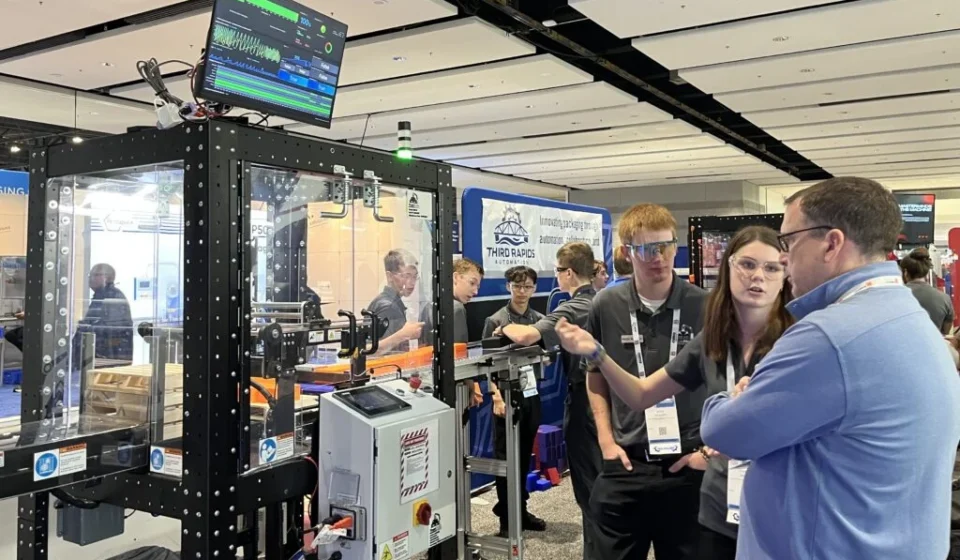
- The Next Generation: In parallel with commercial exhibitions, the West Hall played host to the Workforce Pavilion and the annual Pack Challenge. High school, college, and trade school students built, marketed, and demonstrated operational packaging machines, offering a glimpse into grassroots efforts to inspire future manufacturing talent.
Day Four: Looking Ahead and Consolidating Insights
The final day of Pack Expo 2026 was characterized by synthesis. Industry stakeholders reviewed data platforms like PMMI’s Materials Transitioning Dashboard to chart compliance trajectories for upcoming extended producer responsibility (EPR) regulations. The consensus leaving Chicago was clear: the manufacturing ecosystem must proactively adapt to material and regulatory shifts rather than waiting for mandates to dictate operations.
Supporting Data and Industry Metrics
The qualitative insights gathered on the show floor were heavily underscored by quantitative data presented by trade associations and component suppliers:
- Workforce Attrition: According to PMMI insights shared by Jorge Izquierdo, workforce knowledge loss ranked as the number one response when operators were surveyed regarding factors that slow down plant productivity. The departure of personnel with decades of institutional memory—coupled with high turnover among newer plant-floor workers—has left a widening capability gap.
- Material Transitions: PMMI highlighted approximately 60,000 data points collected over the past three years to populate its open-access Materials Transitioning Dashboard. This tool was designed to help operational planners navigate ongoing shifts from traditional substrates to post-consumer recycled (PCR) content and alternative packaging formats.
- Investment Metrics: Exhibitors noted stark divides in procurement strategies. While short-sighted corporate mandates frequently prioritize lowest upfront purchase prices, lifecycle cost analyses demonstrate that higher-investment components (such as modular wiring solutions from Murrelektronik) drastically reduce installation labor and long-term maintenance overhead.
Official Responses and Expert Insights
Industry leaders provided candid assessments of the challenges and technological responses defining the current manufacturing climate:
1. Addressing the Knowledge Drain
Colin Cartwright, Director of Packaging Industry Development at Murrelektronik, emphasized the severity of the brain drain:
"Trying to find skilled labor is getting hard. Trying to retain skilled labor is harder. People are retiring with a tremendous amount of knowledge in their heads, so when they leave, they take 30 years’ worth of experience with them… An integral part of what we do is helping companies be more productive with the people they have, build machines faster, and build machines that are more reliable on startup… We’re reducing the amount of skill needed."
PMMI’s Jorge Izquierdo reinforced this perspective from a macro level:

"[One] question… is about what will slow down productivity for your operations; and the number one response by far is workforce knowledge loss. There’s a lot of operators leaving manufacturing. They’re either retiring, or they’ve been on the plant floor for maybe five years, but they are moving on. So, it’s hard to keep that knowledge."
2. Pragmatic AI Implementation
Ben Coulombe, SVP of Sales at Maneva, discussed the necessity of contextualizing AI deployment rather than applying blanket solutions across varied plant environments:
"I call it the ideal plant profile. Look at really big companies like Kraft Heinz. They make pickles, deli meat, ketchup, mustard, and other things. But you can’t solve the same problem for the plant that makes cucumbers as you do for the plant that’s doing deli meats. It’s a totally different problem… So, my simple answer is, you have to look at the plant profile and say, what is your biggest issue? Let’s start there."
Dominic Trinko, Principal Solution Architect at Siemens, added context regarding tool selection:
"Our teams use all kinds of different tools to help customers with automation. There isn’t necessarily a one-size-fits-all with AI tools. We have different AI tools for different processes, and when you work with them, you know when [one] kind of task might be better solved with this tool at this time. But it does evolve fast; every couple of months, new models are released."
3. Redefining Operational Performance
Reflecting on the shift away from raw line speed as the sole metric of success, Mackensie Lambert, Principal Category Marketing Manager at Graco, stated:

"You can run as fast as possible, but if it’s not in the right state, the right recipe, the right ingredient, you’re not going to have the right end product… You have to make sure that even if you’re running fast, that it’s as effective as possible and repeatable as possible. That’s what we’re seeing as being the most key, and that goes into a reliable product."
Geoff Schreiber, Director of Product Management, Automation, at Toyota Automated Logistics, highlighted the human-centric role of operational data:
"It really comes down to artificial intelligence that helps a human be faster or smarter in their decision-making. That doesn’t mean that you necessarily have to train models and have all the data behind it, but you’ve got some data that’s paying attention to operational characteristics in the system and helps you respond quicker to maintain or improve performance."
4. Supply Chain and Sourcing Realities
Jonathan Esposito, Business Development Manager at Lapp, explained how external industrial demands have impacted connectivity supply chains:
"The biggest thing that we see right now is with the cord sets, the patch cords. A lot of traditional suppliers have long lead times, and many say it’s because of data centers. They’ve shifted to the data centers, but unfortunately, they’re missing out on their traditional customers and customers they’ve always supported."
Laurie Andres, Marketing Manager at Nord Drivesystems, noted the immense internal resources required by manufacturers to manage parts availability:

"Everyone is trying to stay on top of it, and that in itself is a full-time job of two or three people trying to figure it out to make sure we’re all doing the right thing. Lead time is something that we’ve gotten a lot of feedback on from our customers. They need it fast. They need a structure in place for replacements. They need assistance with interchanges. And we give direct access to our engineers to do that."
5. Navigating Regulatory and Material Changes
Adwoa Coleman, North America Senior Sustainability Manager, Ecosystems and EPR at Dow, outlined the complex legislative landscape facing packaging developers:
"When you consider the regulations that really impact us and our value chain, extended producer responsibility is one of them; post-consumer recycling mandates; and then advanced recycling — advanced recycling being considered a form of recycling, complementary to mechanical recycling, and also leveraging mass balance as a way of accounting for advanced recycling… Those are the three major ones I can highlight, but there are so many more. There are regulations on toxics, PFAS, non-PFAS; there’s a lot happening in this space."
Expounding on the difficulty these regulations create for machine builders, Jorge Izquierdo noted:
"These days, the challenge for many packaging and process operations is what’s next. What material is next? The evolution in terms of sustainable initiatives is not one job. It’s one material, then the next, then the next, then the next. The problem sometimes is what’s next. You need to make a decision today on the investment that you’re going to do. You want a line optimized to run with this material, but that material is going to change maybe a year later. The problem is, you don’t know what the material is yet."
Implications for the Manufacturing and Packaging Sectors
The insights gathered at Pack Expo 2026 point toward several profound strategic implications for design engineers, plant managers, and corporate leadership over the coming years:
- Automation as a Force Multiplier, Not a Total Replacement: Because institutional knowledge is leaving plants at an accelerating rate via retirement, automation cannot merely replace physical labor; it must codify expertise. Systems that simplify configuration, streamline startup, and feature intuitive diagnostics will separate market leaders from legacy operations.
- The Maturation of Industrial AI: The initial hype cycle of implementing AI for its own sake is giving way to pragmatic engineering. Successful deployments will require close alignment between business objectives and data readiness, utilizing specialized tools (such as computer vision for defect detection or digital twins for simulation) rather than monolithic, unverified models.
- Holistic Productivity Over Raw Velocity: Engineering specifications must pivot from peak machine speeds to overall equipment effectiveness (OEE). Minimizing unplanned downtime, streamlining changeovers, and ensuring recipe integrity will take precedence over pushing mechanical throughput limits.
- Supply Chain Resilience and Total Cost of Ownership: Component sourcing strategies must account for long-term operational expenses rather than myopic initial purchasing costs. Furthermore, component suppliers must establish robust regional stock inventories to insulate industrial customers from competing tech-sector supply shocks.
- Agile Compliance Planning: With extended producer responsibility and rapid material transitions forcing frequent packaging redesigns, processing lines must be engineered for extreme flexibility. Utilizing predictive dashboards and maintaining open communication channels between material suppliers, OEMs, and end-users will be vital to future-proofing capital investments.