


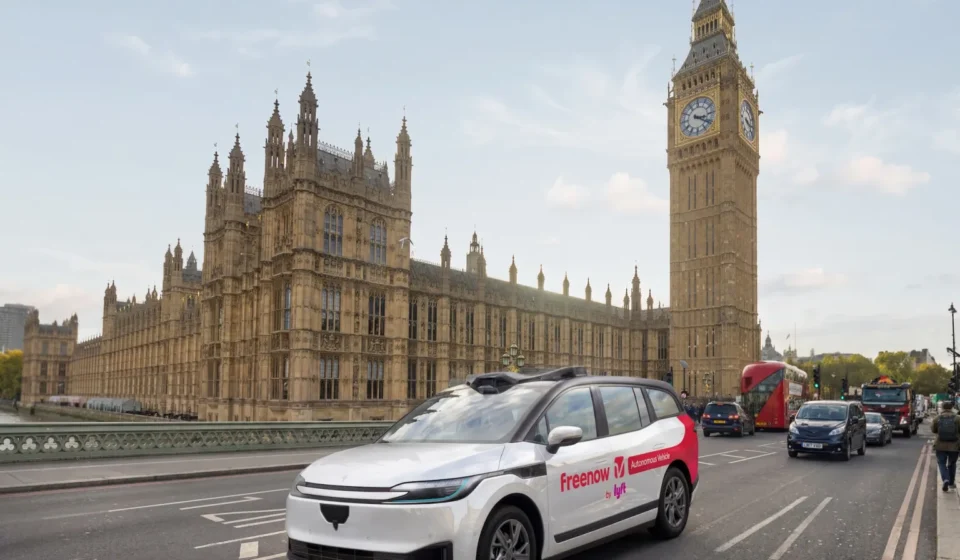
London Becomes the Western Crucible for Chinese Autonomous Driving as Baidu and Freenow Unveil the RT6

By Stewart Burnett
LONDON — As the United States aggressively moves toward a permanent legislative and regulatory blockade against Chinese-manufactured vehicles, the British capital has unexpectedly emerged as the primary Western proving ground for Chinese autonomous driving technology. This high-stakes dynamic was thrown into sharp relief with the recent unveiling of the RT6 robotaxi in London, a collaborative effort between Lyft-owned ride-hailing platform Freenow and Chinese tech giant Baidu’s autonomous driving unit, Apollo Go.
The partnership plans to scale up testing with safety drivers over the coming months, aiming to introduce fully driverless operations next year ahead of a commercial rollout targeted for 2027. Yet, this technological bridgehead is forming at a deeply precarious political moment. The rollout coincides precisely with the United Kingdom weighing strict tariffs on China-built electric vehicles (EVs), setting the stage for a complex collision of geopolitics, trade protectionism, and urban innovation on the winding streets of London.
Main Facts: The Baidu-Freenow London Initiative
The cornerstone of this Anglo-Chinese autonomous venture is the Baidu RT6 robotaxi—a vehicle designed from the ground up specifically for commercial ride-hailing services, setting it apart from retrofitted consumer cars used by several Western competitors.
Unlike the Jaguar I-Pace fleet deployed by Alphabet’s Waymo, the RT6 features a unique, purpose-built architecture that includes a detachable steering wheel. Most compellingly, the vehicle carries an estimated unit cost of roughly US$37,000. This aggressive manufacturing economy gives Baidu a structural cost advantage that few, if any, Western autonomous vehicle developers can hope to match in the near term.
Freenow, which was acquired by ride-share titan Lyft in 2025 for approximately US$197 million, plans to integrate these robotaxis carefully into the existing urban fabric. Rather than positioning the technology to uproot traditional labor pools entirely, Freenow’s leadership insists the vehicles will operate alongside human taxi and private-hire drivers.
Danny O’Gorman, Freenow’s UK General Manager, emphasized this cooperative philosophy during the vehicle’s reveal. "In terms of the taxi in London, the iconic black cab, this is not a replacement for that service," O’Gorman stated, attempting to preempt friction with the city’s entrenched transport unions.
The testing footprint is currently centered in the London Borough of Brent, where vehicles have been navigating public roads with safety drivers behind the wheel since July. According to O’Gorman, the company anticipates scaling its operational fleet to "tens of vehicles in the next year or two."
London’s notorious urban layout—characterized by unpredictable speed bumps, narrow medieval street grids, and widespread 20 mph zones—has proven to be an exceptionally demanding training ground. O’Gorman likened the artificial intelligence’s real-world education to human driving assessments, noting that the vehicle is "learning the rules of the road much like you would do if you’re trying to pass your own driving test."
Chronology: The Timeline to Autonomy in the Capital
The race to deploy autonomous robotaxis in London has accelerated rapidly over the past year, turning the city into a hyper-competitive multi-party racecourse.
- July 2025: Baidu and Freenow quietly initiate on-road testing of the RT6 platform within the London Borough of Brent, relying on onboard safety drivers to gather initial telemetry and mapping data.
- September 2025: Wayve and Uber fundamentally alter the city’s transit landscape by launching London’s very first operational robotaxi service, hitting the streets with an initial fleet of 15 vehicles equipped with safety drivers.
- Late 2025 / Early 2026: Regulatory frameworks begin to tighten as Transport for London (TfL) reviews safety cases. Concurrently, fellow Chinese autonomous driving pioneer Pony.ai initiates preliminary road tests in London through a strategic partnership with Uber.
- Late 2026 (Targeted): Waymo publicly targets the end of the year to launch its fully driverless commercial service in London, intending to bypass safety drivers and offer rides directly through its proprietary consumer app.
- 2027 (Projected): Baidu and Freenow project the official commercial launch of their RT6 fleet for public consumption, following an intensive period of fully driverless trials slated for the preceding year.
Supporting Data: Fleet Economics, Technical Philosophies, and the Competitive Landscape
The push for dominance in London has brought together an eclectic mix of global tech giants, each backing distinct economic models and technical philosophies.
The Economic Divide
Baidu’s RT6 changes the math of autonomous fleet economics. While Western competitors have historically relied on luxury or premium-segment electric vehicles outfitted with expensive aftermarket sensor suites—driving per-vehicle capital expenditures well past the six-figure mark—Baidu’s US$37,000 unit cost transforms the service into a potentially high-margin enterprise. This low baseline cost enables aggressive consumer pricing while maintaining sustainable operational margins, posing a direct threat to legacy Western operators.
Technical Philosophies: Vision vs. LiDAR
Underpinning these commercial efforts is a fierce philosophical split in autonomous driving engineering:
- The Camera-and-AI Approach: Pioneered in the UK by firms like Wayve, this philosophy relies on cameras, radar, and advanced end-to-end artificial intelligence models. These systems are trained to interpret unfamiliar roads dynamically without relying on pre-existing High-Definition (HD) maps.
- The Sensor-Fusion Approach: Adhered to by Waymo and Baidu, this method takes a more traditional, cautious route. It depends heavily on expensive LiDAR (Light Detection and Ranging) systems coupled with hyper-detailed HD mapping of the urban environment.
This ongoing technical divide mirrors the global debate over Tesla’s camera-only autonomous strategy, with safety proponents and traditional mapping advocates frequently clashing over edge-case reliability.
A Crowded Market
Baidu enters a remarkably congested field. Wayve and Uber hold the first-mover advantage with their September launch, while Waymo aims to establish European supremacy via a late-year driverless debut. Meanwhile, Pony.ai’s collaboration with Uber ensures that Chinese technical expertise is represented across multiple competing pipelines in the city. Interestingly, Baidu also maintains broader ties with Uber for international markets outside the UK, illustrating a global web of coopetition among autonomous rivals.
Official Responses and Regulatory Realities
Despite the rapid technological advancements and high-profile launches, the timeline for commercial autonomy in London will ultimately be dictated by regulators rather than engineering milestones.
Transport for London (TfL) has maintained a cautious, methodical stance. According to official disclosures, no autonomous operator has yet successfully registered its vehicles with the Vehicle Certification Agency (VCA)—a mandatory prerequisite and the first formal legal step toward unsupervised, driverless commercial services. Furthermore, industry analysts suggest that securing a permit from the Driver and Vehicle Standards Agency (DVSA) for fully driverless operation is unlikely to materialize before the end of the current year.
Consequently, industry insiders view Waymo’s aggressive year-end target as highly ambitious, while Baidu and Freenow’s 2027 commercial timeline is widely regarded by logistics experts as the more realistic trajectory.
Freenow is actively navigating this regulatory labyrinth. O’Gorman confirmed that the company is working in close cooperation with TfL and expects definitive regulatory guidelines to be issued within the coming week.
However, the companies face formidable opposition from organized labor. Both the App Drivers and Couriers Union (ADCU) and the Licensed Taxi Drivers’ Association (LTDA) have voiced vehement opposition to the swift implementation of driverless permits. These labor groups are actively challenging regulatory bodies, citing severe concerns over potential job displacements for human drivers and the exacerbation of inner-city traffic congestion.
Implications: Geopolitics, Tariffs, and the Future of Trade
For Baidu, the greatest vulnerability in London is not rooted in the complex algorithms required to navigate a roundabout or interpret a pedestrian’s sudden movement; it is fundamentally political.
The RT6 is, by definition, a China-built electric vehicle. As the United States moves to erect permanent trade walls against Chinese automotive technology, the UK is simultaneously contemplating falling in line with the European Union by imposing punitive tariffs on Chinese-manufactured EVs. Unless regulatory exemptions are carved out specifically for commercial autonomous robotaxis, any such tariffs would apply directly to the import of the RT6.
This outcome would severely erode the core cost advantage that makes Baidu’s business model globally competitive, neutralizing the economic edge it holds over homegrown or US-backed rivals.
Ultimately, London’s embrace of foreign autonomous technology will serve as a broader geopolitical litmus test. The city’s streets will not merely determine whether Chinese autonomy can successfully master irregular, historic European urban infrastructure; they will answer a more profound question: Will the United Kingdom treat Chinese robotaxis as restricted industrial imports subject to protectionist tariffs, or as licensed public services welcomed into the future of urban mobility?