By Industrial Technology & Engineering News Desk Published November 2026
Executive Summary & Main Facts
As the global manufacturing and product development sectors grapple with soaring complexity and tightening delivery schedules, a startling reality has come to light: traditional engineers spend only a fraction of their working hours actually engineering. Instead, up to 70% of a typical work week is consumed by administrative overhead—meetings, email chains, multi-tiered approval queues, and manual navigation through legacy CAD (Computer-Aided Design) files.
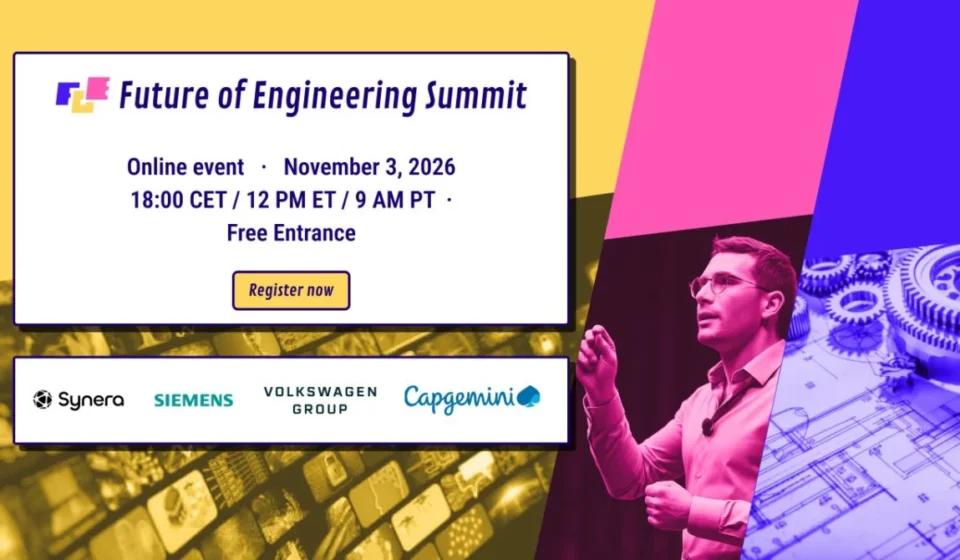
This systemic inefficiency, frequently described as engineering’s "hidden factory," is taking center stage at the upcoming Future of Engineering (FoE) Summit 3.0. Scheduled as a virtual global event for November 3, 2026, at 12:00 p.m. ET (18:00 CET), the conference operates under the theme: “From Pilot to Rollout: What AI Agents Are Actually Delivering in Engineering.”
Moderated by Design World Editor-in-Chief Rachael Pasini, the two-and-a-half-hour Zoom-streamed event brings together heavyweights from global enterprises, cutting-edge software vendors, and pioneering startups. The core thesis of FoE Summit 3.0 is clear: the true value of agentic artificial intelligence does not lie in simply accelerating mundane tasks with fewer hands, but in radically reclaiming engineering talent to focus on true product innovation and market differentiation.
Chronology of the Shift: From AI Hype to Real-World Rollout
The Evolution of Engineering Software
For decades, computer-aided tools promised to streamline product development. While CAD systems, Product Lifecycle Management (PLM) databases, and digital simulation platforms modernized drafting and analysis, they simultaneously introduced administrative burdens. Engineers became data managers, form-fillers, and consensus-builders.
By the mid-2020s, generative AI sparked widespread industry experimentation. Initially, tools acted as rudimentary text-based assistants or code generators. However, the technology has rapidly matured into agentic AI—autonomous systems capable of chaining commands, executing multi-step workflows, interacting with APIs, and modifying native engineering files directly.
The Current Market Realities (Late 2026)
Engineering leadership has officially moved past the foundational question of whether AI agents work. The conversation has pivoted sharply toward deployment strategies, scalable ROI, and risk management. This sense of urgency is underscored by broader market forecasts. Notably, technology analyst firm Gartner has publicly projected that 40% of enterprise agentic AI projects will be canceled by the end of 2027 due to escalating costs, unclear business value, or inadequate risk and compliance controls.
Against this backdrop of high stakes and high expectations, the FoE Summit 3.0 serves as a critical checkpoint for engineering organizations attempting to navigate the chasm between localized AI pilots and enterprise-wide rollouts.
Supporting Data and Industry Insights
Recent empirical research highlights both the immense opportunity and the structural dangers facing modern product development teams.
The Capgemini Research Institute Findings
In October 2026, the Capgemini Research Institute published a landmark report titled Rewiring automotive product development, unveiled at the Paris Motor Show. The study surveyed 800 senior automotive executives and revealed striking statistics:
83% of respondents agreed that agentic AI could enable engineers to spend significantly more time on core engineering by automating administrative and coordination drag.
68% of surveyed organizations reported that they are already actively using or piloting agentic AI within their product development pipelines.
Breaking Down the Engineering Week
Praveen Cherian, Executive Vice President at Capgemini, breaks down the typical allocation of enterprise engineering resources into a stark distribution model:
20% of resources are dedicated to keeping baseline operations running.
70% are consumed by necessary but undifferentiated "context" and administrative work.
Only about 5% each go toward genuinely differentiating work and true innovation.
“No wonder all the cars look the same,” Cherian remarked during a pre-summit interview, pointing out that when talent is perpetually bogged down by legacy coordination processes, creative engineering starves. By deploying agentic AI to tackle that 70% layer of undifferentiated work, Capgemini projects organizations can drop administrative overhead down to 40%, reallocating those human resources toward breakthrough innovation.
Official Perspectives and Expert Responses
Ahead of the November 3 summit, key speakers shared deep insights regarding the operational realities of integrating AI agents into heavy engineering environments.
Praveen Cherian (Capgemini): Eradicating the Hidden Factory
Cherian defines the "hidden factory" as the self-manufactured waste built into organizations via missing tools, outdated legacy processes, and bureaucratic approval chains that have long outlived their operational utility. He cites examples where a routine engineering change order can stall for up to 20 days simply because it requires signatures across dozens of disparate departments.
According to Cherian, the ultimate danger of deploying AI is falling into the trap of "doing more of the same, faster."
"Do you see an agentified organization when you look at the car, or do you see the same old car just done faster using AI?" Cherian asked, reflecting on his observations at the Paris Motor Show. "I think it’s a big failure mode if you see doing more of the same using AI."
Approaching the problem from the software level, Owein Dourneau, CEO and co-founder of MecAgent, looks at the hidden factory from directly inside CAD environments. MecAgent develops AI copilots integrated natively into software like SolidWorks, transforming text prompts, specifications, or STEP files into fully editable features, technical drawings, and macros.
Dourneau emphasizes that the highest-value wins often stem from eliminating the most mundane, repetitive headaches. He shared an instance where a client faced rebranding 25,000 legacy engineering drawings—a projected three-month manual chore. Using MecAgent, the task was completed in roughly five minutes.
"Changing the value of five chamfers is not mechanical engineering; it’s just execution. All of that will be offloaded," Dourneau explained.
Building Trust in Phases
A central philosophical hurdle for engineering leaders is accountability. When AI agents execute tasks autonomously, who carries ultimate liability? Both Cherian and Dourneau agree that humanity remains firmly in the loop.
Phased Guardrails: Cherian compares AI governance to credit card fraud detection algorithms, which developed over time by tracking behavioral anomalies. He envisions an incremental approach where agents initially handle low-risk approvals—such as minor cost adjustments under 50 cents that meet strict predefined criteria—before gradually earning greater autonomy.
The 80% Rule & First Impressions: From the user’s perspective, Dourneau notes that trust is fragile. If an AI assistant fails during its initial deployment, engineers abandon it permanently. Therefore, MecAgent targets outputs that are roughly 80% complete and functionally sound, allowing engineers to quickly review rather than completely rewrite models. Furthermore, to address stringent intellectual property concerns, MecAgent processes workflows locally on user hardware and does not train public foundation models on proprietary client data.
Implications for the Future of Engineering
The discussions at FoE Summit 3.0 point toward a profound structural transformation across mechanical, automotive, aerospace, and industrial manufacturing sectors.
The Shift from Execution to Review: Just as software engineering evolved over the past decade from writing every line of code to orchestrating and reviewing AI-generated code blocks, mechanical and systems engineering are poised for a parallel shift. The primary role of the human engineer will shift from physical execution to strategic oversight, validation, and creative design.
Redefining Enterprise Value: Organizations that successfully harness agentic AI will decouple scale from headcount growth. By dismantling internal administrative friction, companies can compress time-to-market and elevate product customization without burning out their engineering talent.
The Risk of Stagnation: Conversely, enterprises that use AI merely as a superficial accelerator for legacy processes risk cementing mediocrity. As Cherian warns, efficiency without imagination simply results in churning out identical products faster than before.
FoE Summit 3.0 Agenda and Speaker Lineup
The virtual event features a packed schedule designed to address tools, organizational structures, and strategic rollouts:
Opening Keynote:“The Golden Age of Engineering Is Already in Production,” presented by Andrew Sartorelli, VP of Software Partnerships at Synera, detailing what successful tool integration requires from leadership and teams.
Automotive Integration Gates: Clemens Frenzel of Volkswagen Group will outline the four strict gates a pilot must clear before transitioning into a production vehicle program: real data validation, clear ownership, measurable quality metrics, and robust operational stability.
Startup Speed Pitch: Owein Dourneau presents “AI for CAD: Building the Future of Mechanical Engineering.”
PLM and Prompt-Driven Design: Alexandre Poisson (Siemens Digital Industries Software) discusses “Scaling AI in PLM: Practical Insights and Customer Use Cases,” followed by Daniel Kane (Onshape/PTC) presenting “Text to Code to CAD: Making Prompt-Driven Design Real.”
Panel Discussion:“AI Agents in Engineering: Where AI Agents Create Real Business Impact,” featuring Praveen Cherian, Andrew Sartorelli, Daniel Kane, and Michael Finocchiaro (ThreadMoat), with live audience Q&A.
Event Registration
Industry professionals, engineering managers, and technical leaders looking to bridge the gap between AI pilots and transformative enterprise deployment can secure their spots for the November 3, 2026 event. Registration and broadcast details are available at the official portal: future-of-engineering-summit.com.