






Beyond the Brochure: An Engineer’s Guide to Maintaining the Next Generation of Humanoid Robots

By Ahmed Rezika, SimpleWays OU
Published: August 5, 2026
Main Facts: The Industrial Evolution of Humanoid Robotics
When a new piece of heavy machinery arrives at an industrial facility, seasoned maintenance engineers rarely stop at reading the equipment brochure. Their instinct is tactical and immediate: they want to know what lies beneath the outer casing. They seek to understand how every subsystem contributes to the unified whole, mentally dismantling the unit, tracing electrical signals, inspecting physical components, and anticipating failure modes long before the initial maintenance schedule is drafted.
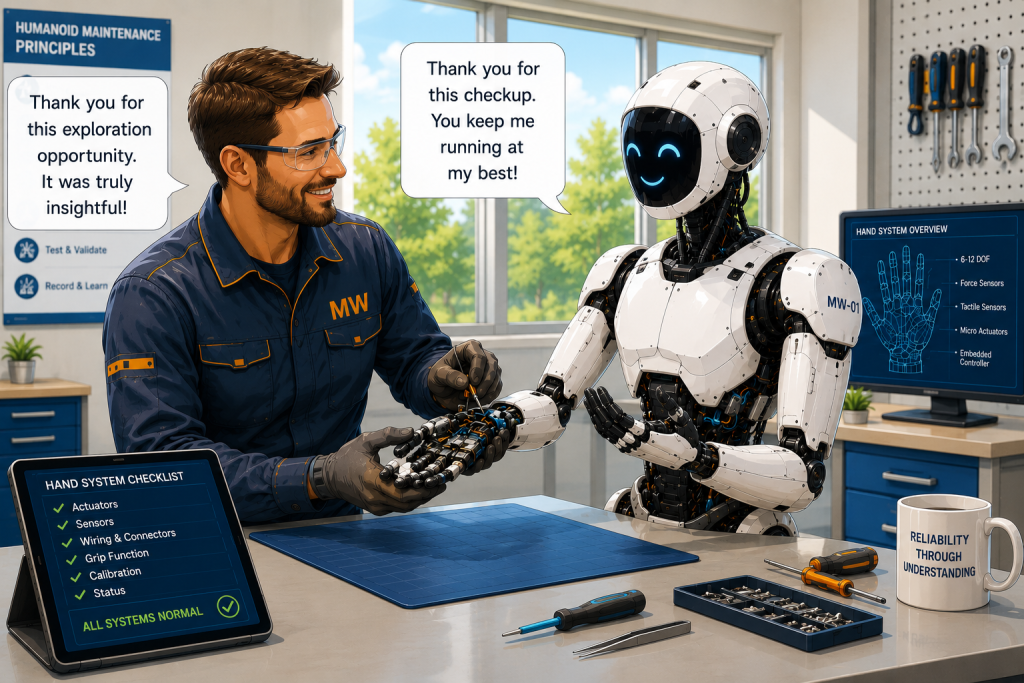
Imagine, however, that your newest maintenance colleague is not a human technician, but a state-of-the-art humanoid robot. During a planned operational shutdown, your engineering team decides to explore its internal architecture. Rather than performing a typical repair, they dismantle the machine to study its physical DNA, with the humanoid willingly participating—exploring and explaining its own subsystems as its protective outer panels are removed.
While this scenario reads like science fiction, every subsystem described reflects technologies fully operational in today’s advanced humanoid robots. This investigation moves beyond theoretical capabilities to reveal the physical construction of humanoids, the purpose of their components, and the convergence of maintenance disciplines required to keep them operational in modern industrial environments.

Chronology: Peeling Back the Layers of Advanced Mechatronics
Phase 1: Removing the Outer Shell and Initial Explorations
As the maintenance team begins unfastening the external body panels, the primary revelation is how familiar the internal architecture appears. Although humanoid robots naturally attract attention for their human-like form factor, their internal construction is fundamentally an integration of well-established engineering disciplines rather than entirely novel technology.
Beneath the cosmetic shell lie structural members, electrical harnesses, communication networks, distributed control electronics, sensors, actuators, thermal management systems, and power distribution arrays—components immediately recognizable to engineers working with modern industrial automation.
- The External Body: The outer covers are engineered with multiple operational objectives. Beyond providing an anthropomorphic appearance, they protect sensitive internal components from dust, debris, and accidental contact. They optimize aerodynamic flow for thermal cooling, dampen operational noise, and offer safe interaction surfaces for human coworkers. Manufacturers commonly fabricate these panels from high-grade engineering plastics, carbon-fiber composites, glass-fiber reinforced polymers, or lightweight aluminum assemblies. Material selection always balances impact resistance, structural stiffness, weight, manufacturability, repairability, and cost—trade-offs long familiar in aerospace, automotive, and collaborative robotics (cobots).
- Internal Discoveries & Distributed Intelligence: Unlike traditional industrial manufacturing lines that rely on large, centralized electrical cabinets, humanoids feature decentralized electronic layouts. Local motor controllers are positioned directly adjacent to individual joints to minimize cable lengths, reduce electromagnetic interference (EMI), and eliminate transmission losses. Higher-level computing units reside within the torso, benefiting from centralized power distribution, enhanced thermal management, and streamlined maintenance access. This distributed layout mirrors the modern industrial shift toward edge computing and decentralized field device control.
- Cable Routing and Joint Integration: Hundreds of power, communication, and sensor conductors must traverse rotating joints while resisting continuous fatigue, torsional stress, and repeated flexing. Designers utilize flexible cable carriers, tightly controlled bend radii, strain-relief mechanisms, and modular connectors to maximize service life. Furthermore, unlike traditional machines where mechanical, electrical, and control systems remain physically separated, humanoids integrate these disciplines into compact mechatronic modules. A shoulder, elbow, or knee is a complete mechatronic assembly containing bearings, high-performance actuators, precision gear reductions, embedded sensors, and thermal management features.
Phase 2: Beneath the Skin – The Structural Skeleton
Unlike conventional industrial robot arms bolted securely to rigid concrete foundations, humanoids must maintain continuous dynamic balance while performing active physical labor. Every movement of an arm shifts the machine’s center of mass, requiring the torso, hips, legs, and ankles to compensate instantaneously.
- Materials and Mass Optimization: Modern humanoids predominantly employ lightweight aluminum alloys for their structural frames, supplemented by high-strength steel inserts at high-stress interfaces like hip joints, knee pivots, and actuator mounts. Some manufacturers integrate magnesium alloys or carbon-fiber composites to minimize limb mass. Reducing a limb’s rotational inertia enables faster acceleration, shorter stopping distances, and drastically lower energy consumption.
- Locomotion and Dynamic Control: To maintain stability, humanoids actively calculate their Center of Mass (CoM), Center of Pressure (CoP), and the Zero Moment Point (ZMP)—the point on the support surface where the resultant ground reaction force acts with zero tipping moment. First formalized by Miomir Vukobratović in the late 1960s, the ZMP concept remains a cornerstone of humanoid locomotion, augmented today by whole-body dynamic control and Model Predictive Control (MPC).
Supporting Data: Sensors, Algorithms, and System Architecture
Maintaining balance and executing precise industrial tasks requires a complex sensor fusion matrix. No single sensor provides sufficient reliability on its own; instead, advanced algorithms synthesize data from multiple hardware inputs hundreds of times per second:
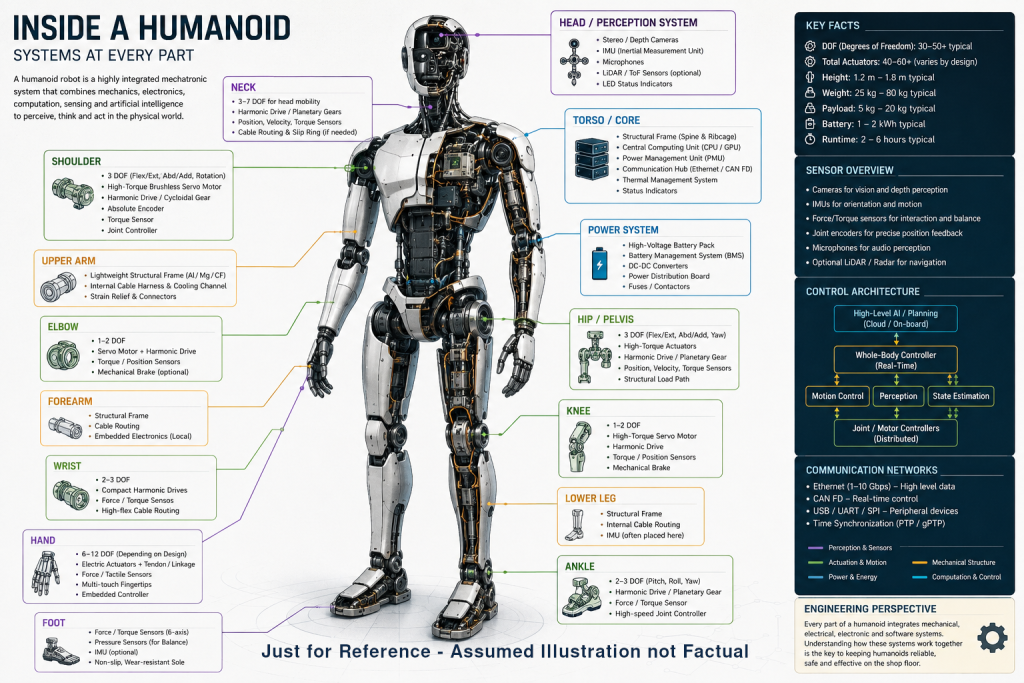
- Inertial Measurement Units (IMUs): Positioned near the torso, IMUs continuously track angular velocity, linear acceleration, and spatial orientation.
- Six-Axis Force/Torque Sensors: Integrated directly into the ankles and feet to measure interaction forces between the robot and the floor.
- High-Resolution Joint Encoders: Provide exact positional and velocity feedback for every individual actuator.
- Optical and LiDAR Systems: Stereo cameras, depth sensors, and LiDAR units supply real-time environmental awareness regarding terrain geometry and dynamic obstacles.
- Sensor Fusion Algorithms: Utilizing variants of the Kalman Filter and factor graph optimization, these algorithms merge independent data streams into a single, cohesive state estimate.
Structural Sensitivity
Because heavy components—such as high-capacity battery packs, high-performance computing units, and power distribution boards—are concentrated within the torso, limbs are kept exceptionally light. For maintenance professionals, this introduces a critical operational warning: a seemingly minor physical modification can disrupt the entire balance model.
Replacing a battery with a slightly heavier alternative, altering cable routing, or installing a heavier sensor changes the robot’s mass distribution. This forces a complete recalibration of the balance controller. In standard machinery, added weight is primarily a structural concern; in humanoids, every gram directly alters the digital dynamic model.
Official Responses and Industry Perspectives
The convergence of robotics and heavy industry has sparked intense dialogue among engineering leaders regarding the future of plant maintenance.
Industry veterans note that maintaining a humanoid robot bridges the gap between traditional mechanical upkeep and aerospace-grade systems integration. As Ahmed Rezika, a seasoned Projects and Maintenance Manager and founder of SimpleWays OU, emphasizes:

"If I assemble a pump incorrectly, it leaks. If I assemble a gearbox incorrectly, it vibrates. But if I assemble our humanoid colleague incorrectly, what exactly have I changed? You haven’t merely broken a machine; you have altered how it understands its own body."
Robotics manufacturers and maintenance experts agree that standard operating procedures must evolve. Maintenance technicians are transitioning from hardware mechanics to mechatronic systems integrators who must balance mechanical precision with software calibration, communication timing validation, and sensor synchronization.
Implications for the Future of Industrial Maintenance
The integration of humanoid robots into industrial facilities carries profound implications for plant operations, workforce training, and asset reliability frameworks.
1. Multidimensional Acceptance Testing
Traditional machinery is cleared for operation based on vibration metrics, temperature thresholds, and output key performance indicators (KPIs). Humanoid maintenance demands multidimensional acceptance testing. Following a component replacement, technicians must verify:
- Mechanical alignment and backlash tolerances.
- Electrical continuity and bus communication timing.
- Sensor calibration (force offsets, IMU zeroing, camera alignment).
- Actuator synchronization and thermal performance under load.
- Software configuration and kinematic model integrity.
2. The Digital-Physical Twin Bond
Modern humanoids rely entirely on accurate internal representations of their physical structure—their kinematic and dynamic models. Any physical repair that fails to update this digital model creates a dangerous disparity between the robot’s expectations and its physical reality. While errors may remain dormant during idle states, they can trigger catastrophic balance failures under heavy loads or complex environmental interactions.
3. Upskilling the Maintenance Workforce
As advanced automation penetrates industrial spaces, the role of the maintenance engineer is expanding. Professionals must become literate in embedded systems, edge computing, sensor fusion, and Model Predictive Control. Training initiatives must focus on empowering technicians to diagnose not just mechanical wear, but the complex interactions between software timing, electrical signals, and mechanical execution.
Ultimately, recognizing the intricate architecture of humanoid robots is the first step toward transforming them from technological curiosities into reliable, maintainable assets on the industrial plant floor.
Must-Know Jargon
- Centre of Mass (CoM): The singular point at which the total mass of a system acts under gravity, critical for calculating balance and load distribution.
- Zero Moment Point (ZMP): The point on the support surface where aggregate inertia and gravity forces generate no tipping moment, ensuring dynamic stability.
- IMU (Inertial Measurement Unit): An electronic sensor package combining accelerometers and gyroscopes to measure tilt, acceleration, and orientation in real time.
- Force/Torque Sensors: Multi-axis load cells measuring forces and rotational moments simultaneously at joints or contact points.
- Sensor Fusion: The algorithmic process of combining multi-source sensor data into a unified, reliable estimate of system state.
- Whole-Body Control: A control strategy coordinating all actuated degrees of freedom simultaneously to achieve tasks while respecting physical constraints.
- Model Predictive Control (MPC): An advanced control method using mathematical models to predict future behavior over a finite horizon and compute optimal actions.
- Kalman Filter: A recursive estimation algorithm combining dynamic system models with noisy sensor measurements to calculate optimal state estimates.
References
- Jorge Angeles, Fundamentals of Robotic Mechanical Systems, Springer International Publishing Switzerland, 2014.
- Matjaž Mihelj et al., Robotics, Springer International Publishing AG, 2019.
- V. Bonnet et al., “Practical whole-body elasto-geometric calibration of a humanoid robot: Application to the TALOS robot,” Robotics and Autonomous Systems (Elsevier), 2023.


