





By Ahmed Rezika, SimpleWays OU
Published: July 9, 2026
The transition of Artificial Intelligence from the digital realm into the physical world has long been the subject of science fiction. However, as of mid-2026, we have crossed a critical threshold. Physical AI—the integration of advanced robotics with real-time, adaptive intelligence—has moved from the speculative confines of research laboratories to the high-stakes, dust-covered floors of industrial manufacturing and maintenance.

Companies like Tesla, Boston Dynamics, and Figure AI are no longer merely showcasing prototypes; they are deploying systems that walk, perceive, and manipulate objects in semi-structured environments. While we have not yet achieved the "holy grail" of full, unsupervised autonomy, the era of theory is over. We have entered the era of application.
The Chronology of Capability: Learning from the Road
To understand the speed of this evolution, one must look at the recent history of autonomous driving. Ten years ago, the idea of a vehicle navigating a complex urban environment without a human driver was dismissed as a logistical impossibility. Today, systems like Waymo operate at scale, executing thousands of safe, driverless rides in defined urban zones.

The lesson here is not about the precision of timelines; it is about the compounding nature of capability. Physical AI is currently mirroring the trajectory of autonomous vehicles: it is not yet fully mature, but it is demonstrably functional in controlled conditions. The question for maintenance managers is no longer if these systems will reach the shop floor, but which tasks are structured enough to be the first candidates for automation, and how organizations must pivot to integrate them.
The Hardware Reality: What Physical AI Can Do Today
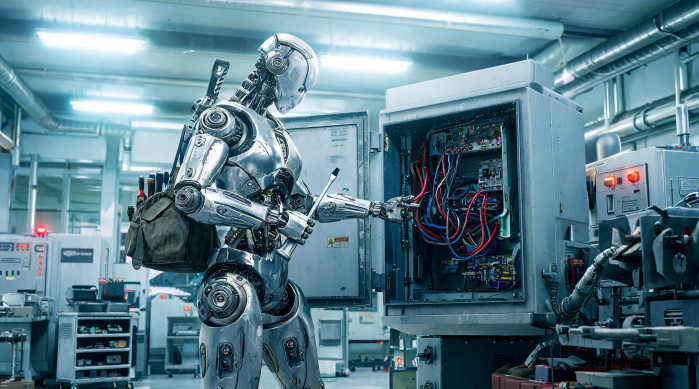
Public perception often fixates on the "humanoid" form factor, but industry professionals should focus on the technical specifications. The latest iteration of the Boston Dynamics Atlas is a case in point. With 56 degrees of freedom, an instant weight capacity of 50 kg, and a sustained handling capacity of 30 kg, this is not a toy. It is a machine engineered for the realities of industrial life.
Technical Performance Metrics
- Operating Envelope: Designed to function in temperatures ranging from -20°C to 40°C.
- Perception: Integrated 360-degree vision combined with advanced tactile feedback.
- Adaptability: Unlike traditional industrial robots that are bolted to the floor, these humanoids are designed to bring the machine to the work, rather than the work to the machine.
Traditional industrial robots have outperformed humans in strength and precision for decades. However, they rely on rigid, pre-programmed work envelopes. A six-axis robotic arm is a master of speed within a static environment, but it fails the moment a tool is moved slightly out of place. The humanoid platform, by contrast, uses coordinated joint movement—crouching, reaching, and adjusting balance—to navigate environments originally built for humans. This mobility is their primary competitive advantage.
Implications for Maintenance: A Shift in the "Grease Monkey" Paradigm
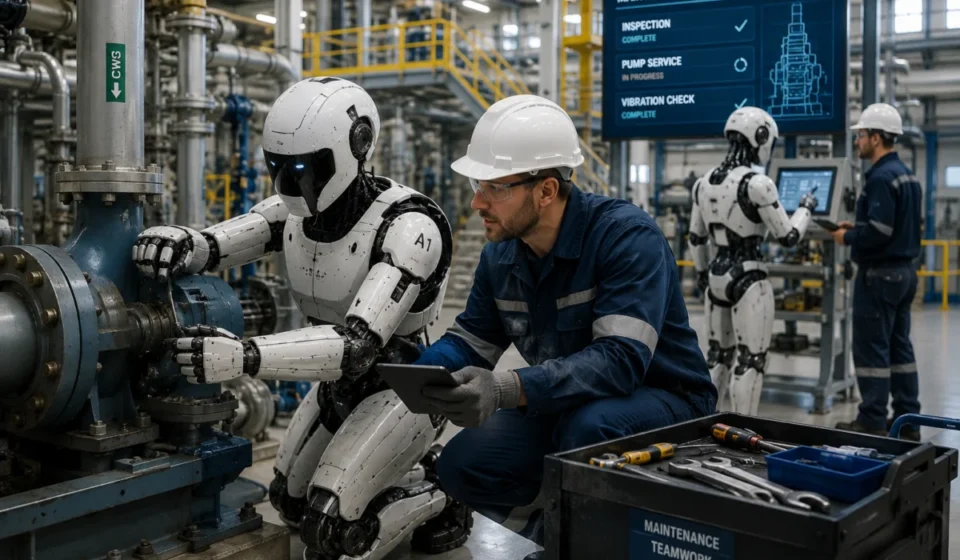
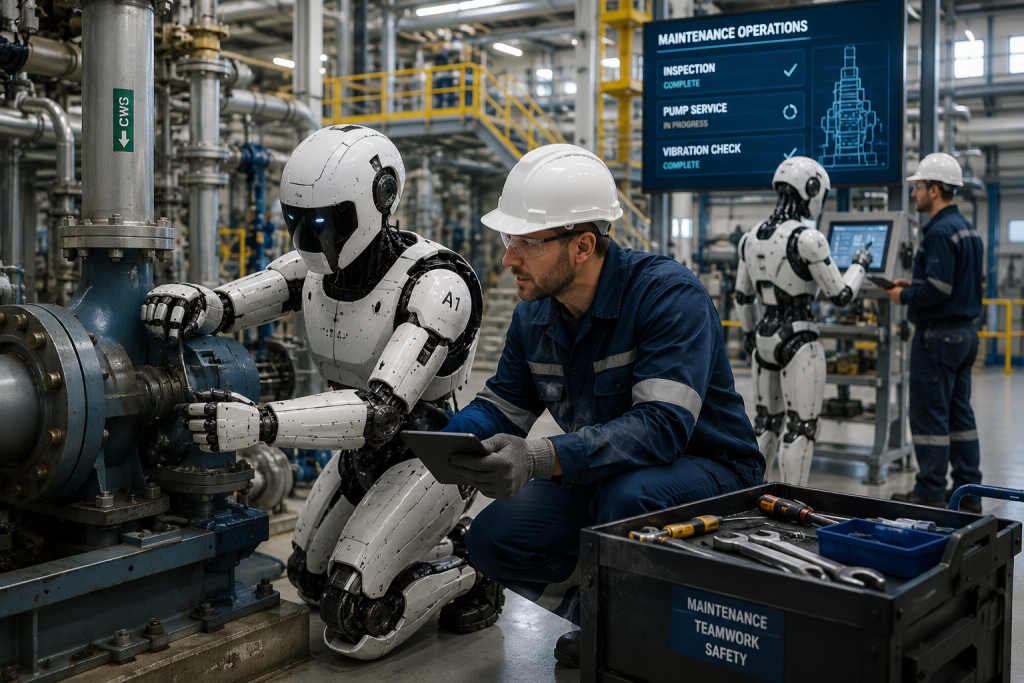
For the maintenance sector, the introduction of Physical AI creates a new, growing middle ground. These machines do not replace the human technician’s need for judgment; they replace the need for the technician to be a pack mule or a repetitive task processor.
1. Routine Inspection and Condition Monitoring
Inspection routes are the "low-hanging fruit" for Physical AI. These tasks are repetitive, governed by Standard Operating Procedures (SOPs), and require high levels of consistency. A robot equipped with thermal imaging, acoustic vibration sensors, and visual inspection cameras can traverse a facility, compare current performance data against historical baselines, and flag anomalies—all without the cognitive fatigue that often plagues human inspectors at the end of a long shift.
2. Material Handling and Tool Logistics
A significant percentage of a maintenance technician’s day is spent moving between the warehouse, the tool crib, and the site of repair. This "travel time" adds zero value to the machine’s uptime. Physical AI can handle the logistics of spare parts and tool delivery, allowing skilled human technicians to remain focused on the complex diagnosis and repair work that actually requires human intuition.

3. Standardized Component Replacement
Tasks like swapping out a modular transmitter, replacing a pressure gauge, or executing routine filter changes are highly conducive to automation. When the procedure is standardized and the torque specifications are known, a robot can perform the replacement with surgical repeatability.
The Boundary Conditions: Where Humans Still Lead
Despite the progress, it is vital to maintain a realistic view of the current limitations. Physical AI is not a panacea.

- Dexterity under variation: While robots are becoming more skilled at grasping, they still struggle with the "unexpected." A seized bolt, a corroded thread, or an undocumented field modification requires improvisation—a hallmark of human maintenance experience.
- Contextual Understanding: A robot can detect an abnormal vibration, but it cannot always differentiate between a benign harmonic frequency and a catastrophic bearing failure. That judgment remains firmly in the hands of the human engineer.
- Adaptation to Unstructured Spaces: Small, unplanned changes—like a stray cable on the floor or a misplaced wrench—can still cause navigation errors that a human would navigate instinctively.
Proof in the Field: The BMW-Figure Deployment
The most compelling evidence for the viability of this technology comes from the BMW-Figure collaboration. During their pilot program, Figure humanoids clocked approximately 1,250 operating hours, interacting with over 90,000 components and supporting the production of 30,000 vehicles.
This was not a lab demo. It was a proof of concept showing that a humanoid could navigate a busy factory floor, locate workstations, and perform repetitive tasks safely alongside human workers. For the maintenance professional, this is the blueprint for the future: identifying tasks that are "mature" enough for robot intervention while keeping the "human element" for high-value decision-making.

Building a Future-Proof Maintenance Strategy
As we look toward 2027 and beyond, the industrial landscape will likely shift toward a collaborative model. The most effective maintenance departments will be those that view Physical AI as a partner rather than a replacement.
Essential Jargon for the Modern Manager
- Embodied AI: The core of the revolution. It refers to intelligence integrated into a physical body, allowing the machine to perceive and act in the physical world.
- Sensor Fusion: The capability to combine data from cameras, LiDAR, and tactile sensors to create a single, accurate environmental map.
- Degrees of Freedom (DoF): The measure of a robot’s flexibility. High DoF allows for the fluid, human-like motion necessary to navigate complex industrial infrastructure.
Conclusion: The Path Forward
The path to integrating Physical AI into your facility is not through a total overhaul, but through the rigorous identification of tasks that are repetitive, measurable, and well-documented.

We are at the beginning of a cycle where capability will continue to outpace our initial expectations. The technology is no longer just a "thought experiment." It is a tool, and like any other tool in the maintenance kit—from a torque wrench to a vibration analyzer—its value depends entirely on how effectively it is deployed.
The successful maintenance manager of the future will be the one who knows exactly which tasks to delegate to the machine, and which to keep for the irreplaceable human mind. The robots are coming to the shop floor; it is time to ensure we are ready to lead them.
References
- Waymo: waymo.com
- Boston Dynamics: Atlas Spec Sheet, December 2025.
- BMW Group: First humanoid robot introduced in Plant Leipzig, March 2026.
- Figure AI: F.02 Contributed to the Production of 30,000 Cars at BMW, November 2025.
- Yale University: Model Q-II: An Underactuated Hand with Enhanced Grasping Modes, ICRA 2025.
- McKinsey & Company: Humanoid robots: Crossing the chasm from concept to commercial reality, October 2025.