


Beyond the Spec Sheet: How SHINING 3D Metrology is Redefining Industrial Scanning

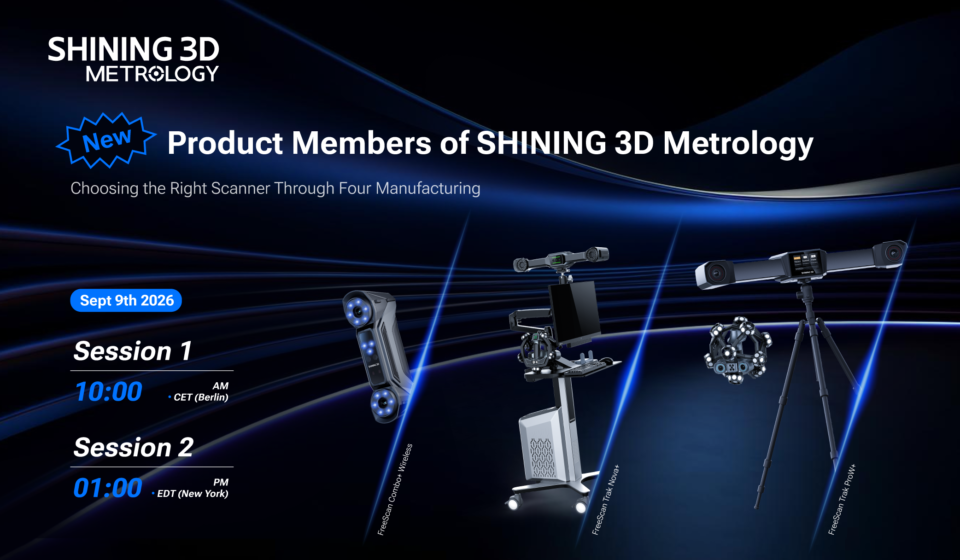
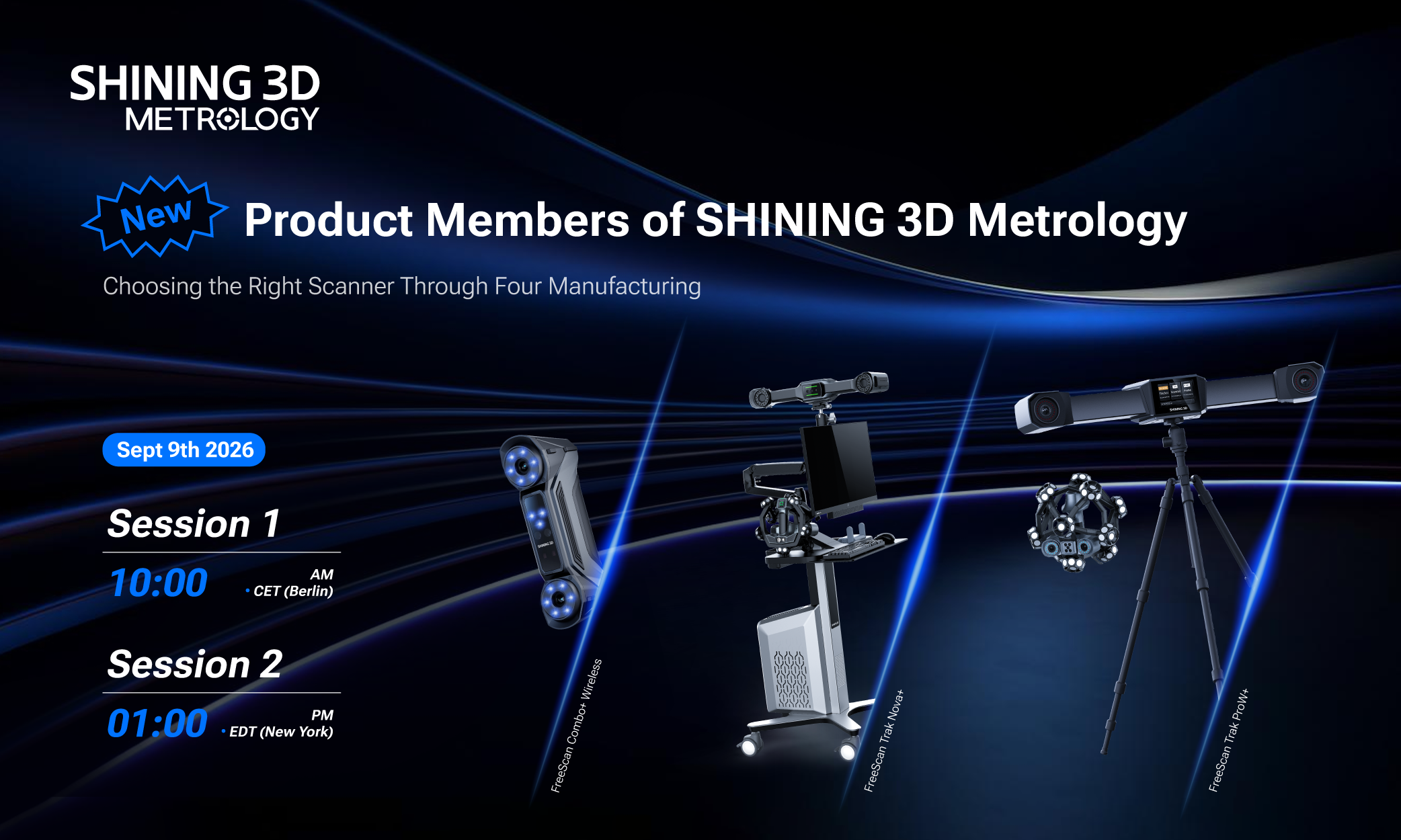
In the rapidly evolving landscape of industrial metrology, the traditional practice of competing solely on technical specifications—such as point density or volumetric accuracy—is undergoing a paradigm shift. On September 9, SHINING 3D Metrology signaled this transition with its latest webinar, "New Product Members of SHINING 3D Metrology." Rather than leading with a dry list of hardware metrics, the company presented a strategic framework designed to guide manufacturers through the complexities of real-world production environments. By unveiling three upgraded scanning systems and mapping them directly to specific industrial challenges, SHINING 3D is pivoting toward a user-centric, application-first marketing philosophy.
Main Facts: The New Hardware Ecosystem
The webinar served as the global debut for three refined systems, each engineered to address distinct friction points in modern manufacturing workflows.
1. FreeScan Combo+ Wireless
The FreeScan Combo+ Wireless represents an evolution of the established FreeScan Combo series. Retaining the signature compact, lightweight ergonomics that made its predecessor a favorite for handheld portability, the new iteration introduces a critical upgrade: a fully wireless operating mode. By removing cable dependency, the system significantly improves maneuverability in confined spaces, such as the interiors of automotive cabins or complex sheet metal assemblies, where agility is paramount. An updated internal scanning engine further bolsters its performance, providing cleaner data capture in challenging lighting conditions.
2. FreeScan Trak Nova+
Designed for scenarios where high-speed tracking is non-negotiable, the FreeScan Trak Nova+ combines advanced dynamic tracking with high-resolution handheld scanning. With a staggering capture rate of up to 7.6 million points per second, the system is engineered to handle large-scale geometry with ease. The "plus" designation denotes significant internal refinements in the laser projection hardware, allowing for more robust performance across multiple scanning modes. SHINING 3D has specifically positioned this device as a solution for server rack manufacturing and large-scale industrial inspection.
3. FreeScan Trak ProW+
The FreeScan Trak ProW+ serves as the flagship for large-scale automation. By revising the structural integrity of the scanner and updating the power delivery architecture, SHINING 3D has created a system capable of continuous, long-term operation in automated production lines. It is designed to integrate seamlessly into automotive assembly plants, where repeatability and scale are the defining metrics of success.
Chronology of the Launch Strategy
The lead-up to the September 9 event followed a methodical trajectory aimed at priming the market for a shift in perspective.
- Pre-Launch Phase: Throughout early 2026, industry reports indicated that manufacturers were struggling to translate high-end scanner specifications into tangible ROI. SHINING 3D identified this "specification fatigue" as a primary hurdle for adoption.
- The Webinar Event (September 9): The session moved away from standard product demos. Instead, it was framed around four distinct manufacturing scenarios: automotive sheet metal inspection, server manufacturing, large-scale automotive assembly, and precision component measurement.
- The Post-Launch Directive: The company has shifted its technical support and sales documentation to mirror these application-based pillars, ensuring that prospective clients identify their specific "use-case" before selecting a device.
Supporting Data: Why Context Matters
The necessity of this shift is backed by the evolving requirements of Industry 4.0. According to the data provided during the session, the choice of a scanner should no longer be binary (i.e., "is it accurate enough?"). Instead, the selection matrix must consider:
- Application Scale and Complexity: The difference between scanning a small, intricate engine valve and an entire automotive chassis requires fundamentally different hardware architectures.
- Inspection Environment: Factors such as ambient lighting, vibration, and space constraints (like those in a crowded server room) dictate whether a wireless, tracked, or fixed system is required.
- Measurement Requirements: The need for sub-micron precision versus the need for rapid, "good-enough" throughput changes the software and hardware requirements significantly.
- Production Workflow: Integration into existing automated lines versus manual, on-demand inspection creates a clear division in hardware needs.
By organizing their portfolio around these factors, SHINING 3D is attempting to reduce the "selection friction" that often leads to under-utilized or misapplied equipment.
Official Responses and Industry Context
The strategy employed by SHINING 3D is not occurring in a vacuum. Major players in the metrology space are increasingly moving toward "application-first" marketing.
Hexagon, for instance, recently launched the HYPERSCAN scanner, which was framed not by its technical resolution, but by its ability to overcome a single, universal bottleneck: the time-consuming setup of reference markers for large, fixed components. While SHINING 3D segments its market into four discrete scenarios, Hexagon focuses on solving a singular technical constraint across multiple sectors.
Similarly, Revopoint has adopted a strategy that segments by user persona rather than industrial application. With the launch of the MetroY Ultra (aimed at professional quality control engineers) and the POP 4 (geared toward versatile, everyday scanning), Revopoint demonstrates that the market is fragmenting based on both the nature of the work and the expertise of the user.
These trends highlight a broader industry realization: the era of the "all-in-one" scanner is fading. Modern metrology is becoming highly specialized, with manufacturers preferring tools that are purpose-built for their specific factory-floor challenges.
Implications: The Future of Metrology Adoption
The shift toward application-defined product releases has significant implications for both manufacturers and developers.
For Manufacturers
This transition offers a clearer path to implementation. By moving away from comparing spreadsheets of specifications—which are often measured under idealized lab conditions—manufacturers can now evaluate hardware based on how it will perform in their specific "production reality." This reduces the risk of capital expenditure on equipment that may prove too cumbersome or too limited for their unique operational needs.
For the Industry
The move signifies a maturation of the 3D scanning sector. When a market stops competing solely on "more points per second" and starts competing on "how well we solve your specific problem," it indicates that the technology has reached a level of baseline reliability. Manufacturers no longer ask "does it work?" but rather "how does it fit my workflow?"
The Path Ahead
As we look toward 2026 and beyond, the industrialization of additive manufacturing and advanced metrology will continue to intertwine. Events like the 3D Printing Industry’s "Additive Manufacturing Applications (AMA) series" reinforce this, as they focus on real-world deployments and supply chain integration rather than just technical benchmarks.
The approach taken by SHINING 3D serves as a case study in how hardware companies can remain relevant in a crowded market. By becoming a partner in the manufacturing process rather than just a vendor of tools, companies like SHINING 3D are setting a new standard for how industrial innovation is communicated and adopted.
In conclusion, the launch of the FreeScan Combo+ Wireless, Trak Nova+, and Trak ProW+ is less about the hardware itself and more about the philosophy of modern inspection. It is a reminder that in the complex, high-stakes world of modern production, the most powerful tool is not the one with the highest specifications, but the one that most effectively bridges the gap between the design file and the finished, inspected product.