

From CAD to Commerce: How David Helmers Turned an Engineering “Itch” into Wolfpack Workshop

In the disciplined world of mechanical engineering, "stress" is usually a calculated variable—a force applied to a material to determine its breaking point. But for David Helmers, a mechanical design engineer based in Columbus, Ohio, the most significant pressure wasn’t coming from a structural load test; it was the mounting tension between a standard 9-to-5 career and an irrepressible entrepreneurial spirit.
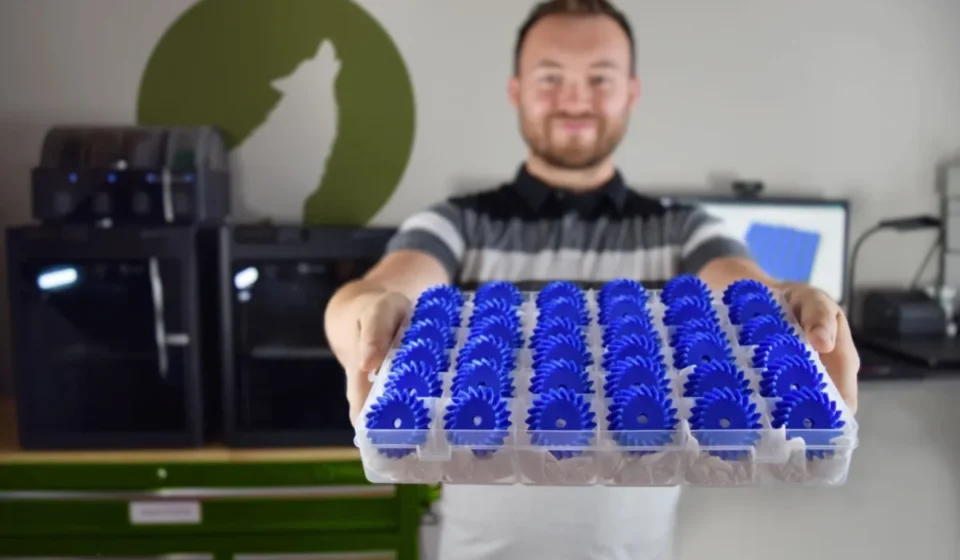
What began as an after-hours experiment has evolved into Wolfpack Workshop, a thriving design and additive manufacturing firm. Helmers’ journey—from a recent college graduate to a business owner—offers a masterclass in the intersection of technical proficiency, business acumen, and the modern "street smarts" required to thrive in the competitive landscape of 3D printing and reverse engineering.
The Genesis: Engineering the Side Hustle
David Helmers graduated from Cedarville University in 2021 with a B.S. in Mechanical Engineering. He immediately entered the industry as a design engineer at Advance CNC Machining. This role was transformative; it provided him with a visceral understanding of the shop floor. Beyond the theoretical, he gained deep experience in sheet metal fabrication, welding, bending, and the harsh realities of how digital designs manifest as physical, production-grade components.
However, the traditional corporate path left a gap. “I’ve always had a drive, an entrepreneurial drive, which a lot of people say is kind of strange for a mechanical engineer to have,” Helmers reflects.
In January 2025, Helmers and his wife decided to bridge that gap. Leveraging his technical background and her expertise in professional photography and marketing, they launched Wolfpack Workshop. Initially a modest 3D printing side project, the venture quickly outgrew its domestic confines. Through a strategic reinvestment of early profits, the company expanded its capabilities to include professional-grade SolidWorks licensing, large-format SLA (stereolithography) printing, and advanced 3D scanning equipment for high-precision reverse engineering. By August 2026, the operation had reached a level of maturity that allowed Helmers to leave his day job and commit to Wolfpack Workshop full-time.
Chronology of a Startup
The growth of Wolfpack Workshop was not linear; it was a series of tactical pivots.

- 2021–2024: Helmers builds his professional foundation at Advance CNC Machining, refining his skills in documentation standards and design for manufacturability (DFM).
- January 2025: Official launch of Wolfpack Workshop. The focus is on small-scale 3D printing and design consulting.
- Mid-2025: The "Everything Phase." Helmers accepts nearly every project—from one-off prototypes to hobbyist requests—to build a portfolio and test market demand.
- Early 2026: Strategic transition. The acquisition of large-format SLA hardware and 3D scanners marks a move toward industrial-grade inspection and end-use part production.
- August 2026: The leap. Helmers transitions to full-time entrepreneurship, focusing on high-value B2B relationships.
Navigating the Value Gap: Education vs. Expectations
One of the most significant hurdles Helmers faced in his first year was the "3D printing misconception." Many early clients expected the convenience and speed of 3D printing to come with the unit pricing of mass-produced, injection-molded parts.
"I have seen quite a few jobs lately where people want help designing and making a first prototype," says Helmers. "It makes sense because 3D printing is the perfect technology for that—you don’t have to pay for expensive tooling. But the transition to end-use parts is where the conversation changes."
Helmers realized he needed to stop being a "yes-man" and start being a consultant. He began educating clients on the economics of manufacturing, often walking away from projects where the client’s target price point rendered the manufacturing pathway unviable. This shift in mindset marked his maturation from a freelancer to a business owner. He learned that saying "no" to a bad contract is often as important as saying "yes" to a good one.
Bridging the Gap: "Book Smarts" vs. "Street Smarts"
Helmers distinguishes between the theoretical knowledge gained in an engineering degree and the practical, gritty realities of the industry. "You learn your book smarts when you’re in school, and you learn your street smarts when you get your first job," he notes.
At Advance CNC, Helmers wasn’t just a designer; he was an advocate for standards. He realized that a drawing is only as good as the machinist’s ability to interpret it. This realization led him to prioritize:
- Documentation Clarity: Ensuring that tolerances and critical dimensions are unmistakable.
- Manufacturing Feedback Loops: Designing components that don’t just work on screen but are actually efficient to produce in the shop.
- Cross-Disciplinary Communication: Understanding the needs of purchasing agents, shop floor leads, and end-users.
This philosophy of "Designing for Reality" is the cornerstone of Wolfpack Workshop. When Helmers designs a part, he considers the entire lifecycle, from the print orientation and support removal to the final inspection and assembly.

Technical Edge: Small Hardware, Big Impact
A prime example of Helmers’ professional approach is his use of heat-set threaded inserts. To a hobbyist, a 3D-printed hole with a self-tapping screw is often sufficient. To a professional, that is a point of failure.
By integrating brass heat-set inserts into his designs, Helmers creates a metal-on-metal interface that allows for repeated disassembly and assembly—a requirement for most industrial hardware. This seemingly simple technique has allowed his clients to move from flimsy, single-use prototypes to robust, production-ready components. This level of detail has helped his clients secure high-value contracts with global firms, proving that in engineering, the smallest components often dictate the largest successes.
The AI Dilemma: Efficiency Without Atrophy
As the industry grapples with the integration of AI, Helmers maintains a pragmatic, cautious stance. He utilizes AI as a high-level research assistant—using it to look up obscure mechanical standards or to assist in software script development.
However, he remains wary of the "outsourcing of intelligence." He is particularly concerned about the security risks associated with feeding sensitive CAD geometry into public AI models, noting that his previous experience in ITAR-compliant environments taught him to be vigilant about intellectual property.
"I think there will come a point where AI will have the ability to do a lot of the things for us, and it’ll actually cause people to regress in their ability to solve problems," Helmers warns. His philosophy is one of augmentation, not replacement. He wants to remain a problem-solver, not merely a prompter of algorithms.
Ethical Engineering as a Competitive Advantage
Perhaps the most significant takeaway from Helmers’ journey is the freedom to define his own ethical boundaries. In a corporate environment, engineers are often subject to the decisions of stakeholders who may prioritize short-term profit over technical integrity. As the founder of Wolfpack Workshop, Helmers is the ultimate arbiter of the company’s ethics.

"I get to decide what decisions we make," Helmers says. "If a customer ever asks me to do something unethical, I am the ultimate authority for my own business, and I can say, ‘Sorry. Nope.’"
This commitment to integrity has become a core brand value, fostering long-term trust with his clients. By prioritizing transparency and quality over the "hustle for the next buck," Helmers has built a foundation that is as durable as the parts he prints.
Implications for the Future
The story of Wolfpack Workshop is more than a success story about 3D printing; it is a blueprint for the modern engineer. As manufacturing becomes increasingly decentralized and "maker-driven," the demand for engineers who possess both deep technical knowledge and a holistic understanding of business operations will continue to skyrocket.
David Helmers’ transition shows that the "entrepreneurial itch" is not a distraction from engineering—it is the evolution of it. By blending the precision of mechanical design with the adaptability of a startup, Wolfpack Workshop is proving that the most effective engineers of the future will be those who can design not just the part, but the entire business model behind it.
For those looking to follow in his footsteps, the lesson is clear: Master the fundamentals, respect the shop floor, know your value, and never outsource your integrity. As Helmers continues to scale his operations in Columbus, he stands as a testament to the fact that when you combine the right tools with the right mindset, the possibilities for innovation are, quite literally, printed.