

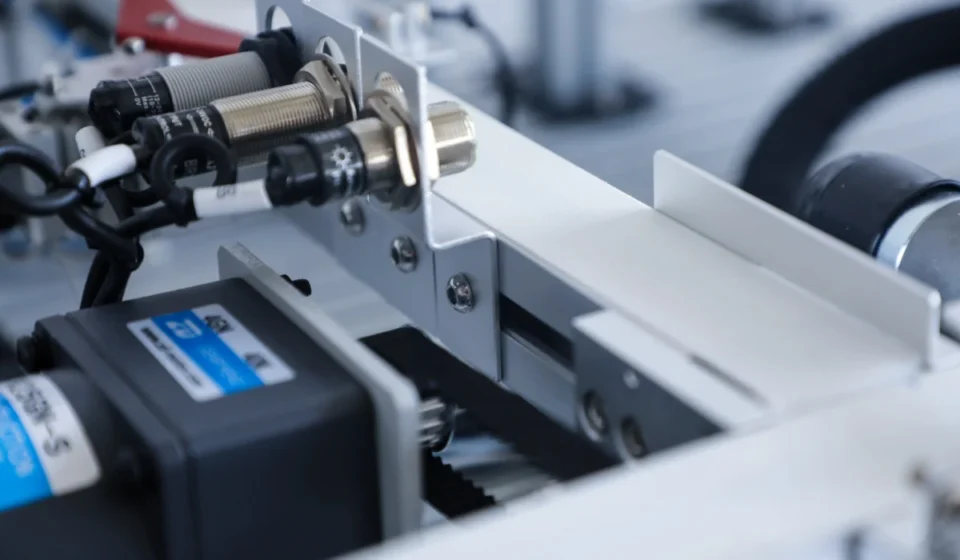
The Edge Revolution in Industrial Automation: How Distributed Processing and Smart Drives are Redefining Machine Control

ABSTRACT: The convergence of industrial computing and motion control is undergoing a profound architectural shift. By moving computational intelligence from centralized control cabinets to the edge—specifically into multi-core Industrial PCs (IPCs) and intelligent, drive-integrated processors—modern manufacturing facilities are overcoming traditional bandwidth bottlenecks. This comprehensive report explores the technological evolution of edge computing in discrete automation, examines real-world deployment on advanced industrial conveyors, evaluates the integration of safety and diagnostic functions, and analyzes the profound implications for both complex multi-axis networks and simpler open-loop motion systems.
1. Main Facts: The Architectural Shift Toward Edge Computing
For decades, the standard architecture of industrial automation relied on a clear hierarchical divide: centralized industrial PCs (IPCs) or programmable logic controllers (PLCs) executed deterministic motion control and general-purpose operating systems on separate pieces of hardware or isolated silicon layers. Fieldbuses such as SERCOS III, EtherCAT, PROFINET, and EtherNet/IP carried deterministic traffic to keep servo axes synchronized within sub-microsecond jitter tolerances, while ancillary data was filtered, discarded, or painstakingly routed to the cloud.
Today, this paradigm is fracturing—and evolving. Driven by the proliferation of multi-core system-on-chip (SoC) architectures utilizing x86 and ARM processors, modern machine control permits real-time deterministic kernels and general-purpose operating systems to share the same silicon. Simultaneously, motion-component manufacturers are embedding computing power directly into servo amplifiers and smart edge nodes.
This dual-pronged approach—distributing intelligence both to multi-core IPCs and out to cabinet-free drive hardware—allows automation engineers to process high-frequency operational data at the absolute point of origin. By filtering, timestamping, and analyzing data locally, systems can dramatically curtail extraneous network traffic, execute localized safety protocols, and enable predictive maintenance without overburdening central controllers.
2. Chronology: The Evolution from Centralized PLCs to Distributed Edge Intelligence
Understanding how edge computing achieved its current prominence requires tracing the historical trajectory of machine control networks over the past twenty years:
- Early 2000s (The Centralized Era): Machine controls relied heavily on distinct hardware boundaries. PLCs and central IPCs processed all control loops, sequence logic, and safety routines. Fieldbuses were strictly optimized for cyclic, deterministic data (like position and velocity commands), while diagnostic information from drives was largely treated as overhead and discarded between cycles.
- Early 2010s (The Rise of Industrial Ethernet): The maturation of high-speed industrial Ethernet protocols (EtherCAT, PROFINET, EtherNet/IP) increased bandwidth, enabling broader data collection. However, the computational burden still fell squarely on central controllers, creating severe bottlenecks when engineering teams attempted to pull high-frequency operational data for advanced analytics.
- Mid-2010s (The Multi-Core IPC Breakthrough): Silicon vendors introduced multi-core x86 and ARM SoCs robust enough to run real-time deterministic kernels on designated cores while handling general-purpose tasks (such as HMI rendering and data logging) on remaining cores. This allowed edge platforms to natively synchronize distributed clocks across multi-axis networks.
- Late 2010s to 2020s (Cabinet-Free Motion and Smart Drives): Motion-component manufacturers began offering advanced servo amplifiers capable of executing local logic and safety functions. Drives evolved from simple followers of centralized position commands to autonomous edge devices capable of calculating phase current, rotor position, and winding temperature locally.
- Present Day (Ubiquitous Edge Integration): Modern automation ecosystems feature programmable edge controllers, smart I/O terminals, and wireless-paired sensor nodes that publish data via MQTT and OPC UA protocols, bridging the gap between high-end multi-axis servocontrols and simpler, open-loop industrial machinery.
3. Supporting Data: Technical Mechanics of Edge Processing
To appreciate the efficiency gains of edge computing, one must examine the raw mechanics of how data is captured, filtered, and synchronized across industrial hardware.
High-Frequency Data Capture at the Servo Drive
Servodrives are inherently the best-instrumented components within a machine architecture. They continuously close control loops on current, velocity, and position at extremely high-frequency intervals. Historically, parameters such as:
- Phase current
- Rotor position
- DC bus voltage
- Winding temperature
…were utilized solely for immediate motor commutation and loop stabilization, with intermediate telemetry discarded between fieldbus cycles. Modern edge-enabled drives intercept this data stream locally. By integrating logic directly into the amplifier, the drive can communicate machine health status within microseconds.
Distributed Clocks and Time-Stamping
In advanced multi-axis workcells, data sources include multi-axis servodrives, IO-Link primaries, and discrete sensors monitoring physical interactions with workpieces. Because these data points are timestamped to a synchronized distributed clock, the edge platform can effortlessly correlate disparate variables:
$$textEvent Correlation = f(textMotor Current, textPositioning Error, textTorque, textTemperature, textVibration)$$
This precise temporal alignment allows the system to match physical anomalies with the exact machine state that induced them, eliminating guesswork during root-cause failure analysis.

Data Filtering and Bandwidth Optimization
Without edge filtering, the sheer volume of high-frequency sensor and drive data would easily overwhelm network backbones and central processing units. Edge components execute localized pre-processing—such as thresholding, scaling, and feature extraction—ensuring that only actionable summaries or anomalous events are transmitted upstream. This decoupling preserves communication bandwidth across any industrial protocol, regardless of transmission speed.
4. Official Responses and Industry Perspectives
Industry leaders and automation architects view the migration of logic and safety to the edge as a foundational milestone in modern manufacturing design.
On Cabinet-Free Architecture and Safety Migration:
Automation specialists note that moving safety functions—such as Safe Torque Off (STO), safe operating stops, and complex motion limits—directly onto the drive marks a departure from traditional engineering paradigms. By running these as certified functions on the drive, system designers can eliminate rows of physical safety relays, traditional contactors, and complex hardwired stop circuits.
“The transition of safety and logic to the peripheral hardware fundamentally transforms cabinet layouts,” explains an industrial automation engineering director. “While these drives require ruggedized, IP-rated housings and specialized hybrid cabling when deployed in harsh environments, the savings in physical wiring and the dramatic reduction in safety response latency far outweigh the initial integration hurdles.”
On the Democratization of Edge Computing:
Not every factory floor runs on high-speed, deterministic Ethernet networks. Many legacy or cost-sensitive machines rely on single-axis pneumatic indexers, VFD-driven conveyors, and basic proximity switches. Industry suppliers have responded by introducing programmable edge controllers equipped with native digital and analog I/O terminals that locally ingest, debounce, scale, and timestamp signals before publishing them via lightweight industrial IoT protocols like MQTT and OPC UA.
5. Implications: Use Cases, System Benefits, and Future Outlook
The practical ramifications of edge computing span across complex multi-axis conveyance systems and simpler, open-loop machinery alike.
Deep Dive: Industrial Conveyance Applications
Consider a modern industrial conveyor. Far from being simple single-speed transport belts, contemporary conveyor networks incorporate sensors and encoders coordinated dynamically with servodrives and robotic workcells.
- Traceability and Quality Control: Sensors track workpiece orientation, surface quality, weight, and lot numbers. When integrated with edge timestamps, this creates an unassailable audit trail—a critical requirement in pharmaceutical, medical device, and food processing facilities.
- Dynamic Flow Control: Edge computing enables advanced operational capabilities such as zero-pressure accumulation, precise product gapping, material merging, and dynamic diverting. When multiple robotic arms service a single conveyor, edge controls utilize real-time workpiece positioning to command picking, sorting, labeling, or ejecting operations on the fly.
- Predictive Condition Monitoring: By applying motor-torque signature analysis at the edge, systems can immediately spot mistracking belt sections or accumulation pressures that signal an emerging workpiece jam. Furthermore, gradual increases in motor-current draw—paired with subtle elevations in component operating temperatures—allow edge algorithms to predict bearing and seal wear long before catastrophic failure occurs.
[Sensors / Servodrives]
       │ (High-Frequency Sampling & Distributed Clock Timestamping)
       ▼
[Edge / Drive-Level Processing]
       │ (Local Logic, Safety Execution, Filtering, Anomaly Detection)
       ├───────────────────────────────┐
       ▼                               ▼
[Immediate Action]              [Upstream Transmission]
(Anti-collision, STO,           (MQTT / OPC UA Cloud Sync,
 Jam Prevention)                 Condition Monitoring Records)
Implications for Simpler Motion Systems
For machinery operating without deterministic Ethernet protocols—such as basic VFD-driven rollers, cam-actuated mechanisms, and pneumatic indexers—smart edge devices provide an accessible entry point into industrial intelligence.
By terminating binary and analog signals locally, these edge nodes perform essential preprocessing tasks:
- Debouncing and Scaling: Cleaning up noisy signals from legacy limit and proximity switches.
- Threshold Monitoring: Utilizing current transducers and 4-20 mA loops to run basic motor-current signature analysis.
- Vibration Trend Analysis: Deploying simple accelerometers near gearboxes and couplings to flag peak threshold violations without requiring full, costly spectral condition-monitoring racks.
Summary of Operational Benefits
The overarching migration toward edge-computed machine control yields measurable advantages across the manufacturing lifecycle:
- Reduced Footprint & Wiring: Cabinet-free drives and distributed edge I/O drastically cut down physical cable runs.
- Enhanced Fault Tolerance: Localized logic execution allows drives to react in microseconds to prevent mechanical crashes, misfeeds, and jams independently of central controller polling.
- Simplified Diagnostics: Addressable hardware combined with standardized IoT publishing protocols makes machine-health transparency a native operational feature rather than an afterthought.
As silicon processing power continues to scale downward into micro-amplifiers and compact edge nodes, the line between "centralized control" and "peripheral execution" will continue to blur, cementing edge computing as the definitive backbone of modern industrial automation.