Automotive manufacturing is undergoing a silent, high-stakes revolution. On the bustling production floors where internal combustion engines and complex powertrains come to life, precision is measured in millimeters and milliseconds. For decades, traditional industrial automation has relied on rigid programming: robots go precisely where they are told to go, assuming that every part, component, and chassis arrives in the exact same spot, every single time.
However, the real-world manufacturing floor is rarely so cooperative. Component variations, wear-and-tear on mechanical infrastructure, and the dynamic nature of moving assembly lines frequently conspire to throw parts out of alignment. When rigid automation encounters this variability, the results are missed bolts, flawed adhesive applications, misaligned part pickups, and costly manual interventions.
To solve this persistent industrial challenge, global automotive giant Stellantis turned to cutting-edge artificial intelligence and 3D vision technology developed by Inbolt, a specialized start-up pioneering real-time robotic guidance systems. By integrating Inbolt’s AI-powered guidance solutions across multiple manufacturing facilities globally—spanning the United States, Hungary, and France—Stellantis has successfully transformed traditionally rigid robotic cells into adaptive, autonomous systems.
The results have been nothing short of transformative. At Stellantis’ legendary engine manufacturing complex in Trenton, Michigan, a vision-guided robotic bolting application slashed non-engagement rates from 2.55 percent down to 0.24 percent, virtually eliminating rework and securing a full return on investment (ROI) within just 12 months. Similar deployments at the Detroit Assembly Complex, a Hungarian engine plant, and a French transmission facility have yielded staggering operational improvements, reducing unplanned downtime by up to 70 percent, cutting part rejections by over 90 percent, and proving that AI-driven vision can rescue automation from the limitations of mechanical rigidity.
Chronology
To understand the magnitude of this technological leap, it is helpful to examine the timeline of how Stellantis identified its manufacturing bottlenecks, evaluated traditional solutions, and ultimately embraced Inbolt’s real-time AI guidance systems.
The Historic Roots: Trenton Engine Complex
Stellantis’ manufacturing footprint in Trenton, Michigan, runs deep. For nearly 75 years, the Trenton engine complex has been a cornerstone of engine production for the automaker. The complex is divided into two distinct manufacturing spaces: the north factory, which originally opened its doors in 1952, and the newer south plant, which commenced operations in 2010. Together, these facilities shoulder the heavy responsibility of manufacturing the corporation’s widely utilized 3.2-liter and 3.6-liter V6 engines.
The Operational Bottleneck
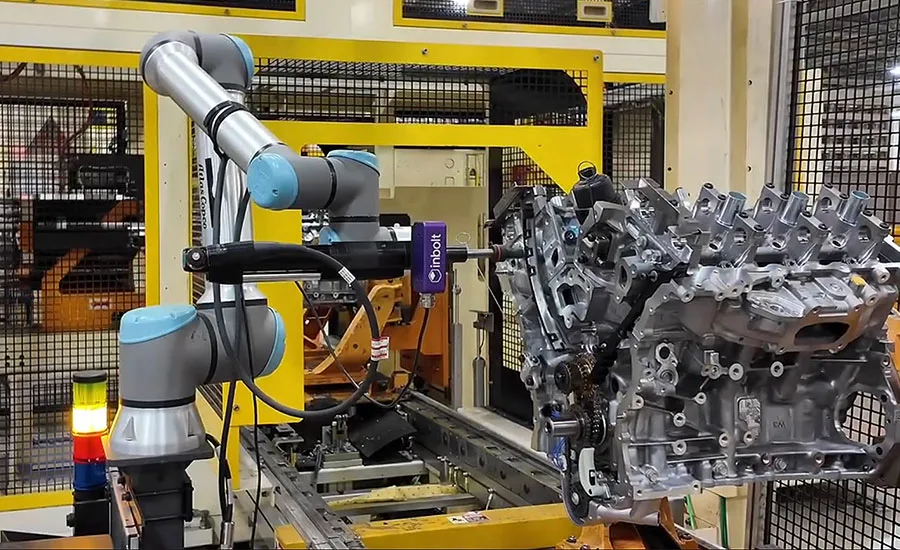
Despite housing modern machinery, the assembly lines at Trenton faced a classic automation headache. Engines are continuously conveyed down the line on moving transport systems. At a critical assembly station, a six-axis industrial robot was tasked with tightening a sequence of essential structural bolts.
To ensure the robot could find its targets, engineers initially relied on a mechanical "lift-and-locate" system designed to physically halt and position each engine block. Yet, this mechanical approach suffered from an inherent flaw: the resting position of the engine was not repeatable enough within the tight tolerances demanded by the robotic arm. Consequently, the robot missed approximately 2.55 percent of the bolts. Fixing these omissions required stationing a human operator at the end of the line to manually locate and torque missed fasteners, driving up labor overhead and creating an inconsistent workflow.
Searching for Solutions
Historically, engineers attempted to resolve such repeatability issues by upgrading lift-and-locate systems or installing fixed lighting and structured-environment camera rigs. However, these traditional methods brought heavy drawbacks: they required extensive and expensive infrastructure overhauls, increased overall cycle times, and inevitably degraded over time due to mechanical wear and cumulative tolerance stack-ups.
The Inbolt Integration and Global Expansion
Recognizing the limitations of legacy approaches, Stellantis engineers broke new ground by deploying Inbolt’s real-time 3D vision and AI guidance technology at the Trenton plant. The success of the Trenton pilot acted as a catalyst, prompting Stellantis to rapidly expand the technology across its global industrial network:
Detroit Assembly Complex–Jefferson (United States): Deployed to optimize a complex adhesive dispensing operation, eliminating minor misalignments and slashing unplanned downtime.
Szentgotthárd Plant (Hungary): Implemented to automate the cylinder head pick-and-place process, compensating for variable pallet delivery positions and uneven part placement.
Valenciennes Plant (France): Integrated onto mobile cobot carts to safely load and unload gears on a machining line despite raw part variation and geometric shifts caused by heat treatment.
Supporting Data
The commercial and operational success of the Stellantis and Inbolt partnership is underscored by hard metrics. Across four distinct plants and four entirely different manufacturing processes, the integration of AI-driven 3D vision delivered quantifiable improvements in efficiency, quality, and cost savings.
Trenton Engine Complex (Bolting Operation)
Initial Non-Engagement Rate: 2.55 percent of bolts missed by the robot, requiring manual human intervention.
Post-Implementation Non-Engagement Rate: Reduced dramatically to 0.24 percent.
Part Rejection Reduction: Overall component and assembly rejections dropped by 90.5 percent.
Rework Status: Virtually eliminated, optimizing human labor utilization at the end of the line.
Return on Investment (ROI): Achieved full capital payback within 12 months.
Detroit Assembly Complex–Jefferson (Adhesive Dispensing)
Unplanned Downtime: Reduced by a staggering 70 percent, greatly improving station reliability.
Tolerance Control: Successfully mitigated deviations as small as 4 millimeters that previously threw off end-effector trajectories.
Return on Investment (ROI): Fully paid for itself in just 6 months.
Szentgotthárd Plant (Cylinder Head Handling)
Challenge Addressed: Autonomous mobile robots (AMRs) delivered pallets with non-repeatable stopping locations, and cylinder heads rested unevenly on surfaces.
Solution Impact: The AI system dynamically realigned the robot’s trajectory in real time, entirely bypassing the need to upgrade factory dunnage and significantly lowering total automation capital expenditures.
Valenciennes Plant (Gear Machining and Handling)
Challenge Addressed: Raw parts arrived with unpredictable positioning, heat-treated pallets exhibited geometric warping and inconsistent pin locations, and mobile cart-mounted cobots shifted slightly each time they were relocated.
Solution Impact: The Inbolt system continuously recalculated pallet pins and part locations on the fly, preventing potential collisions, ensuring precise insertions, and making flexible mobile cobotry viable in a heavy industrial setting.
Official Responses and Technological Insights
To fully grasp why this technology succeeded where traditional systems failed, it is necessary to examine the mechanics of how Inbolt’s system operates and why industry engineers view it as a paradigm shift.
Traditional industrial robots are creatures of habit. As manufacturing experts note, a skilled human worker can effortlessly adjust a fastening tool on an engine even if the engine is shifting slightly on a moving conveyor belt. Humans possess spatial reasoning and tactile feedback loops. In contrast, standard industrial robots can only navigate to coordinates dictated by their pre-written programming. If a part deviates even slightly from its expected position, the robot becomes blind to the new reality, resulting in missed targets or damaged tooling.
Inbolt’s real-time guidance system bridges this cognitive gap between humans and machines. The technology leverages advanced artificial intelligence coupled with a standard 3D camera mounted directly onto the robotic arm. This setup captures real-time 3D data of the entire assembly environment.
"Unlike traditional vision setups, there’s no need for fixed lighting or controlled environments. It works in variable, real-world conditions and enables robots to adapt in place," engineering documentation notes.
The underlying AI model is pre-trained and subsequently fine-tuned using Computer-Aided Design (CAD) data. This dual-layer training enables the model to rapidly recognize a vast array of complex part geometries and generalize across multiple distinct component references.
By continuously processing depth information, the AI model identifies the exact position and orientation of parts—accounting for variations across all six degrees of freedom: X, Y, Z, yaw, pitch, and roll. It updates the robot’s trajectory on the fly. Because the system calculates adjustments instantaneously, the robot can successfully execute high-precision tasks while parts remain in motion on the assembly line, entirely eliminating the need for rigid mechanical constraints like lift-and-locate systems.
Implications
The successful deployment of AI-driven 3D vision systems across Stellantis facilities carries profound implications for the future of global manufacturing, automotive engineering, and industrial robotics.
1. The Death of Rigid Tooling Infrastructure
For decades, achieving robotic precision required heavy investments in mechanical infrastructure—custom jigs, heavy-duty lift-and-locate mechanisms, specialized fixtures, and rigid dunnage. These mechanical systems were expensive to install, slow down cycle times, and inevitably degraded. The Stellantis case study proves that software-defined adaptability can replace heavy mechanical fixturing. By letting AI handle spatial variability, manufacturers can save millions in capital expenditure and drastically shorten deployment timelines for new assembly lines.
2. True Flexibility for Mobile Robotics and Cobots
One of the most exciting implications of this technology is its compatibility with flexible manufacturing concepts, such as mobile cobots mounted on carts. At the Valenciennes plant, the fact that mobile carts shifted slightly every time they were repositioned would have crippled traditional automation. By empowering the cobot to "see" and adjust to its immediate environment dynamically, manufacturers can now design modular, reconfigurable factory floors that can be rearranged overnight to accommodate new vehicle models or shifting production volumes.
3. Redefining Human-Robot Collaboration
Far from completely eliminating human workers, technologies like Inbolt’s vision guidance system redefine the nature of human labor on the shop floor. At the Trenton engine plant, the human operator stationed at the end of the line was not laid off; rather, their role shifted from tedious, repetitive manual rework (chasing missed bolts) to higher-value quality oversight. By eliminating monotonous frustration and reducing physical strain, advanced automation creates a safer, more engaging work environment for skilled technicians.
4. Setting a New Industrial Standard
As automotive manufacturers worldwide race to achieve higher levels of efficiency, flexibility, and quality control, the success stories at Stellantis—ranging from 12-month ROIs in Michigan to 70 percent reductions in downtime in Detroit—will serve as a blueprint. Real-time AI guidance is no longer a futuristic concept or an experimental beta test; it is a proven, battle-tested industrial reality that is actively redefining what automated machinery can achieve on the modern factory floor.