



Heavy Lifting on the Factory Floor: The Engineering, Economic, and Operational Realities of Industrial Humanoid Robots

CAMBRIDGE, U.K. — The modern factory floor is undergoing a quiet, mechanical revolution. For decades, industrial automation has been dominated by stationary robotic arms, automated guided vehicles (AGVs), and autonomous mobile robots (AMRs) designed to execute repetitive, highly specific tasks. However, a new paradigm is rapidly taking shape: the humanoid robot.
According to comprehensive new research published by market intelligence firm IDTechEx, approximately 80% of all humanoid robots and prototypes developed to date are purpose-built for industrial settings. This statistic signals a profound shift in how manufacturers envision the future of production lines, logistics hubs, and assembly plants. Rather than redesigning entire facilities to accommodate specialized machines, developers are aiming to introduce bipedal and wheeled humanoids capable of operating within spaces originally engineered for human workers.
Yet, this ambition comes paired with daunting technical hurdles. Engineering a machine that mimics the human form while possessing the strength, endurance, and precision required for grueling industrial environments is testing the limits of modern materials science, power management, and software architecture. As the robotics sector attempts to transition from speculative prototypes to widespread commercial deployment, the industry finds itself at a critical crossroads.
Main Facts: The State of Industrial Humanoids
The IDTechEx research highlights several foundational metrics that define the current landscape of industrial humanoid development:
- Market Dominance: Four out of every five humanoid robots or prototypes currently in existence are engineered specifically for industrial applications.
- Mass and Burden: Industrial humanoids carry an average weight of 78 kilograms (approximately 172 pounds). Meanwhile, certain wheeled humanoid variants exceed the 100-kilogram (220-pound) threshold.
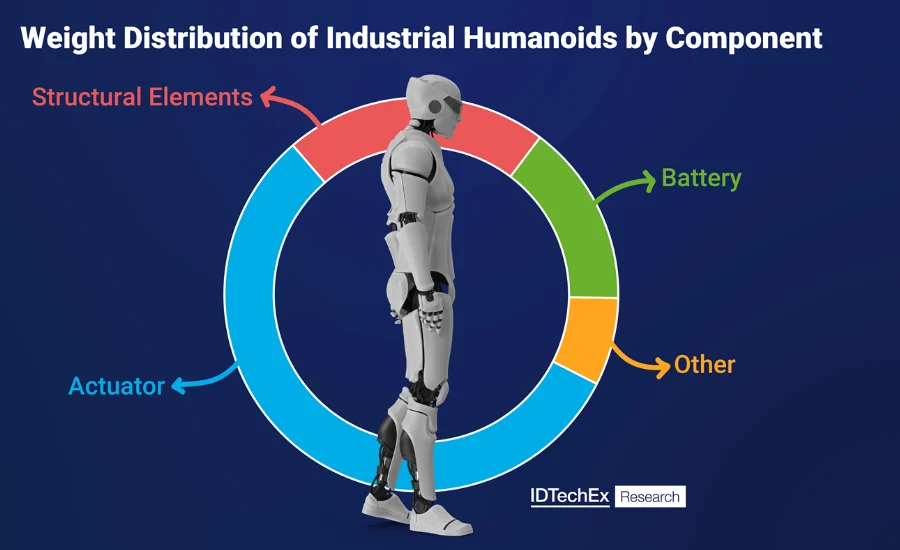
- Actuator Impact: Actuators alone account for more than 50% of a typical humanoid robot’s total weight.
- Market Projections: Industry forecasts suggest that the broader humanoid robot market could scale to approach 1 million active units globally by approximately 2030.
- The Mobility Compromise: To mitigate the complex balancing demands and energy drains of bipedal locomotion under heavy loads, a subset of developers is turning to wheeled humanoid configurations.
These facts outline an industry caught between visionary market potential and grinding physical realities. While the allure of a universal worker that can navigate stairs, manipulate standard tools, and integrate seamlessly into existing human workflows is undeniable, the engineering trade-offs required to achieve this vision are immense.
Chronology: From Sci-Fi Novelty to Industrial Reality
To understand how the industrial humanoid sector arrived at its current state, it is necessary to examine the trajectory of robotics development over the past half-century.
Phase One: Academic Curiosity and Bipedal Exploration (1970s–2000s)
For decades, humanoid robotics was primarily the domain of academic institutions and government-funded laboratories. Early milestones, such as Japan’s WABOT project initiated in the early 1970s, proved that bipedal walking was mechanically possible, though computationally expensive and severely limited by power constraints. Throughout the late 20th and early 21st centuries, humanoids were largely viewed as technological showcases—complex novelties capable of slow, highly calculated steps, but devoid of practical economic value.
Phase Two: Dynamic Mobility and Hydraulic Breakthroughs (2010s)
The 2010s marked a dramatic acceleration in dynamic control systems and actuation technologies. Spurred by defense research funding and private venture capital, companies began developing robots capable of running, jumping, and recovering from significant physical disturbances. Hydraulic systems allowed these machines to exert impressive force, but they suffered from high maintenance requirements, fluid leaks, and extreme energy inefficiencies that rendered them impractical for standard factory floors.
Phase Three: The Electric Transition and Commercial Pivot (2020–Present)
Entering the 2020s, the industry experienced a sharp pivot. High-torque electric actuators, advanced brushless DC motors, and sophisticated machine learning algorithms largely displaced hydraulics in newer commercial designs. Concurrently, venture capitalists and major automotive and logistics conglomerates poured billions of dollars into humanoid startups.
Rather than focusing solely on acrobatic demonstrations, developers realized that the most viable path to profitability lay in industrial labor—specifically manufacturing, warehousing, and supply chain logistics. This realization drove the surge identified by IDTechEx, where 80% of current development pipelines are explicitly targeted at industrial integration.
Supporting Data: Engineering the Mechanical Worker
Behind the polished promotional videos of humanoid robots walking across factory floors lies a grueling series of physics and materials engineering challenges. The core difficulties center on weight distribution, actuator durability, and power supply management.
The Actuator Burden
At the heart of any humanoid robot are its actuators—the mechanical muscles responsible for joint movement. According to IDTechEx, actuators account for more than half of a typical humanoid’s overall weight. Because these components must continuously bear heavy loads, absorb shock, and execute precise movements, internal elements such as gears, harmonic drives, and planetary roller screws are subjected to extreme mechanical stress.
Manufacturing these components with the requisite precision, hardness, durability, and wear resistance remains a major bottleneck. A failure in a single gear or screw can immobilize an entire limb, leading to costly downtime on a commercial production line. Furthermore, to increase the load-bearing capacity of the robot, engineers must scale up the size and power of the actuators, which in turn increases the overall weight of the machine—creating a compounding design cycle.
The Weight-Versus-Balance Dilemma
Weight directly dictates the design of critical load-bearing joints, particularly the hips and knees. An average industrial humanoid weighing 78 kilograms exerts massive force on its lower joints during dynamic tasks like lifting, carrying, and squatting.

To cope with these forces while extending battery life, some developers are bypassing pure bipedal locomotion in favor of wheeled humanoids. Wheeled bases allow designers to integrate substantially larger battery packs while eliminating the complex, energy-intensive balancing computations required for bipedal walking—especially when the robot is off-center while holding a heavy payload. However, wheeled units sacrifice the multi-terrain versatility that makes bipedal humanoids so attractive for unstructured human environments.
Market Realities vs. Projections
Despite aggressive internal targets set by manufacturers, actual deployments of humanoid robots have thus far fallen short of initial projections. IDTechEx notes that while the market trajectory points toward a potential milestone of 1 million units around 2030, the path to commercial scale is fraught with operational friction.
Official Responses and Industry Perspectives
Robotics developers, manufacturing executives, and systems integrators are increasingly vocal about the gap between laboratory capabilities and factory-floor readiness.
Industry engineers emphasize that building a prototype that can operate for 15 minutes on a tethered power supply is vastly different from deploying a machine that must run reliably for an eight-hour industrial shift. "The challenge is no longer just about making a robot look and move like a human," notes one automation integration specialist. "The challenge is making it economically viable, resilient to dust and debris, and capable of working safely alongside human colleagues for thousands of hours without catastrophic mechanical failure."
Safety certification bodies and industrial labor organizations are also raising crucial questions. Unlike traditional industrial arms—which are typically caged behind physical safety barriers or equipped with laser light-curtains—humanoid robots are designed to move freely through human workspaces. Ensuring that these mobile, heavy units can reliably detect, interpret, and react to unpredictable human behavior is an unprecedented certification hurdle.
Furthermore, plant managers stress the importance of clear value identification. Industrial buyers are not purchasing humanoids out of a desire for technological novelty; they require clear return-on-investment (ROI) metrics. Identifying specific tasks where a humanoid outperforms existing automation solutions—such as legacy conveyors, fixed-axis gantry robots, or traditional AMRs—remains a primary strategic hurdle for early adopters.
Implications: The Future of Manufacturing Labor
The convergence of industrial demand and robotics engineering carries profound implications for the global manufacturing sector over the remainder of the decade.
1. Shift in Factory Design and Human Roles
If the market projections toward 1 million units by 2030 are realized, the nature of human labor within manufacturing facilities will evolve significantly. Rather than performing strenuous, repetitive, or ergonomically hazardous lifting tasks, human workers will increasingly transition into supervisory, programming, and maintenance roles. However, this transition will require massive workforce upskilling programs to ensure workers can interact effectively with advanced robotic systems.
2. Supply Chain Evolution for Precision Components
The heavy reliance on high-durability actuators and planetary roller screws will spur a parallel boom in precision manufacturing supply chains. Companies specializing in advanced metallurgy, specialized coatings, and micro-machining will find themselves in high demand as robotics developers race to source components that can withstand the rigors of continuous industrial use without premature wear.
3. The Bipedal vs. Non-Bipedal Debate
The commercial success of industrial humanoids may ultimately hinge on a pragmatic compromise. While bipedal robots capture the imagination, the engineering compromises highlighted by IDTechEx—such as excessive weight, high energy consumption, and balancing instability—may push the market toward hybrid models. Wheeled humanoids, quadrupedal bases with torso attachments, and specialized mobile manipulators may prove to be far more economically viable in the near term than fully articulated bipedal systems.
4. Regulatory and Safety Frameworks
As industrial humanoids move from controlled testing environments into pilot deployments, regulatory bodies will be forced to establish new standards for mobile, collaborative robotics. Certification processes will need to evolve to address dynamic collision forces, cybersecurity risks in networked fleets, and liability frameworks in the event of workplace accidents.
Conclusion
The IDTechEx research underscores a fundamental truth about the current state of industrial robotics: humanoid form does not automatically equal industrial function. While 80% of current development is aimed squarely at the factory floor, the path from prototype to widespread commercial adoption requires overcoming formidable barriers in materials science, thermal management, actuator durability, and power density.
As the industry navigates these engineering bottlenecks toward the 2030 horizon, success will belong not to the companies with the most agile demonstration videos, but to those that can deliver safe, reliable, and economically sound machines capable of bearing the heavy lifting of modern manufacturing.