





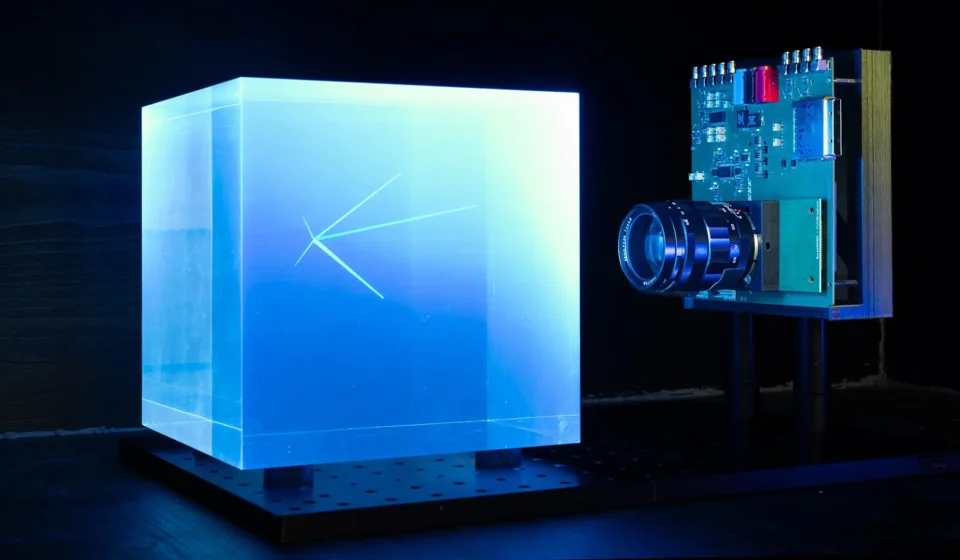
The Future of Particle Detection: How Light-Field Photography is Revolutionizing Subatomic Imaging

In the high-stakes world of particle physics, progress is often measured in millimeters and nanoseconds. For decades, the gold standard for tracking elementary particles—such as neutrinos and elusive dark matter candidates—has been the "segmented" detector. These massive, complex instruments rely on dividing vast volumes of material into millions of individual sensing units to capture the faint, fleeting signals of subatomic interactions.
However, this reliance on massive segmentation has reached a technological and financial plateau. A collaborative team from ETH Zurich and EPFL has unveiled a radical departure from this paradigm: the PLATON project. By repurposing light-field photography—a technology more commonly associated with artistic 3D imaging—researchers have successfully demonstrated a method to perform high-resolution particle tracking in large, unsegmented blocks of scintillator material. This innovation, recently published in Nature Communications, promises to redefine how we observe the invisible building blocks of the universe.
The Bottleneck of Modern Physics
To understand the significance of PLATON, one must first appreciate the logistical nightmare of modern particle detection. Experiments like the T2K neutrino-oscillation project in Japan are feats of engineering, requiring approximately two tons of sensitive material. To track particles within this mass, scientists currently divide it into nearly two million individual scintillator cubes, each wired to optical fibers that ferry photons to sensitive photomultiplier tubes.
While this "brute force" approach provides the necessary spatial resolution, it is inherently difficult to scale. As detector volumes grow to meet the requirements of next-generation experiments, the complexity of manufacturing, assembling, and maintaining millions of fragile, interconnected components becomes a prohibitive barrier. The cost of such experiments often balloons, and the risk of hardware failure increases with every additional segment added to the grid. The physics community has been searching for a way to maintain this sub-millimeter precision without the infrastructure of a literal city of sensors.
A Chronology of Innovation: From Labs to Prototypes
The development of PLATON represents a pivot from traditional hardware engineering toward computational imaging.
- The Conceptual Phase: Recognizing the limitations of segmented detectors, researchers at ETH Zurich, led by Professor Davide Sgalaberna, began exploring whether a single, large block of scintillator could be imaged from the outside.
- The Partnership: The project coalesced when the ETH team joined forces with the Advanced Quantum Architecture Lab at EPFL, led by Professor Edoardo Charbon, a pioneer in high-speed, single-photon imaging.
- Proof-of-Concept: PhD student Till Dieminger and senior scientist Dr. Saúl Alonso-Monsalve spearheaded the development of the prototype. By integrating a micro-lens array (MLA)—supplied by Raytrix GmbH—directly onto a SwissSPAD2 imaging sensor, the team created a functional light-field camera capable of detecting individual photons.
- Experimental Validation: Using a strontium-90 source to generate electrons, the team tested the device’s ability to reconstruct particle tracks within a solid plastic scintillator block. The results, corroborated by extensive simulations, proved that the system could accurately map 3D positions even when the total light detected was as low as five photons.
Decoding the Physics of Light-Field Photography
At the heart of the PLATON detector lies the concept of the plenoptic camera. A standard camera collapses a 3D scene into a 2D image, recording intensity and color. A light-field camera, however, captures the direction of incoming light.
By placing a micro-lens array between the camera’s main aperture and its sensor, each lens acts as a localized "eye." These lenses record the same scene from slightly different perspectives. When this raw data is synthesized, the system reconstructs a 4D light field, providing the depth information necessary to trace a particle’s path in three dimensions.
For particle physics, the challenge is that the light produced by a particle passing through a scintillator is incredibly faint. This is where the integration of Single-Photon Avalanche Diode (SPAD) arrays becomes revolutionary. SPAD sensors are ultra-sensitive, capable of registering the impact of a single photon. By using the SwissSPAD2 sensor, the PLATON team introduced "gated photon detection." This allows the detector to open its "shutter" only during precise, defined time windows, effectively silencing background noise and spurious counts that would otherwise overwhelm the faint signal of a particle interaction.
Supporting Data and Simulation Performance
The performance metrics reported in Nature Communications suggest that PLATON is not merely a theoretical curiosity but a viable replacement for segmented detectors. In laboratory tests, the spatial resolution remained consistent even as the light intensity dropped significantly, confirming the robustness of the light-field reconstruction algorithm.
Perhaps more compelling are the simulations for future, larger-scale applications. Using a Transformer-based neural network—an architecture borrowed from the world of Large Language Models (LLMs)—the team modeled how an unsegmented 10x10x10 cm³ block of scintillator would perform. The neural network, trained to recognize the spatial and temporal correlations of scintillation light, was able to reconstruct particle tracks with sub-millimeter resolution.
When extrapolated to a one-cubic-meter detector—the scale required for many neutrino experiments—simulations indicate that the system would achieve resolution on par with current state-of-the-art detectors. Crucially, this performance is achieved without the millions of physical segments currently required, representing a massive reduction in assembly complexity and material cost.
Official Perspectives: The Path Forward
Professor Davide Sgalaberna and his colleagues emphasize that the transition from a 10cm prototype to a 1-meter detector is the primary objective for the coming years. "The goal is to maintain this level of precision while moving toward larger volumes," notes the team.
The researchers are currently developing a third-generation SPAD array. Unlike the current version, which uses fixed time windows, the next iteration will assign a high-precision time stamp to every individual photon. This level of temporal resolution will allow the neural network to "see" the trajectory of a particle with unprecedented clarity, significantly reducing the "noise" of unwanted signals. Furthermore, by optimizing the optical design of the micro-lens array, the team aims to widen the field of view, allowing a single camera system to monitor an even larger volume of scintillator.
Broader Implications: Beyond the Laboratory
The impact of PLATON may eventually extend far beyond the underground caverns of particle colliders. The researchers have already secured three patents for the application of this technology in Positron Emission Tomography (PET) scanning.
In a medical context, PET scans are used to map the metabolic activity of tissues by tracking radioactive tracers in the body. Current PET scanners are essentially large, complex ring-detectors that are expensive to build and maintain. If the PLATON approach can achieve equivalent or superior image reconstruction in medical imaging, it could lead to the development of more compact, efficient, and affordable PET scanners. This would increase the accessibility of high-end diagnostic tools, potentially enabling earlier detection of cancers and neurological diseases.
The history of scientific progress is littered with examples of "crossover technology." Just as the World Wide Web was born from the data-sharing needs of CERN, and proton therapy emerged from the cooling systems of particle accelerators, PLATON stands as a testament to the utility of fundamental physics. By solving the specific, extreme problems of particle detection, researchers are inadvertently crafting the tools that will define the next generation of medical diagnostics and imaging.
As the team prepares to scale their prototype, the physics community watches with anticipation. If the unsegmented detector proves as scalable as the initial simulations suggest, the era of building "cities" of sensors may soon give way to a more elegant, computational approach—one where the light-field camera acts as a window into the subatomic world, clear and unsegmented.