




Revolutionizing Aerospace Manufacturing: The Multi-Metal Breakthrough in Additive Tooling

In a significant leap for industrial manufacturing, Oak Ridge National Laboratory (ORNL) and Boeing have successfully produced a massive, two-ton steel Stamp Form Die (SFD) mold using wire-arc additive manufacturing (WAAM). This collaboration, conducted at the Department of Energy’s Manufacturing Demonstration Facility (MDF), represents a paradigm shift in how complex, large-scale industrial tools are fabricated. By leveraging multi-metal printing and integrated thermal management, the project addresses critical bottlenecks in the production of thermoplastic composite aircraft parts, potentially reshaping the future of the aerospace supply chain.
Main Facts: A Colossal Achievement in WAAM
The project resulted in a tool standing six feet tall and four feet wide, weighing nearly two tons. Printed over an intensive eight-week period, the mold is designed for use in NASA’s Hi-Rate Composite Aircraft Manufacturing (HiCAM) project.
The SFD is a fundamental component in aerospace manufacturing, acting as a high-pressure punch used to cut or form materials into precise shapes. Traditionally, these tools are produced through subtractive methods—machining, casting, forging, and drilling—which are notoriously time-consuming and expensive. The ORNL-Boeing initiative demonstrates that additive manufacturing is no longer limited to small, intricate parts but can scale to the massive, structural requirements of commercial aviation.
The technical brilliance of the project lies in its "multi-material" approach. The tool utilizes mild steel for its structural core, providing the necessary strength and stiffness, while the working surface is composed of stainless steel. This combination offers the best of both worlds: a cost-effective, robust foundation coupled with a durable, corrosion-resistant surface that ensures dimensional stability during the high-heat forming process.
Chronology: From Digital Simulation to Physical Reality
The journey from concept to a functional, two-ton reality was defined by rigorous iteration and advanced engineering.
Phase I: Planning and Simulation
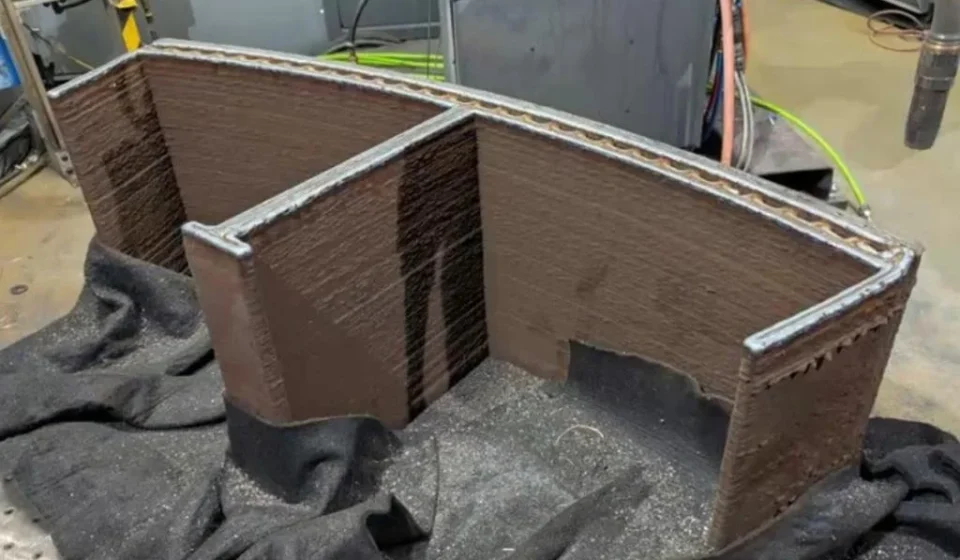
Before a single drop of metal was deposited, the team at ORNL engaged in extensive residual stress simulation. The primary challenge of large-scale WAAM is distortion; as molten metal cools, the resulting thermal contraction can twist the structure, rendering it useless. To preempt this, the team performed 32 separate simulation iterations, refining the design to compensate for expected warping.
Phase II: The Printing Process on Arc-1
The mold was fabricated on ORNL’s specialized Arc-1 system. Unlike standard robotic welding platforms, the Arc-1 system features a unique capacity to feed multiple wires simultaneously. This capability allows the printer to switch between different metal alloys mid-build—a feature essential to the structural-versus-surface material requirement of the mold. The system utilizes a robotic arm and welding torch to build the tool layer-by-layer.
Phase III: Structural Stabilization
During the printing process, the team attached temporary support ribs to the rear of the mold to maintain its integrity against the forces of cooling. These ribs served as a "scaffolding" that prevented the massive structure from pulling out of its target dimensions.
Phase IV: Post-Processing and Finishing
Once the print was completed, the mold was transported to Baker Industries, a subsidiary of Lincoln Electric in Michigan. Here, the tool underwent annealing—a heat treatment process designed to relieve internal stresses accumulated during the printing phase. Following annealing, the temporary support ribs were removed, and final CNC machining was performed to meet Boeing’s stringent aerospace-grade tolerances.
Supporting Data: Why This Matters
The shift toward additive manufacturing for large tools is driven by the need to increase production rates for composite aircraft. As demand for global air travel climbs, manufacturers are under pressure to produce lighter, more fuel-efficient aircraft at a faster pace.
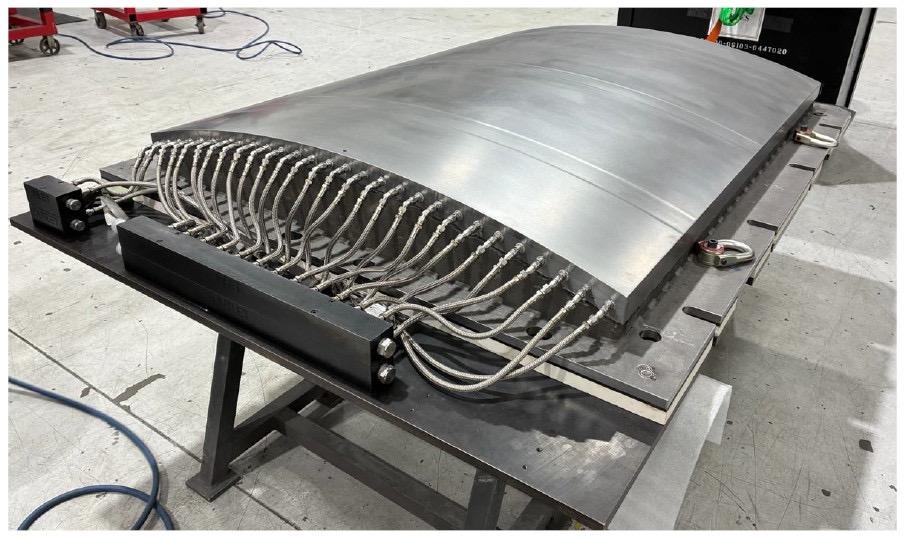
A standout feature of this printed mold is the inclusion of "conformal cooling channels." In traditional molds, heating and cooling fluids are routed through straight, drilled holes. However, these holes cannot easily follow complex geometries. Because the tool was 3D printed, the engineering team was able to incorporate curved, internal channels that follow the exact contours of the mold surface. This allows for significantly more efficient heat transfer, resulting in faster cycle times and higher-quality composite parts.
While the project did not publicly disclose specific cost-to-savings ratios compared to traditional casting, the ability to eliminate months of lead time associated with forged or cast tooling is a major competitive advantage. For an industry where "tooling lead time" can stretch into 24 months, the capacity to iterate and manufacture tools in a matter of weeks is a game-changer.
Official Responses: Aligning for the Future
The collaboration represents a concerted effort between public research institutions and private aerospace giants to maintain American competitiveness.
William Carter, an ORNL robotics engineer at the MDF, noted the exploratory nature of the project: "Boeing wanted to explore the possibility of using WAAM. They worked with us to evaluate the issues in making the mold."
The strategic importance of this development was highlighted by Richard Young, NASA HiCAM project manager. "NASA and its industry partners are working to increase the production rate of composite aircraft to meet the growing demand for air travel and to reduce aircraft weight," Young stated. "Doing so is essential to maintaining U.S. competitive advantage in the commercial aircraft industry."
Andrzej Nycz, a senior robotics engineer at ORNL, emphasized the technological leap, stating, "Multi-material WAAM allows for the realization of completely new designs, combining fine-tuned mechanical performance with time and cost savings."
Implications: The Industrialization of Additive Manufacturing
The success of this two-ton mold serves as a proof-of-concept for a broader range of industrial applications. According to Ahmed Arabi Hassen, ORNL’s group leader for Composites Innovation, the test case was a success, suggesting that this technology could be scaled for the energy and automotive sectors, where large, high-performance tooling is similarly essential.
The Broader Landscape of WAAM
This project does not exist in a vacuum. It is part of a global push to validate wire-arc manufacturing for aerospace.
- Eligio Re Fraschini and Caracol: In Italy, these companies recently demonstrated a 50% weight reduction in a spar tool used for carbon fiber lamination. While their tool was smaller (110 kg) and utilized a single alloy, it showcased the speed and efficiency of WAAM in replacing conventional tooling.
- AML3D: The Australian firm is currently engaged in a three-year R&D project to qualify WAM for aerospace tooling, specifically targeting the 24-month lead time bottleneck that plagues the industry.
However, the ORNL/Boeing mold stands out due to its technical complexity. By combining multi-alloy deposition with conformal thermal control at a two-ton scale, the team has moved beyond simple geometry printing into the realm of functional, high-performance tooling.
The Path Forward
The implications for the future are clear: the "black box" of industrial tooling is being opened. As additive manufacturing moves toward the qualification of its processes, we can expect to see a drastic reduction in the time required to bring new aircraft designs to market. The ability to print tools on-demand, with optimized internal channels and tailored material properties, marks the transition of 3D printing from a prototyping novelty to the backbone of heavy industrial production.
As the industry moves toward 2026 and beyond, the focus will shift from "can we print it?" to "how do we certify it?" The work done by ORNL and Boeing serves as the foundational blueprint for this transition, signaling that the era of massive, high-efficiency, printed tooling has officially arrived.