


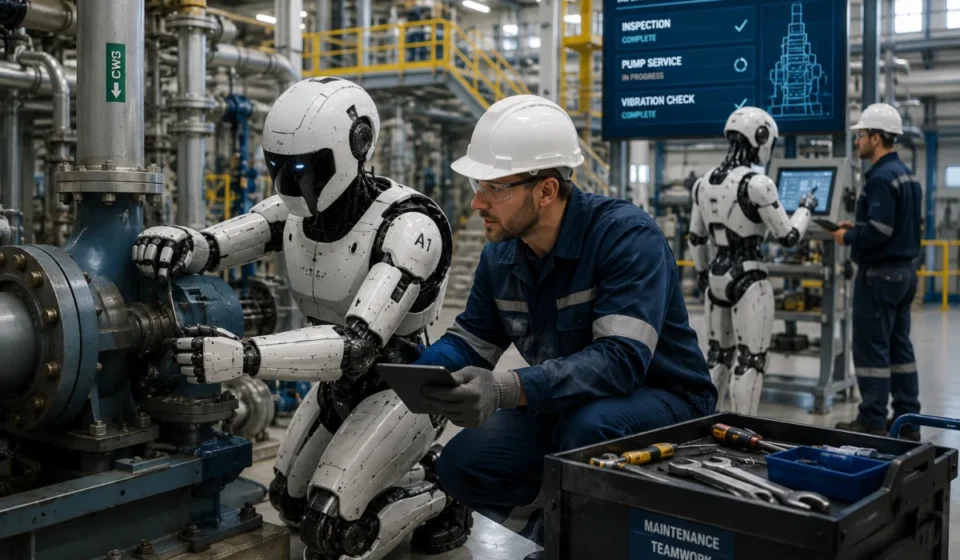
From Lab Bench to Shop Floor: The New Era of Physical AI in Industrial Maintenance

By Ahmed Rezika, SimpleWays OU | July 9, 2026
For decades, the concept of a humanoid robot walking the halls of a factory was relegated to the realm of science fiction. Today, that narrative has shifted from speculative theory to tangible industrial reality. Physical AI—the integration of advanced artificial intelligence into mobile, robotic platforms—has moved beyond the controlled environment of the laboratory and onto the production floor.

Companies like Tesla, Boston Dynamics, and Figure AI are no longer merely showcasing prototypes; they are deploying systems capable of walking, manipulating complex objects, and executing multi-step tasks in semi-structured industrial environments. While we have not yet reached the threshold of "full autonomy," we have definitively crossed the line from theory to practice.
The Chronology of Capability: Learning from Autonomous Driving
To understand the trajectory of Physical AI, one must look at the evolution of autonomous driving. Ten years ago, the idea of a vehicle navigating a city street without a human driver was widely dismissed as an impossibility. Today, systems like Waymo operate at scale, conducting commercial rides in complex urban environments without a human operator at the wheel.

The lesson here is not that timelines are exact, but that technological capability compounds faster than human expectation. Physical AI today mirrors the state of autonomous driving a decade ago: it is not yet fully mature, but it is already functional within controlled, defined conditions. For the maintenance professional, the question has shifted from "Will this ever reach the shop floor?" to "Which maintenance tasks are structured enough to be the first to adopt it?"
Main Facts: The Hardware of Modern Maintenance
What is being demonstrated today is measurable and grounded in physics. Take the latest Boston Dynamics Atlas platform. With 56 degrees of freedom, an instant weight capacity of 50 kg, and a sustained handling capacity of 30 kg, these machines are built for the rigors of industrial work.
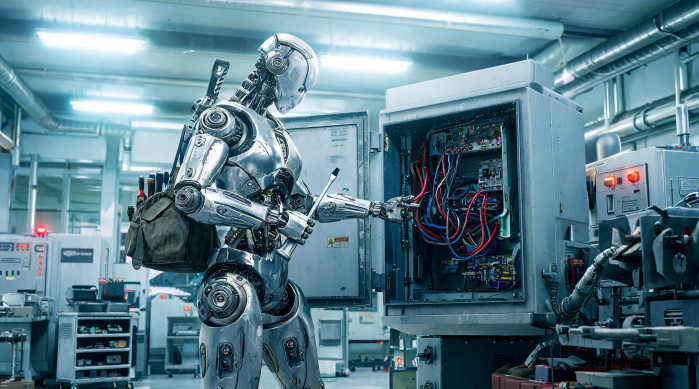
Crucially, these robots are designed to function in extreme temperature ranges, from -20°C to 40°C. They are equipped with 360-degree vision and sophisticated tactile feedback systems. This combination of strength, reach, and environmental tolerance puts these platforms squarely within the operational parameters of many routine maintenance tasks.
However, unlike traditional, floor-bolted industrial robots—which have outperformed human lifting capacity for decades—these new systems prioritize mobility and adaptability. While a six-axis arm is confined to a rigid workspace, an Atlas-style humanoid can navigate stairs, crouch under equipment, and reach around obstacles to access machinery designed for human interaction.
Supporting Data: Proof of Concept in the Field
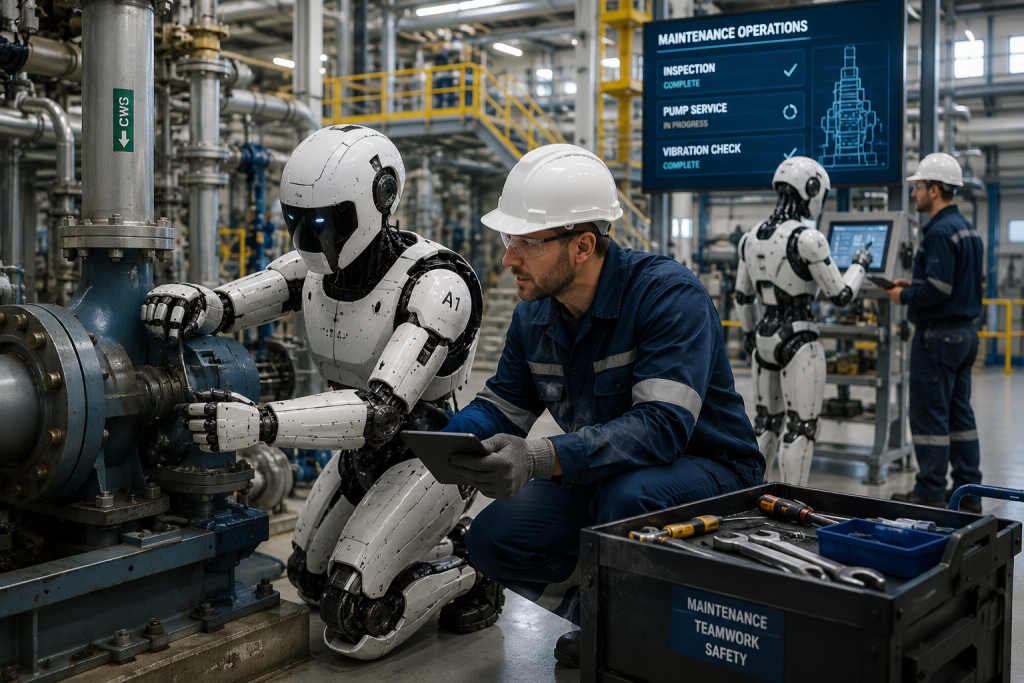
The transition from demonstration to deployment is best exemplified by the recent BMW-Figure pilot program. During this deployment, Figure humanoids accumulated approximately 1,250 operating hours, successfully handling over 90,000 components and supporting the production of more than 30,000 vehicles.
These figures represent a watershed moment. The achievement was not the act of assembly itself, but the demonstration of sustained, safe operation in a live factory environment. The robots proved capable of navigating dynamic workspaces, locating workstations, and repeating precise tasks alongside human workers.

Current Performance Benchmarks
- Sensor Fusion: By integrating LiDAR, thermal imaging, and acoustic sensors, these systems can monitor equipment conditions in real-time. They can compare live data against historical baselines, effectively acting as mobile condition-monitoring units.
- Locomotion: Utilizing optimization-based control, these robots perform "closed-loop" movement. They do not follow pre-scripted paths; they constantly adjust their balance and step placement in response to floor conditions, enabling them to move across uneven industrial surfaces safely.
- Dexterity: While dexterity remains the primary technical bottleneck, progress is accelerating. Research from Yale University and other institutions on robotic hands that mimic the 33 standard human grasp types suggests that we are closing the gap between robotic "handling" and human "manipulation."
Implications for Maintenance Strategy
As these platforms mature, they will not replace the maintenance technician. Instead, they will fundamentally alter the composition of the maintenance workflow.
1. The Automation of Routine Inspections
Inspection routes are prime candidates for Physical AI. These tasks are repetitive, structured, and governed by strict standard operating procedures. A humanoid robot can execute these rounds with perfect consistency, generating reports and flagging anomalies without the cognitive fatigue that often plagues human inspectors. The limitation remains in contextual judgment—while the robot can identify a high-temperature reading, the decision on whether that reading constitutes a failure or a harmless operational fluctuation still requires human engineering expertise.

2. Standardized Preventive Maintenance
Tasks such as lubrication, filter replacement, and routine adjustments are highly standardized. A robot can be programmed to identify a grease nipple, apply the correct lubricant, and record the completion of the task. The challenge arises when reality deviates from the manual—a seized fitting or a contaminated bolt requires the kind of improvisation that is currently the exclusive domain of the human technician.
3. Logistical Support and Tooling
Maintenance technicians currently lose a significant portion of their day to the "non-value-added" task of transporting tools and parts between the workshop and the site of repair. Physical AI can assume this logistical burden, ensuring that the right tools and parts are staged at the equipment location before the technician arrives. This allows skilled personnel to focus their energy on high-level diagnosis and complex repairs.

Limitations: Where the Human Edge Remains
Despite the rapid advancement of Physical AI, there are distinct "boundary conditions" where the human technician remains superior.
- Dexterity Under Variation: While robots are excellent at handling standardized components, they struggle with "unstructured" environments where shapes, weights, and conditions vary.
- Contextual Understanding: A human technician can walk into a facility and understand that a specific sound or smell indicates a looming problem, even if the sensors haven’t triggered an alarm. This "tacit knowledge" is the current horizon for AI research.
- Unplanned Adaptation: Industrial assets do not age uniformly. Corrosion, undocumented field modifications, and cramped access points often require the unique human ability to "work around" a problem.
Official Industry Perspectives
In its 2025 analysis, McKinsey & Company noted that the "chasm" between concept and commercial reality is being bridged by focusing on high-predictability, low-variance tasks. They identify inspection rounds and material transport as the "low-hanging fruit" for early adoption. The consensus among industry leaders is that we are entering a phase of "Assisted Maintenance," where the robot acts as a force multiplier for the human workforce.
Conclusion: Preparing for the Future
The emergence of Physical AI is not a signal to abandon traditional skills; it is an invitation to elevate them. As repetitive physical labor is increasingly offloaded to robotic systems, the role of the maintenance professional will shift further toward diagnostic reasoning, data analysis, and complex problem-solving.
The pattern is clear: Physical AI excels where the workflow is measurable, documented, and repetitive. Its value proposition decreases as the task complexity—and the need for engineering judgment—increases.

For maintenance organizations, the path forward is to audit current maintenance tasks. Which routines are "structured enough" to be automated today? By starting with these, organizations can build the digital and operational infrastructure necessary to integrate these systems. We are no longer discussing a distant future; we are discussing the integration of the next generation of industrial tools. The era of the "smart" maintenance facility is here—and it walks on two legs.
Glossary of Key Terms
- Dexterity: The ability to manipulate objects with the precision and skill of a human hand, essential for tasks involving fasteners, tools, and fragile components.
- Degrees of Freedom (DoF): The number of independent movements a robot can perform. High DoF is critical for navigating human-centric environments like staircases and tight corridors.
- Sensor Fusion: The integration of data from multiple inputs (thermal, acoustic, LiDAR, vision) to create a comprehensive understanding of the machine’s state.
- Embodied AI: Intelligence that is not just "in the cloud" but integrated into a physical, moving machine capable of interacting with the physical world.
- Locomotion: The ability of a humanoid to move through space, maintain balance, and adapt to obstacles in real-time, moving beyond scripted paths to dynamic movement.