





In a landmark development for the field of quantum physics, researchers at the Max Planck Institute for the Science of Light (MPL) have successfully pushed the boundaries of molecular stability. By overcoming the persistent challenge of surface-level "noise," the team has demonstrated, for the first time, that individual molecules attached to a solid surface can reach the ultimate quantum limit of optical coherence.
This breakthrough, recently detailed in the journal Science, marks a fundamental shift in how scientists approach the manipulation of quantum emitters. By achieving what is known as the "Fourier limit"—the theoretical maximum duration for which a quantum system can maintain its coherence—the MPL team has unlocked a new paradigm for studying molecular interactions, potentially accelerating the development of next-generation quantum computers, sensors, and secure communication networks.
The Quantum Emitter Dilemma
At the heart of emerging quantum technologies lies the "quantum emitter." These are infinitesimal objects, such as individual atoms or molecules, capable of interacting with light to produce single photons. These photons are the currency of quantum information; they can carry data across vast distances and serve as the backbone for quantum computing architectures.
To utilize these emitters, scientists must solve a difficult containment problem: they must keep the emitter perfectly still and isolated from external interference. Historically, this has been achieved by suspending atoms in a vacuum or burying them deep within solid crystals. While effective, these methods present a limitation—they are notoriously difficult to manipulate.
The scientific community has long eyed surfaces as the ideal "worktable" for quantum experiments. If a molecule were placed on a surface, it could theoretically be touched, probed, and repositioned using tools like Scanning Tunneling Microscopy (STM) or Atomic Force Microscopy (AFM). These instruments allow researchers to interact with matter at the sub-nanometer scale. However, there has been a catch: the "dirty" nature of real-world surfaces.
"Surfaces are notoriously difficult environments," explains the research team. "They are magnets for contaminants from the atmosphere, which create a noisy, unstable environment that decoheres quantum systems almost instantly." Until now, this environmental "static" has prevented scientists from studying molecules on surfaces with the precision required for quantum applications.
A Chronology of Discovery: The Sublimation Solution
The breakthrough at MPL’s Nano-Optics Division, led by Professor Vahid Sandoghdar, did not come from a new laser or an exotic material, but from a clever application of thermodynamics.
The Cleaning Phase
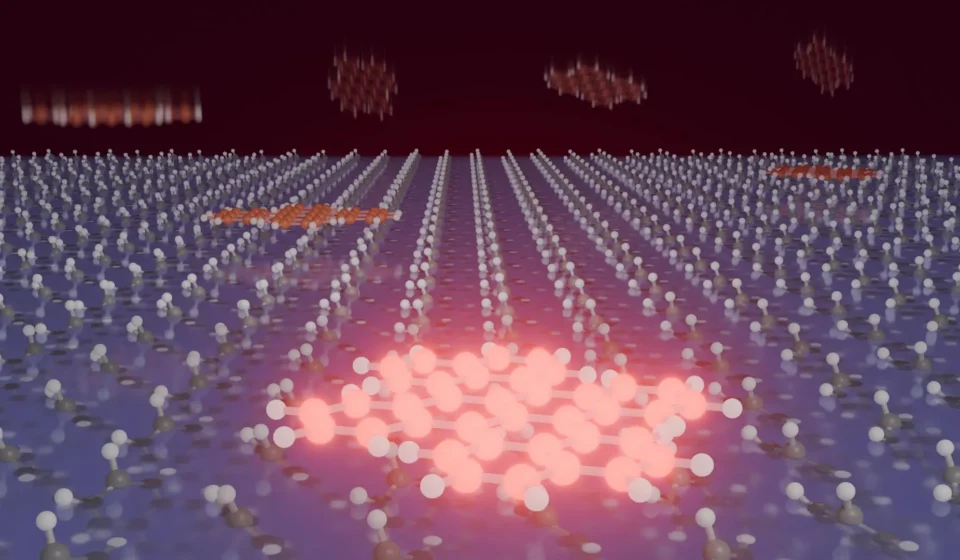
The team focused on organic crystals, noting a specific natural property: sublimation. Sublimation is the process where a solid transitions directly into a gas, bypassing the liquid phase. The researchers realized that if they could control this process, they could essentially "peel" the surface of a crystal to expose a pristine, atomic-scale layer.
In a controlled experiment, the team placed an organic crystal inside a cryostat—a specialized vacuum chamber designed to reach temperatures near absolute zero. By carefully managing the temperature, they induced a slow sublimation of the crystal’s topmost layers. As these layers evaporated, they acted as a self-cleaning mechanism, carrying away any lingering surface contaminants.
The Preservation Phase
Once the surface was purged of impurities, the team rapidly cooled the crystal to a few degrees Kelvin above absolute zero. This extreme cooling served two purposes: it effectively "froze" the sublimation process, ensuring the surface remained stable, and it silenced the thermal vibrations that usually disrupt quantum states.
The Deposition Phase
With the stage set, the researchers employed a micro-fabricated oven to gently deposit individual molecules onto the ultra-clean, frozen crystal surface. This sequence—cleaning via sublimation, stabilization via cryogenics, and controlled deposition—created the first truly "quiet" environment for surface-bound quantum emitters.
Supporting Data: Reaching the Fourier Limit
The success of the experiment was measured by "coherence time"—the duration for which a quantum system can maintain its quantum state. In the fragile world of quantum mechanics, coherence is fleeting. Disturbances from the environment cause "decoherence," where the quantum information leaks out and is lost, often thousands of times faster than physics theoretically allows.
The theoretical benchmark for this is the "Fourier limit," a boundary defined by the laws of energy conservation. When a quantum emitter releases its energy into its surroundings, it must do so at a specific rate. If the environment is "noisy," this energy release is chaotic, and coherence collapses prematurely.
When Dr. Alexey Shkarin and his colleagues measured the molecules on their pristine surface, they found that the coherence times aligned perfectly with the Fourier limit. "This was the smoking gun," the researchers noted. "The fact that the molecules reached the Fourier limit proved that the surrounding surface environment was, for all intents and purposes, perfectly quiet." It was the first time this fundamental physical limit had been observed in a surface-bound system, validating the team’s methodology.
Official Perspectives: The Path Forward
Professor Vahid Sandoghdar, Director at MPL and head of the Nano-Optics Division, views this as a foundational step toward a new era of quantum engineering. "We have proven that surfaces do not have to be the enemies of quantum coherence," Sandoghdar stated.
The research team suggests that the influence of the surface is not just a nuisance to be overcome, but a potential tool for discovery. Their data indicates that the surface actually shapes the molecules in subtle ways, influencing their orientation, energy levels, and vibrational modes. By adjusting the surface material or the crystal structure, researchers may be able to "tune" the behavior of molecules, effectively programming their quantum properties from the ground up.
Implications for Quantum Technology
The implications of this research are far-reaching. By combining this ultra-clean surface technique with existing microscopy tools like AFM and STM, the MPL team aims to achieve local nanometer-scale control over individual emitters.
1. Advanced Quantum Computing
If individual molecules can be manipulated while maintaining their quantum coherence, they could serve as the building blocks for molecular quantum processors. These systems would be significantly smaller and potentially more scalable than the bulky, low-temperature superconducting qubits currently used in modern quantum computers.
2. Precise Molecular Sensing
The ability to observe how surfaces alter the energy levels and vibrations of a molecule opens doors to hyper-sensitive sensors. Such devices could detect chemical changes or biological processes at the single-molecule level, revolutionizing fields ranging from medical diagnostics to environmental monitoring.
3. Engineering New States of Matter
Beyond immediate applications, the research provides a new "laboratory" for fundamental physics. By placing different molecules on different surfaces and using atomic-scale probes to manipulate them, scientists can explore the interactions between light and matter in ways previously thought impossible.
As the MPL team moves toward the next phase of their research—integrating their cleaning technique with high-precision microscopy—the scientific community watches with anticipation. The barrier between "dirty" surfaces and "pure" quantum systems has been breached, and the potential to engineer matter at the molecular scale has never been closer to reality.
By mastering the interface between the quantum world and the solid surface, the researchers have not only cleared the air—literally—they have provided the tools to build the next generation of quantum architecture.