




From Athletic Spectacle to Industrial Reality: Preparing Humanoid Robots for Plant Maintenance

By Ahmed Rezika, SimpleWays OU
Published October 8, 2026
Executive Summary: Bridging the Gap Between Robotic Athletics and Heavy Industry
Watching humanoid robots sprint across stadium turf, execute backflips, or recover gracefully from unexpected falls is undeniably captivating. These demonstrations are far more than mere entertainment—they serve as high-profile showcases for rapid advancements in dynamic movement, mechanical coordination, multi-axis balance, and physical interaction.
However, for plant managers, reliability engineers, and industrial maintenance veterans, the spectacle must eventually give way to operational reality. Running a 100-meter dash in record time is fundamentally different from identifying a micro-vibration, securing a loose terminal connection, or opening an unfamiliar enclosure on an active production line without causing collateral damage.
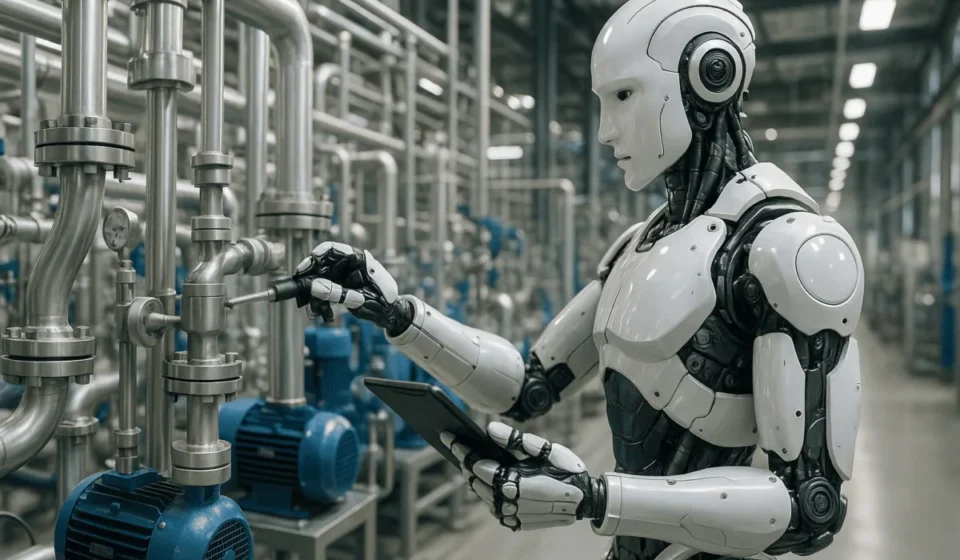
Industrial maintenance demands an entirely different performance standard. It requires repeatability, precision measurement, adaptive responses to chaotic environments, and absolute adherence to equipment and personnel safety protocols. As the conversation shifts from robotic athletic prowess to shop-floor utility, the central question for engineering teams is no longer whether a humanoid robot can perform a stunt once. Instead, it is whether that machine can execute complex tasks thousands of times reliably, recognize anomalies autonomously, and know precisely when to halt operations and request human intervention.
Chronology of Progress: From Simulation Breakthroughs to Real-World Trials
To understand how humanoid robotics is evolving toward industrial capability, it is necessary to trace the technological milestones achieved across recent academic and industrial research initiatives.
Phase 1: Overcoming the Sim-to-Real Barrier (2025)
For years, the primary bottleneck in robotics has been the sim-to-real gap—the performance degradation that occurs when an algorithm trained in a virtual physics engine encounters the friction, sensor noise, and unpredictability of the physical world.
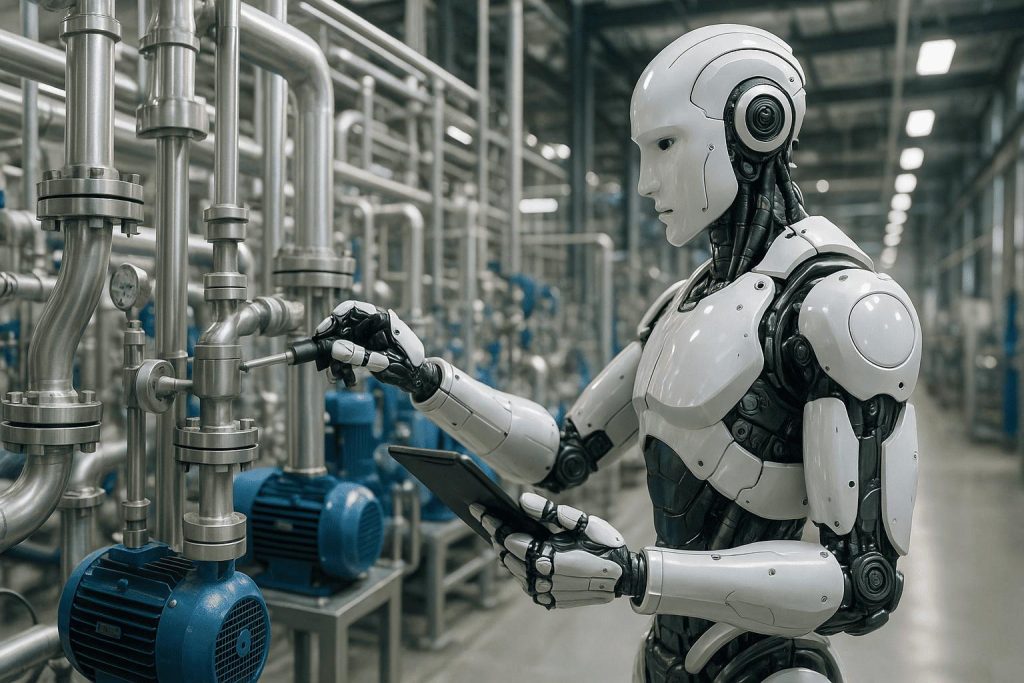
A major turning point occurred in 2025, when robotics researchers demonstrated successful sim-to-real reinforcement learning for vision-based dexterous manipulation on humanoid platforms. By training systems in simulation on core tasks—such as grasp-and-reach operations, box lifting, and bi-manual object handovers—and deploying automated real-to-simulation tuning alongside visual variation, researchers significantly narrowed the gap between digital training and physical execution.
Phase 2: Scaled Loco-Manipulation and Pixel-to-Action Policies (2026)
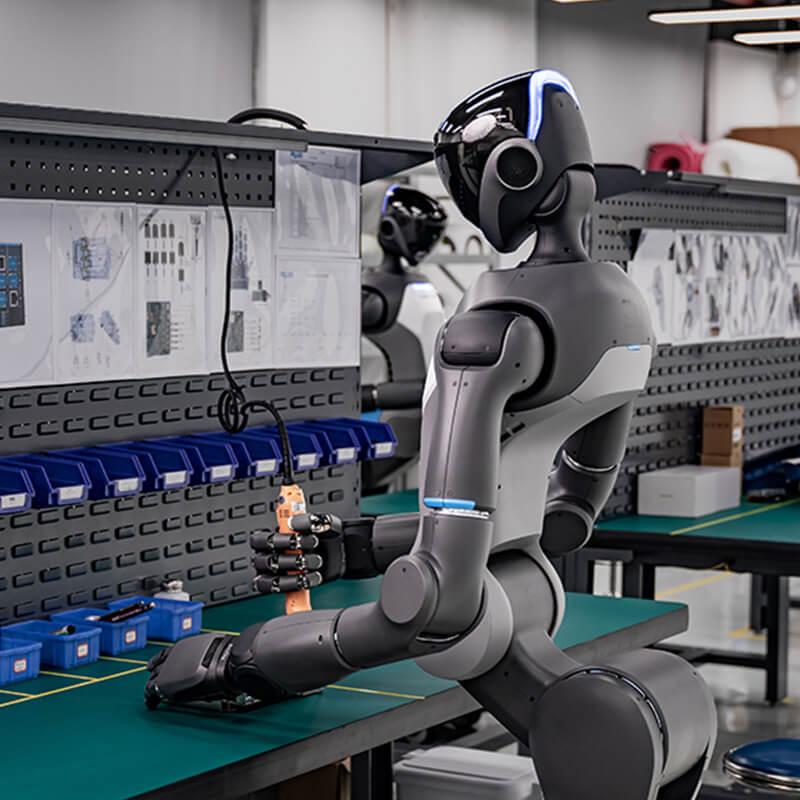
The pace of innovation accelerated dramatically into 2026. Researchers introduced frameworks such as VIRAL (Visual Sim-to-Real at Scale for Humanoid Loco-Manipulation), which trained humanoid movement and manipulation entirely within simulation environments before deploying the software directly onto standard hardware platforms like the Unitree G1 humanoid. By deliberately introducing chaotic randomization into the training data—varying lighting conditions, material textures, camera angles, image quality, and sensor latencies—the resulting robots achieved continuous loco-manipulation in real-world spaces without requiring costly on-site fine-tuning.
Concurrently, parallel 2026 studies enabled humanoid platforms to learn direct pixel-to-action policies entirely from simulated visual data, successfully interacting with complex, articulated objects like industrial access doors.
Supporting Data: Benchmarks, Reinforcement Learning, and Performance Metrics
While simulation provides a safe proving ground, real-world deployment requires rigorous testing frameworks, often driven by advanced reinforcement learning (RL).
The Dual Nature of Robotic Athletics
The contrast between athletic achievement and operational utility was starkly highlighted at the 2026 World Humanoid Robot Games in Beijing. During the event, the Chinese-developed Tiangong Ultra completed a 100-meter dash in 8.86 seconds, surpassing human icon Usain Bolt’s legendary 9.58-second world record. Another humanoid platform, Lightning, clocked a remarkable 9.47 seconds.
Yet, these athletic triumphs coexisted with stark operational failures:
- Several participating robots experienced catastrophic braking failures, crashing into safety barriers.
- Balance mechanisms routinely collapsed when machines attempted to lift unstructured loads, such as a 15-kilogram barbell.
These incidents underscore a fundamental truth for industrial engineering: learning to execute a dynamic motion is not equivalent to controlling every downstream consequence of that action. A robot that can sprint efficiently may struggle to decelerate safely; a machine that can grasp a target object may lose stability when that object shifts unexpectedly.
Harnessing Reinforcement Learning for Plant Tasks
To move beyond hard-coded scripts, engineers utilize reinforcement learning, where an agent achieves a goal through trial, feedback, and iterative refinement—a methodology conceptually akin to DeepMind’s AlphaGo Zero optimizing win probabilities in board games.
In an industrial context, consider task execution like positioning a vibration sensor against a bearing housing. Rather than dictating every joint angle, engineers define a success-oriented reward function. The system receives positive reinforcement for target accuracy, low contact force, and stability, and negative feedback for errors. Through thousands of iterations, the robot discovers optimal approaches:
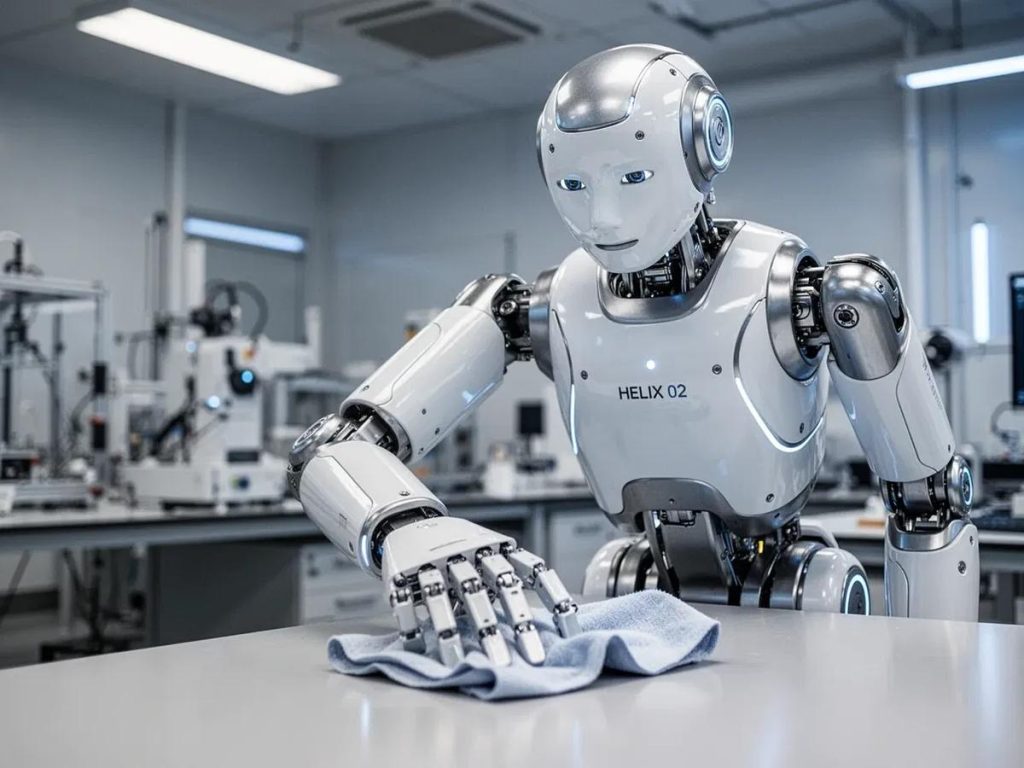
- Approaching from a specific vector to maximize structural stability.
- Modulating insertion force to protect delicate hardware components.
- Repositioning its core chassis before extending manipulator arms.
Recent frameworks, such as HARC (real-world online reinforcement learning via centralized training and critic decomposition), have demonstrated tangible success in accelerating pick-and-place and object-relocation tasks on physical hardware. However, unlike a robot learning to dance or sprint in a controlled gym, an industrial humanoid cannot be permitted to learn through trial and error beside an energized turbine or a high-pressure production line.
Official Perspectives and Industry Frameworks
Leading automation experts and maintenance directors advocate for a hybrid training architecture rather than relying on a single learning paradigm. The emerging consensus for industrial deployment follows a structured pipeline:
$$textDemonstration longrightarrow textSimulation longrightarrow textControlled Practice longrightarrow textAsset Testing longrightarrow textSupervised Autonomy$$

Redefining Performance Metrics for Maintenance
In industrial environments, traditional metrics like execution speed must take a back seat to reliability and safety. Maintenance humanoids should be evaluated against a holistic performance vector:
$$textPerformance = f(textSafety + textAccuracy + textRepeatability + textCorrect Diagnosis + textEquipment Protection)$$
A humanoid that completes a lubrication cycle two minutes faster but damages a critical seal is a liability, not an asset. Similarly, a machine that detects abnormal vibration but fails to recognize when its sensor placement is compromised lacks the baseline autonomy required for plant deployment.

Practical Implications: Where Humanoids Fit on the Shop Floor
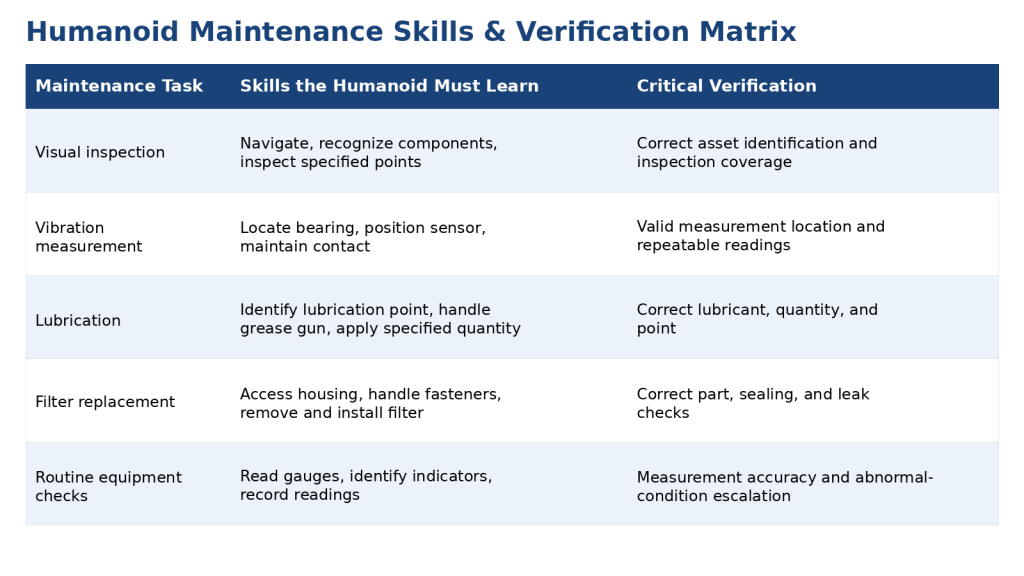
From a maintenance engineering standpoint, humanoid deployment must be approached pragmatically. Not every plant activity requires a bipedal robot; many routine inspections are executed more efficiently by fixed internet-of-things (IoT) sensors, autonomous drones, or wheeled mobile robots.
Humanoid platforms become indispensable only when tasks demand human-centric ergonomics: navigating stairs, maneuvering through tight service corridors, opening standard access panels, and utilizing conventional hand tools.
Phased Integration Strategy
- Non-Invasive Inspection: Initial deployments will likely focus on data collection, thermal imaging, and visual checks in hazardous or high-risk human zones.
- Tool-Based Intervention: As vision-language models and manipulation policies mature, low-risk physical tasks—such as fluid sampling or filter changes—can be evaluated individually.
- Strict Compliance Boundaries: Automated policies can never replace established plant safety protocols. Hazardous energy control, Lockout/Tagout (LOTO) verification, and confined-entry permits will always require human authorization and oversight.
Must-Know Jargon
- Sim-to-Real Gap: The performance discrepancy that occurs when a control policy trained in a virtual simulator is deployed onto physical hardware, driven by unmodeled variables like friction, wear, and sensor noise.
- Loco-manipulation: The simultaneous coordination of whole-body mobility, balance, and fine-motor object manipulation.
- Domain Randomization: A training technique that deliberately alters environmental parameters (lighting, textures, physics properties) in simulation to prepare algorithms for real-world unpredictability.
- Reinforcement Learning (RL): A machine learning paradigm where an agent learns optimal behavior through trial and error, guided by a mathematical reward function.
- Reward Function: A computational formula that defines operational success, prioritizing metrics like safety, accuracy, and equipment preservation over raw speed.
References
- Toru Lin et al., "Sim-to-Real Reinforcement Learning for Vision-Based Dexterous Manipulation on Humanoids," Proceedings of the 9th Conference on Robot Learning, PMLR 305:4926-4940, 2025.
- Tairan He et al., "Visual Sim-to-Real at Scale for Humanoid Loco-Manipulation," Proceedings of the IEEE/CVF Conference on Computer Vision and Pattern Recognition (CVPR), 2026.
- Haoru Xue et al., "Opening the Sim-to-Real Door for Humanoid Pixel-to-Action Policy Transfer," IEEE/CVF CVPR, 2026.
- D. Silver et al., "A general reinforcement learning algorithm that masters chess, shogi, and Go through self-play," Science, 362(6419):1140–1144, 2018.
- Y. Zhang et al., "Efficient Real-World Online Reinforcement Learning for Robot Manipulation via Centralized Training and Critic Decomposition," alphaXiv, August 2026.
- Ahmed Rezika, "Training the Next Maintenance Technician: Can Robots Learn Industrial Tasks," MaintenanceWorld.com, September 2026.