



The Architecture of Growth: Mentoring Humans and Programming Humanoids in an Evolving Industrial Landscape

By Ahmed Rezika, SimpleWays OU
Published: June 9, 2026
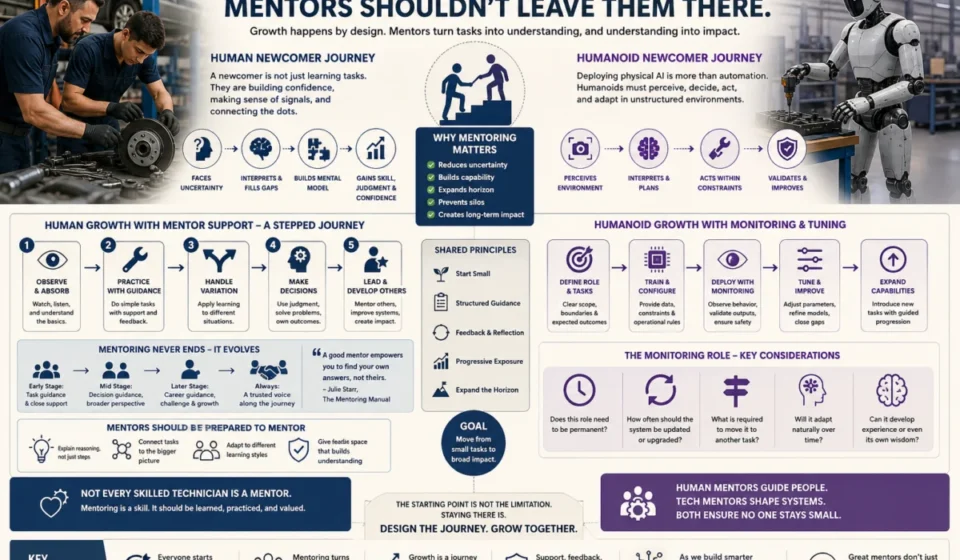
In the quiet corners of a brake repair shop, mastery begins with the mundane. A newcomer starts by removing parts, cleaning grease-caked components, and watching the rhythmic, purposeful movements of a veteran technician. At this stage, the work is purely procedural. Over time, however, the apprentice begins to "feel" the machine. Awareness builds in the periphery; judgment develops in the center. Eventually, the worker moves from following steps to understanding systems.

This trajectory—moving from the specific to the systemic—is universal. Whether in a multi-brand automotive workshop, a high-stakes software engineering team at Meta, or a factory floor, no one begins with full ownership of a complex environment. We start with the manageable, and we grow into the complex. Yet, as we stand on the precipice of an era defined by the integration of humanoids and AI-driven physical systems, we must ask: Are we designing the journey of growth, or are we leaving it to chance?
The Problem of Perpetual Smallness
The primary challenge in modern professional development is that many newcomers stay "small." They master tasks but fail to map the connections between them. They become efficient in a narrow silo, disconnected from the broader operational ecosystem. This is rarely a failure of individual capability; it is a failure of system design. When organizations prioritize immediate output over long-term cognitive development, they inadvertently stifle the very curiosity required to solve complex, non-linear problems.
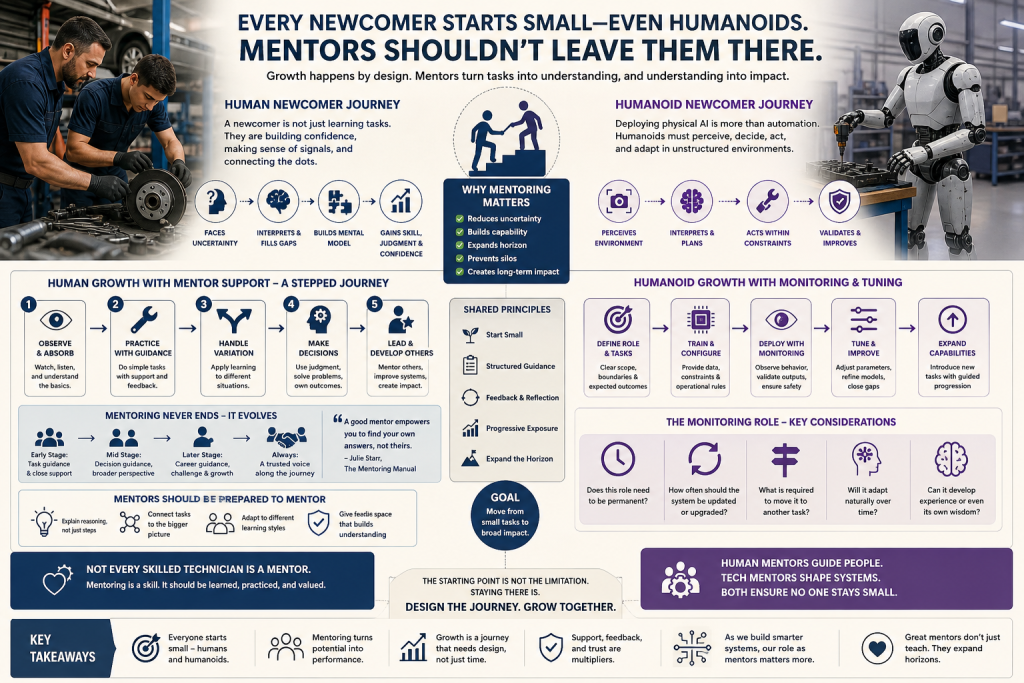
As we introduce robot colleagues into our work environments, this challenge takes on a new dimension. Unlike humans, machines cannot "pick it up." We are forced to be explicit. We define roles, constraints, and validation steps. We design their onboarding with scientific rigor. Yet, for human employees, we often rely on a passive, "sink or swim" approach. In this, we see a glaring discrepancy: we treat humanoid integration as an engineering project while treating human integration as a byproduct of presence.
The Chronology of Capability: From Novice to Expert
The progression of a worker—or an autonomous system—follows a predictable, albeit often interrupted, timeline.

- Observation (The Shadowing Phase): The newcomer enters the environment. Cognitive load is at its peak. The brain is flooded with signals, most of them unspoken.
- Guided Execution: Under the watchful eye of a mentor, the individual performs tasks. Here, the "Zone of Proximal Development" (ZPD) becomes the engine of growth. The mentor provides just enough support to make the challenging achievable.
- Autonomous Operation: The newcomer begins to handle variability. They no longer need to be told what to do; they understand why it matters.
- Systemic Integration: The individual (or system) can now troubleshoot, adapt to changing conditions, and mentor others.
For humans, this transition is mediated by psychological safety. Research by Amy Edmondson highlights that when individuals feel safe to ask "stupid" questions, they learn exponentially faster. Without that safety, silence is often mistaken for understanding, leading to "execution drift"—the gradual erosion of standards as workers rely on incorrect assumptions.
The Humanoid Shift: Operating Without Intuition
A humanoid system entering the same environment faces a different set of challenges. It cannot rely on intuition, context, or the "unspoken" culture of a workplace. As Jensen Huang of NVIDIA has noted, moving AI from the digital realm into the physical world introduces immense complexity. A robot does not "know" that a tool should be kept clean; it must be programmed to recognize the necessity of maintenance within the broader goal of operational efficiency.
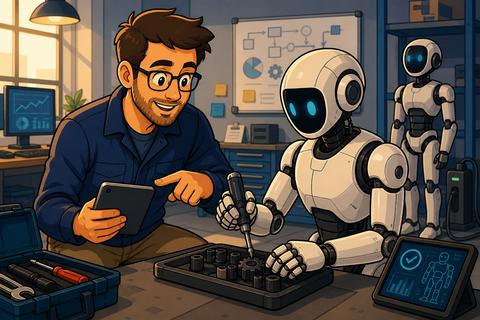
The integration of humanoids—reminiscent of the vision presented in the 2004 film I, Robot—is no longer a cinematic trope; it is a 2035 reality. Because machines lack human "common sense," they force us to define everything explicitly. If a robot is to be a reliable colleague, we must codify our roles, constraints, and success metrics. In doing so, the humanoid exposes a fundamental truth about our own workplaces: what we consider "experience" in humans is often just a collection of implicit, poorly defined rules.
Supporting Data and Theoretical Frameworks
The effectiveness of any onboarding process rests on four key pillars of organizational learning:

- Cognitive Load Theory (Sweller): Learning is hindered when the brain is overwhelmed by extraneous information. By structuring onboarding into discrete, logical modules, mentors reduce the "noise," allowing the newcomer to focus on building a robust mental model of the system.
- Communities of Practice (Wenger): Learning is a social act. Newcomers learn by participating, observing, and engaging in the community. Isolation is the enemy of expertise.
- Experiential Learning (Kolb): True knowledge comes from a cycle of doing, reflecting, and adjusting. A mentor’s job is to ensure the "reflection" phase actually occurs.
- Growth Mindset (Dweck): Framing mistakes as data points rather than failures keeps the newcomer engaged.
When these theories are applied, the "human burden"—the stress of making sense of a chaotic environment—is significantly lowered.
Implications for Industry Leaders
The rise of AI and physical robotics does not diminish the need for human mentoring; it elevates it.
The Evolution of the Mentor
A mentor is not merely a trainer who shows someone which buttons to push. A mentor is a bridge between the individual and the organization. They translate abstract goals into concrete actions. In a world where humans and humanoids will increasingly work side-by-side, the mentor’s role shifts:
- For humans: The mentor activates curiosity and builds the mental scaffolding required for independent judgment.
- For humanoids: The "mentor" becomes the designer, the tuner, and the monitor. They define the parameters, validate the outputs, and iterate on the system’s behavior.
Training the Trainers
Many organizations make the mistake of assuming that a "10x-coder" or a "top-tier technician" is inherently a good mentor. This is a false equivalence. Mentoring requires a distinct set of skills: the ability to observe, the patience to allow for "productive struggle," and the insight to adjust their teaching style to the individual’s learning curve. We must train our mentors to build confidence without lowering standards.

Official Perspectives: The Path to 2035
As we look toward 2035, the distinction between "mentoring" a human and "monitoring" a humanoid will blur. Both processes require the same fundamental components: clear roles, defined tasks, explicit constraints, and measurable outcomes.
Industry leaders like Elon Musk and Yann LeCun emphasize that the physical world is far less predictable than the digital one. Variability is the constant. Whether it is a human apprentice dealing with a rusted bolt or a humanoid robot navigating a cluttered warehouse, the system must be capable of handling the unexpected.

The primary difference is the mechanism of adaptation. Humans adapt through awareness and intuition; humanoids adapt through structured, iterative tuning. However, both require a "designer of behavior" who can oversee the transition from a small, task-focused starting point to broad, systemic capability.
Conclusion: Designing the Future of Work
Every newcomer starts small—even a state-of-the-art humanoid. The danger is not the starting point; the danger is the assumption that the newcomer will naturally "grow out of it."

Growth is not a function of time; it is a function of design. Organizations that invest in the human element of mentoring will find that they are better equipped to integrate the humanoid element of monitoring. By formalizing our knowledge, clarifying our expectations, and fostering a culture of continuous reflection, we do more than just improve efficiency. We build a workplace where both people and machines can reach their full potential.
The journey from a task-doer to a system-thinker is the most important path an employee—or a system—can take. Let us ensure that our organizations are built to facilitate that journey, not block it.
Must-Know Jargon for the Modern Industrialist
- Mentoring: A structured, ongoing relationship where an experienced guide facilitates another’s growth, focusing on judgment and decision-making rather than simple task instruction.
- Cognitive Load: The total mental effort being used in the working memory. Managing this is critical for preventing "newcomer overwhelm."
- Zone of Proximal Development (ZPD): The "sweet spot" of learning—tasks that are too hard to do alone but manageable with the right guidance.
- Experiential Learning: The process of learning through reflection on doing. It turns raw experience into wisdom.
- Psychological Safety: The belief that one will not be punished or humiliated for speaking up with ideas, questions, or mistakes.
- Human-in-the-Loop (HITL): A model where human oversight is integrated into automated systems to ensure safety, accountability, and ethical alignment.
- Onboarding: The structured lifecycle of integrating a new entity (human or robotic) into a workflow, ensuring they are safe, capable, and aligned with organizational goals.
Selected References
- Vasileva, O., & Balyasnikova, N. (2019). (Re)Introducing Vygotsky’s Thought. NIH.
- Tierney, A. (2016). Communities of Practice in Life Sciences. F1000Research.
- Clark, C., & Kimmons, R. (2026). Cognitive Load Theory. EdTech Books.
- Edmondson, A. C. (2022). Psychological Safety in Organizations. Harvard Business School.
- Starr, J. (2026). The Mentoring Manual: Tools for Empowerment. LearnStarr.
- Kolb, D. A. (1984). Experiential Learning: Experience as the Source of Learning. Prentice-Hall.
- Dweck, C. S. (2006). Mindset: The New Psychology of Success. Random House.
- LeCun, Y., et al. (2026). Why AI Systems Don’t Learn: Lessons from Cognitive Science. arXiv.
- Hassabis, D. (2022). Using AI to Accelerate Scientific Discovery. University of Oxford Lecture Series.