



Next-Generation Electrical Assembly and Harness Manufacturing: Innovations Driving Speed, Ergonomics, and Precision

As global manufacturing sectors face increasing pressures to accelerate production, reduce error rates, and improve operator ergonomics, component and machinery suppliers are stepping up with advanced tooling and systems. Modern manufacturing environments—ranging from high-end aerospace and medical device assembly to cutting-edge robotics and data center infrastructure—demand unprecedented levels of precision and reliability.
This report examines a wave of technological advancements and product launches across the wire processing, crimping, and connectivity sectors. By merging digital automation with mechanical refinements, these innovations address persistent bottlenecks in harness assembly, quality control, and panel building.
Main Facts: A Snapshot of Current Industry Innovations
Recent product rollouts highlight a concerted industry-wide push toward modularity, digital connectivity, and operator well-being. Key developments include:

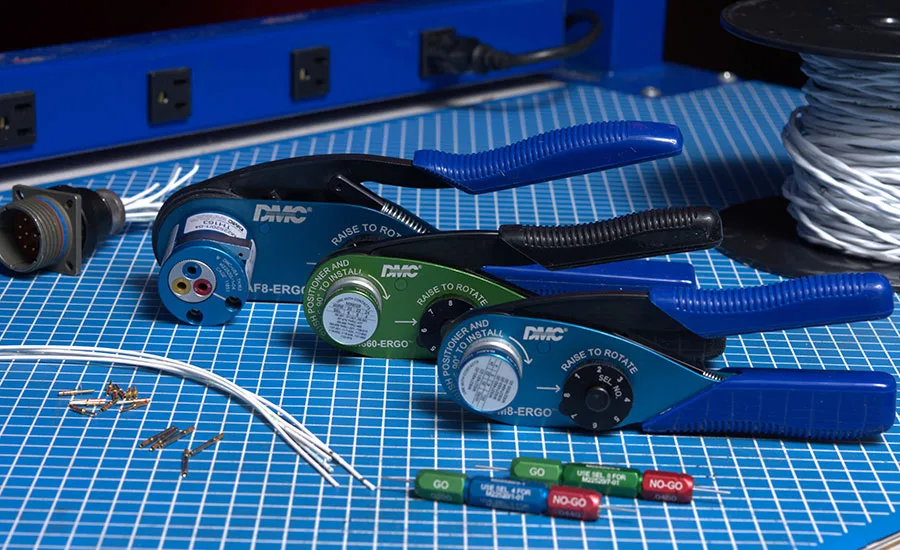
- Ergonomic Crimp Tools: Next-generation hand tools (such as the Gen 2 Ergo Series from manufacturers utilizing military-qualified platforms like M22520) reduce the physical strain on operators while maintaining compatibility with legacy turrets and positioners. Innovations include a 32 percent reduction in handle span and a 20 percent decrease in required crimping force.
- Digital Assembly Boards: Systems like Komax Group’s EasyWiring Board—integrated with testing units like the Cirris 8100—replace traditional paper-guided wooden boards with continuous digital data streams, cutting production times by up to 70 percent.
- Specialized Micro-Connectors: Molex’s MiniMix hybrid power and signal connectors target space-constrained multi-axis joints in humanoid robots, streamlining installation in tight mechanisms like wrists, ankles, and necks.
- Modular Networking and Gateways: Phoenix Contact’s PLC-Interface Ethernet Gateway allows relay banks to connect to programmable logic controllers (PLCs) via a single Ethernet cable, handling up to 56 I/O channels while significantly reducing cabinet wiring complexity.
- High-Demand Power Infrastructure Connectors: NSI Industries’ Polaris compression connectors provide reliable, UL-listed copper and aluminum solutions for data centers and heavy-duty North American electrical grids.
- Real-Time Quality Monitoring: Schaefer Group’s CrimpWise system integrates directly into crimp machines or operates externally, using browser-based interfaces for centralized quality management and reproducible measurement accuracy.
- High-Precision Stripping for Critical Sectors: Schleuniger’s Strip Series B300 offers automatic conductor detection and adaptive incision control to eliminate human error in safety-critical aerospace and medical applications.
Chronology of Technological Evolution in Wiring and Harness Assembly
The evolution of wire harness manufacturing has progressed from purely manual, analog methodologies to highly integrated, software-driven digital ecosystems. Tracing this timeline reveals how automation and ergonomics have transformed the factory floor.
Phase 1: The Era of Manual Tooling and Paper Instructions (Pre-2010s)
Historically, wire harness assembly relied heavily on manual labor. Workers utilized standard hand-crimping tools that often placed repetitive strain injuries (RSI) at the forefront of occupational health concerns. Assembly floors depended on large wooden pegboards paired with paper-based blueprints and routing sheets. Quality control was predominantly reactive, relying on offline destructive testing or manual visual inspections after batches were completed.
Phase 2: Introduction of Semi-Automation and Modular Networking (2010s–2020)
As industrial automation accelerated, manufacturers began adopting semi-automated stripping and crimping machines. During this decade, industry standards such as ISO 9001 and IATF 16949 drove rigorous traceability requirements. Companies started implementing basic crimp force monitoring systems to catch gross defects mid-run. Simultaneously, electrical panels began shifting toward modular relay systems, though interconnectivity between individual electromechanical relays and PLCs remained wiring-intensive, requiring discrete multi-conductor cabling.

Phase 3: The Digital Transformation and Human-Centric Engineering (2020–Present)
Today, the industry is experiencing a convergence of Industry 4.0 paradigms and advanced ergonomics. The latest phase is characterized by:
- Ergonomic Redesigns: Hand tools are engineered with biomechanical studies in mind, dramatically reducing grip spans and muscle-load forces.
- Paperless Assembly: Digital light-guided or screen-guided boards pull CAD and harness data directly to the workstation, eliminating paper blueprints entirely.
- Miniaturization for Advanced Robotics: The rise of autonomous mobile robots (AMRs) and humanoid robotics has forced connector manufacturers to design ultra-compact hybrid connectors that replace tedious manual hand-soldering.
- Edge Connectivity: Gateways now allow low-voltage relay banks to communicate natively over Ethernet, bridging the gap between field-level switching and high-level controllers.
Supporting Data and Technical Deep Dives
To fully appreciate the impact of these modern manufacturing solutions, it is essential to examine the specific engineering metrics and performance data associated with each innovation.
Ergonomic Crimp Tooling Metrics
Hand-tool fatigue remains a primary contributor to operator error and repetitive motion injuries. The Gen 2 Ergo Series tools (including the AF8-ERGO, AFM8-ERGO, and MH860-ERGO) incorporate quantitative ergonomic improvements over legacy models:

- Handle Span Reduction: A 32 percent decrease in handle span accommodates a broader range of hand sizes, preventing over-extension.
- Force Reduction: An average of 20 percent less crimping force is required across selector settings, directly lowering the incidence of carpal tunnel strain.
- Backward Compatibility: Operators can transition to these next-generation frames without rendering existing M22520-qualified turrets, positioners, and calibration gauges obsolete, protecting capital investments.
Digital Assembly Efficiency
Traditional harness assembly boards require operators to read complex diagrams, manually measure wire lengths, and cross-reference part numbers. The integration of systems like the EasyWiring Board and Cirris 8100 tester yields dramatic operational changes:
- Time Savings: Up to a 70 percent reduction in production time, depending on harness complexity and variant mix.
- Error Elimination: Real-time digital verification ensures that wires are assigned to the correct cavity before the test phase, drastically cutting scrap rates.
Specialized Terminals and Connectors
Modern generator systems and power distribution grids require high-integrity connections. ETCO’s specialized line of F-crimp terminals outperforms conventional rollover-style flag ears by offering:
- Enhanced Contact Integrity: F-crimp geometries maximize surface contact area and mechanical pull-out strength.
- Processing Speeds: Designed for high-speed automated wire processing equipment, minimizing material fracturing during high-volume runs.
- Compliance: Lead-free, RoHS compliant, and manufactured under ISO 9001:2015 and IATF 16949:2016 certifications.
Aerospace and Medical Stripping Precision
In aerospace and medical manufacturing, insulation stripping errors can lead to short circuits, signal degradation, or catastrophic device failure. Schleuniger’s Strip Series B300 addresses this through:

- Adaptive Incision Control: Automatically detects wire gauge properties and adjusts blade penetration depth.
- Multi-Tiered Versatility: Available in Core, Plus, Pro, and Ultra variants to scale functionality directly to the regulatory and precision requirements of the application.
Official Responses and Industry Perspectives
Engineering leaders and manufacturing executives emphasize that modern tooling must balance raw operational efficiency with adaptability to shifting labor markets.
According to manufacturing application specialists, the ongoing labor shortage has placed a premium on intuitive, error-proof systems. "When training times for new operators must be compressed from weeks to days, you cannot rely on tribal knowledge or paper instructions," notes an automation integration engineer. "Systems that guide the operator visually through the assembly process while automatically validating the work via integrated testing are no longer luxury upgrades—they are operational necessities."
In the realm of robotics, connector manufacturers point out that the humanoid robotics market is moving from experimental lab prototypes to commercial deployment. Molex representatives highlight that MiniMix connectors were specifically engineered to eliminate the artisanal, time-consuming hand-soldering and wire threading that previously bottlenecked robot joint assembly. By consolidating power and signal lines into a single robust, vibration-resistant package, manufacturers can achieve higher joint density and reliability under continuous mechanical flexing.

Similarly, component providers focusing on data center infrastructure—such as NSI Industries with their Polaris compression connector lines—note that North American electrical grids and hyperscale data centers are expanding at an unprecedented rate. Installers require color-coded, clearly marked, and dual-rated components that minimize installation time inside cramped electrical enclosures while maintaining rigorous UL listings.
Implications for the Future of Manufacturing
The convergence of advanced ergonomics, digital wiring boards, precision strippers, and smart crimp force monitors carries profound implications for the global assembly landscape:
- Lower Cost of Quality: By moving quality verification upstream—integrating testing directly into assembly boards (EasyWiring) and crimp processes (CrimpWise)—manufacturers reduce the cost associated with end-of-line failures, expensive field recalls, and manual rework.
- Mitigation of Workforce Constraints: Ergonomic hand tools and intuitive, browser-based monitoring interfaces lower the physical and cognitive barriers to entry for new factory personnel. This helps maintain high throughput despite high employee turnover and a shrinking pool of veteran assembly technicians.
- Scalability for Mass Customization: As consumer and industrial markets demand greater product variety (e.g., custom generator specifications, diverse robotic configurations), modular systems like the Phoenix Contact Ethernet Gateway and digital assembly boards ensure that changeovers remain rapid, transparent, and economically viable.
- Heightened Safety and Compliance Standards: With critical sectors like aerospace, medical devices, and heavy-duty power infrastructure demanding absolute zero-defect performance, automated process controls (such as Schleuniger’s adaptive stripping incision control) set a new baseline for regulatory compliance and audit-readiness.
As these technologies continue to mature, the boundary between manual assembly and fully automated robotics will blur further. Manufacturers who embrace this holistic approach—upgrading not only their core machinery but also the digital workflows and ergonomic tools supporting their workforce—will be best positioned to lead the next era of industrial production.