



Empowering the Next Industrial Revolution: NSING Technologies and the Future of Full-Stack Semiconductor Solutions

By: Industry Analysis Desk | September 27, 2026
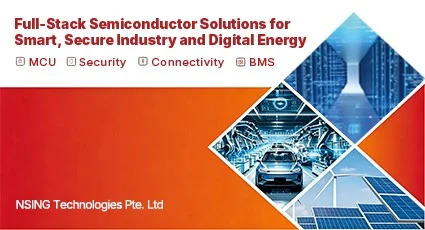
As the global industrial landscape undergoes a rapid metamorphosis driven by the twin engines of artificial intelligence and sustainable energy, the underlying silicon infrastructure has become the most critical battleground for technological sovereignty. Singapore-founded semiconductor firm NSING Technologies is positioning itself at the vanguard of this shift, unveiling a comprehensive, full-stack chip ecosystem designed to address the most demanding requirements of industrial automation, AI data centers, and digital energy management.
By bridging the gap between high-performance computing and mission-critical reliability, NSING is setting a new benchmark for how hardware can facilitate the digital transformation of global infrastructure.
I. Main Facts: The NSING Technological Ecosystem
NSING Technologies has moved beyond the traditional role of a component supplier, evolving into a holistic provider of integrated silicon solutions. At the heart of their current product portfolio lies the N32-series Microcontroller Units (MCUs), a versatile suite of processors ranging from 144 MHz to 600 MHz and utilizing the high-performance Cortex-M4F and M7 architectures.
The core strength of the N32 series lies in its heterogeneous integration. Unlike general-purpose MCUs that require extensive external hardware, NSING’s chips integrate essential industrial communication protocols, including EtherCAT for real-time motion control, CAN-FD for high-speed vehicle and industrial networking, and USB-HS. Furthermore, the inclusion of high-precision Analog-to-Digital Converters (ADCs) allows these MCUs to function as the “brains” of complex servo drives, frequency inverters, and Programmable Logic Controllers (PLCs).
Perhaps most critical to the modern industrial environment is NSING’s commitment to security. Recognizing that the convergence of IT and OT (Operational Technology) has created massive vulnerabilities, the company has implemented TPM 2.0-based hardware root-of-trust modules. This ensures that every NSING-powered device features secure boot capabilities, robust device authentication, and encrypted data transmission, all while maintaining strict compliance with the IEC 62443 standard for industrial cybersecurity.
II. Chronology: The Evolution of NSING Technologies
The trajectory of NSING Technologies serves as a microcosm of the rise of specialized semiconductor firms in the Asia-Pacific region.
- Early Inception: NSING began with a clear mission to overcome the fragmentation in industrial electronics. Their early research focused on high-temperature endurance and electrical fast transient (EFT) immunity, identifying a gap in the market where mass-market chips were failing under harsh factory conditions.
- The Scaling Phase: As the demand for AI-driven data centers surged, NSING pivoted toward high-efficiency power management. This led to the development of the digital energy portfolio, combining MCUs with specialized Battery Management System (BMS) Analog Front-Ends (AFEs) like the NB1802 and daisy-chain isolators like the NBT02.
- Safety and Compliance Milestone: A defining moment in the company’s history was the achievement of ISO 26262 ASIL D and IEC 61508 SIL3 certifications. These milestones signaled that NSING was no longer a niche player but a viable partner for automotive and heavy industrial giants requiring “zero-failure” standards.
- Current Standing (2026): Today, the company maintains a reported return failure rate of less than 1 PPM (Part Per Million), a figure that places them in the top tier of global semiconductor reliability, effectively challenging established legacy incumbents.
III. Supporting Data: Precision and Performance Metrics
The performance specifications of NSING’s flagship N32H474 and N32DP474 series highlight a strategic focus on high-efficiency power conversion. For engineers designing AI power supplies and bi-directional energy storage inverters, the technical specifications are nothing short of impressive:
- High-Resolution Timing: The series features 125 ps High-Resolution Timers (SHRTIM), essential for the precise PWM control required in high-frequency switching power supplies.
- Accelerated Processing: The integration of CORDIC and FMAC (Fused Multiply-Accumulate) hardware accelerators allows the MCUs to offload complex trigonometric and mathematical functions from the main CPU core, significantly reducing latency in feedback loops.
- Rapid Conversion: With 4.7 Msps (Mega-samples per second) ADC capabilities, the chips provide the real-time visibility necessary for advanced power factor correction (PFC) and LLC resonant converter control.
These metrics are not merely academic; they are the enabling factors that allow AI data centers to minimize power loss during voltage conversion—a critical requirement for sustainability in an era of massive energy consumption.
IV. Official Responses: The Philosophy of Reliability
While corporate representatives from NSING Technologies emphasize that their growth is rooted in a “customer-centric engineering philosophy,” the implications of their work are broader. In recent statements, the company’s engineering leads highlighted that “reliability is not a feature; it is the foundation.”
The company’s rigorous adherence to 17 global certifications serves as a competitive moat. By investing heavily in the validation process—ensuring that their chips can withstand extreme temperature fluctuations and intense electromagnetic interference—NSING has effectively lowered the barrier for their clients to achieve compliance in their own end-products.
“When a client builds a servo drive using our N32 series, they aren’t just buying an MCU,” the company noted in a recent briefing. “They are buying the assurance that their product will meet the highest international safety and security standards out of the box.”
V. Implications: Shaping the Future of Global Industry
The impact of NSING Technologies extends far beyond the semiconductor industry. Their work carries profound implications for three specific sectors:
1. The Decentralized Energy Grid
As nations push toward net-zero, the shift toward decentralized energy storage becomes mandatory. NSING’s portfolio—specifically the MCU+BMS+Isolator triad—provides the technical backbone for domestic and industrial energy storage systems. By making power management more efficient and safer, they are directly contributing to the viability of renewable energy microgrids.
2. The Hardening of Critical Infrastructure
The geopolitical climate has made industrial cybersecurity a national security imperative. By integrating TPM 2.0 and IEC 62443 compliance directly into the hardware layer, NSING is helping to prevent the “soft” failures that occur when legacy systems are retrofitted for connectivity. This "Security by Design" approach is essential for modern factories, which are increasingly vulnerable to remote cyber-physical attacks.
3. Efficiency in the AI Era
AI data centers are the largest consumers of electricity in the modern digital economy. Even a 1% improvement in the efficiency of an energy storage inverter or a power supply unit translates into millions of dollars in cost savings and a significant reduction in the global carbon footprint. The specialized accelerators (CORDIC/FMAC) embedded in NSING chips represent a deliberate move to optimize the power-to-performance ratio in these high-demand environments.
Conclusion: A New Standard for Semiconductor Excellence
As we look toward the remainder of the decade, the industry is moving away from “good enough” silicon toward specialized, highly integrated, and intensely validated hardware. NSING Technologies has successfully demonstrated that a full-stack approach—covering computing, communication, power, and security—is the most effective path forward for complex industrial applications.
With a failure rate of under 1 PPM and a suite of certifications that rivals the most established names in the industry, NSING is no longer just a participant in the market; they are an architect of the next generation of industrial technology. For developers, systems integrators, and industrial architects, the company’s roadmap offers a clear path toward building the smarter, more secure, and more sustainable systems that the 2030s will demand.
To learn more about the technical specifications of the N32-series or to request a consultation for your industrial application, please reach out to the NSING Technologies support team.