



From 19th Century Physics to 21st Century Computing: The Renaissance of Optical Skyrmions

In a remarkable synthesis of historical optical theory and cutting-edge quantum research, a team of scientists at Nanyang Technological University, Singapore (NTU Singapore) has unlocked a simplified method for generating optical skyrmions. By reviving a 200-year-old experiment involving the "Poisson spot," researchers have bypassed the need for expensive, highly engineered metamaterials, potentially accelerating the development of next-generation data storage and optical computing technologies.
The research, led by Assistant Professor Shen Yijie from NTU’s School of Physical and Mathematical Sciences and the School of Electrical and Electronic Engineering, was recently published in the journal Optica. It represents a significant shift in how scientists approach the manipulation of complex light structures, moving from labor-intensive nanofabrication toward elegant, fundamental physics.
The Nature of Optical Skyrmions: Light’s Hedgehog Spines
To understand the significance of the NTU team’s work, one must first grasp the nature of optical skyrmions. Named after British physicist Tony Skyrme, who originally proposed the concept in the context of nuclear physics, skyrmions are stable, particle-like swirling patterns. When applied to optics, they describe the intricate topological distribution of light properties—such as polarization, spin, and field orientation—within a beam.
Visually, these structures are often likened to the spines of a hedgehog. Because of their topological stability, these "spines" maintain their configuration even when distorted. This robustness is the "holy grail" for data science; if information can be encoded into these stable light patterns, it could theoretically lead to memory and communication systems that are virtually immune to the data degradation that plagues current electronic systems. Until now, however, creating these structures required complex metamaterials—artificial structures engineered at the nanoscale to force light into specific configurations. These materials are not only costly but also difficult to produce at scale.
Chronology: From the Debate over Light to Modern Discovery
The story of this discovery is deeply rooted in the history of science, specifically the early 19th-century struggle to define the essence of light.
The 1818 Controversy
In the early 1800s, the scientific community was embroiled in a debate: Was light a stream of particles, as Isaac Newton had suggested, or was it a wave, as Christiaan Huygens argued? In 1818, the French Academy of Sciences held a competition to settle the matter. Augustin-Jean Fresnel, a proponent of the wave theory, submitted a paper detailing how light behaves when it hits a circular obstacle.
A judge of the competition, Siméon Denis Poisson—a staunch supporter of the particle theory—attempted to disprove Fresnel. He used Fresnel’s own equations to predict a bizarre consequence: if light were a wave, then a bright spot should appear in the dead center of the shadow cast by a circular disc. Poisson argued this was absurd, assuming it would debunk the wave theory. However, when fellow judge François Arago performed the experiment, he found the bright spot exactly where Fresnel predicted. This "Poisson spot" became the definitive proof that light behaves as a wave, diffracting around obstacles to interfere constructively at the center of a shadow.
The Modern Re-discovery
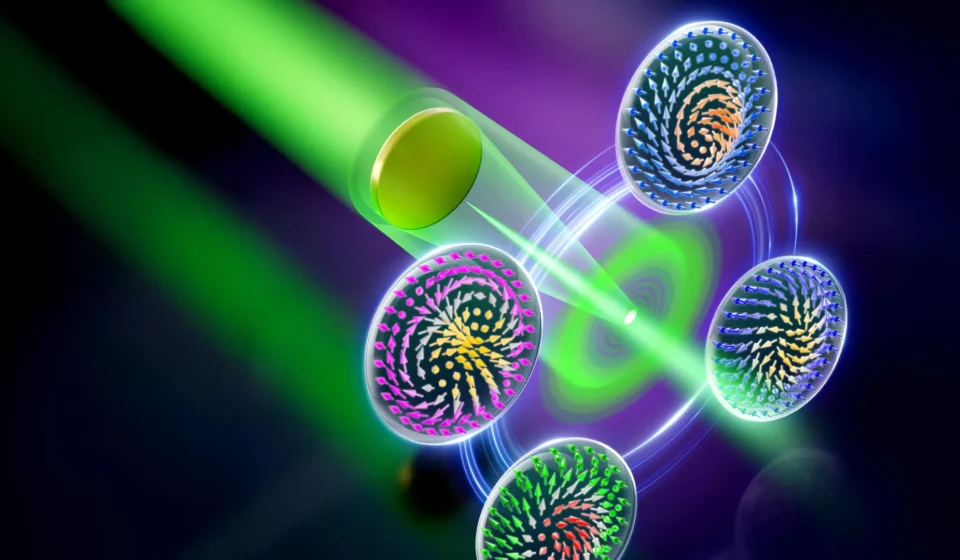
For two centuries, the Poisson spot remained a classroom demonstration—a historical artifact used to teach students about diffraction. The NTU team, led by Asst Prof Shen, revisited this classic phenomenon with a modern lens. By placing a circular disc in the path of a coherent laser beam, the team observed the bright spot not merely as a curiosity, but as a rich, topological laboratory. They discovered that the diffraction occurring at the edge of the disc naturally "coils" the properties of the light into the complex structures known as skyrmions.
Supporting Data: Four Structures in a Single Beam
Perhaps the most startling aspect of the NTU research is the "multiplexing" capability of the Poisson spot. While previous methods typically produced a single type of skyrmion under highly controlled conditions, the researchers found that their simple setup generated four distinct types of topological field patterns simultaneously:
- Spin Skyrmions: Related to the rotational properties of the light.
- Stokes Skyrmions: Defining the polarization states of the light waves.
- Electric Field Skyrmions: Mapping the topological distribution of the electric vector.
- Magnetic Field Skyrmions: Mapping the topological distribution of the magnetic vector.
The existence of these four structures within a single Poisson spot is a breakthrough for comparative physics. Because these skyrmions are generated in the same light field, they share a common origin, allowing researchers to observe how they interact, evolve, and influence one another.
Computer simulations performed by the team depicted these structures as swirling arrays of arrows, illustrating how the vectors of light rotate and shift as they move across the shadow’s center. This visual evidence confirms that the Poisson spot is not just a bright point, but a high-density, multi-dimensional topological field.
Official Responses: Lowering the Barrier to Entry
The impact of this research is primarily defined by the democratization of optical research. By stripping away the need for nanofabricated metamaterials, the NTU team has opened the door for laboratories worldwide to experiment with skyrmions.
"What is remarkable is that optical skyrmions can now be generated using a simple effect where light bends around an object, without relying on expensive, complex man-made metamaterials or highly specialized techniques," said Asst Prof Shen.
He emphasized that the current reliance on metamaterials has acted as a bottleneck for the field. "This could make optical skyrmions much more accessible to researchers," he noted. "By lowering the technical barrier to creating and studying them, the method opens up new possibilities for scientists to study how they could be used in future optical, materials, and computing research."
Asst Prof Shen also highlighted the internal mechanics of the system: "In the light spot that we created, several types of optical vectors could form topological structures at the same time. These different components of light are closely connected, but they do not necessarily form identical topological patterns. Being able to produce and compare several skyrmions within one system could help researchers uncover new links between light’s electric, magnetic, and other physical properties."
Implications: The Future of Photonics and Computing
The implications of this discovery reach far beyond the physics laboratory. The quest to manipulate light at the sub-wavelength scale is the foundation of the next industrial revolution in computing.
1. Data Storage and Memory
Traditional magnetic storage devices are nearing their physical limits. Optical skyrmions offer a potential alternative, as they can represent information in a topological form that is highly resilient to noise and environmental interference. If researchers can "write" data into these skyrmions and "read" them back, it could lead to storage densities orders of magnitude higher than today’s hard drives.
2. High-Speed Communications
Topological light structures can carry more information per photon than traditional light waves. By modulating the shape of these skyrmions, scientists could develop new protocols for light-based communication, enabling ultra-fast, high-capacity data transmission for 6G networks and beyond.
3. Topological Photonics
The NTU study serves as a foundation for "topological photonics," a burgeoning field that seeks to create light-based circuits. Since these skyrmions are stable and self-correcting, they could be used to transmit signals through complex photonic chips without the need for constant amplification or error correction.
4. Fundamental Physics
Beyond applications, the study of how electric and magnetic field vectors form skyrmions simultaneously provides deep insights into the fundamental relationship between light and matter. As researchers continue to refine this 200-year-old experiment, they are likely to discover new physical phenomena that could redefine our understanding of electromagnetic waves.
Conclusion
The work of the NTU Singapore team serves as a powerful reminder that history often holds the keys to the future. By looking back at the work of Fresnel and Poisson, Assistant Professor Shen Yijie and his team have bypassed the limitations of modern material science to find a elegant, scalable, and highly efficient way to manipulate the fundamental properties of light. As this research moves from the laboratory into the realm of practical application, the humble Poisson spot may well become the cornerstone of a new era of optical technology.