



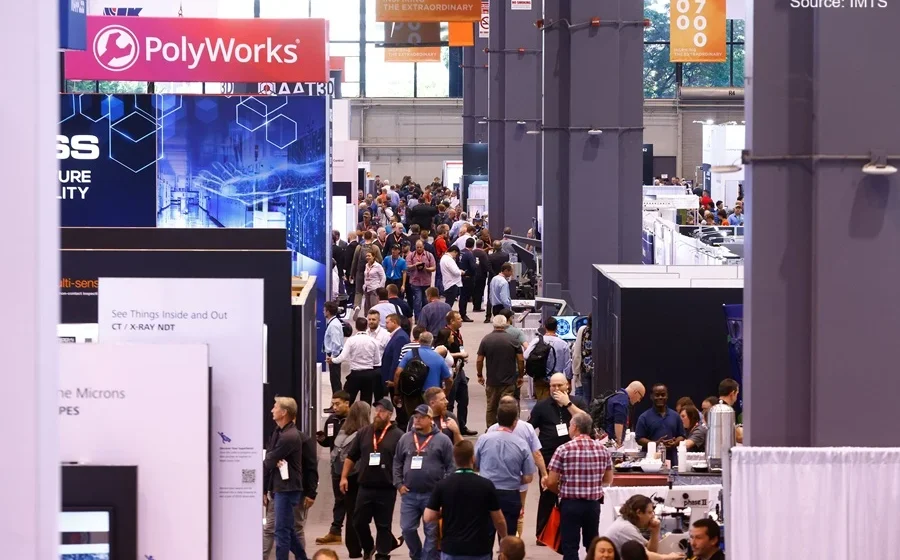

The International Manufacturing Technology Show (IMTS) concluded its landmark 2026 edition, running from September 14 to September 19, painting a vivid picture of an industry undergoing a profound technological and cultural renaissance. Held at McCormick Place, the sprawling event brought together 91,295 registrants—including 14,447 students—representing all 50 U.S. states, Washington, D.C., Puerto Rico, and 123 countries. Featuring 1,788 exhibiting companies across a staggering 1.17 million square feet of exhibit space, IMTS 2026 served as a high-octane crucible where traditional metalworking met the bleeding edge of artificial intelligence, robotics, and defense-driven reshoring.
Far from a mere trade exhibition, this year’s show encapsulated a pivotal moment for domestic manufacturing. Bolstered by trillions in output, surging technology orders, and a desperate race to bridge a persistent labor gap, IMTS 2026 showcased how the sector is rapidly modernizing to secure America’s industrial future.
Chronology of the Event: A Week of Breakthroughs and Buying Sprees
The momentum for IMTS 2026 began building even before the official ribbon-cutting ceremony.
Pre-Show Momentum
On September 13, just one day prior to the opening bell, the Association For Manufacturing Technology (AMT)—which owns and produces IMTS—released data showing that manufacturing technology orders had exceeded $500 million for the fifth consecutive month. This milestone marked only the second time such a streak has occurred since AMT began tracking the metric in 1998, establishing an exceptionally bullish backdrop for the week.
Daily Highlights and Show Floor Frenzy
From September 14 through September 19, the exhibition floors at McCormick Place hummed with unprecedented activity.
- Day 1–2: The opening days established an immediate focus on heavy-hitting applications, defense logistics, and AI integration. Keynotes from U.S. Navy and Department of War officials highlighted the urgency of scaling production for critical defense programs, while inaugural conferences like the Industrial AI Summit sold out repeatedly.
- Day 3–4: The mid-week period saw intense deal-making. Exhibitors reported overwhelming commercial activity, punctuated by Okuma’s tradition of striking a gong with every sale. By Friday morning, the gong had rung over 100 times, famously fracturing after a massive 24-machine order was finalized. Similarly, Tsugami America reported selling every single machine off its show floor.
- Day 5–6: The final days shifted slightly toward future workforce development and global partnerships, culminating in the massive influx of students via the Smartforce Student Summit and international delegations exploring cross-border trade opportunities.
Supporting Data: Scale, Shortages, and Surging Investments
To fully grasp the gravity of IMTS 2026, industry analysts look to the macroeconomic metrics governing the sector.
- Economic Footprint: U.S. manufacturing generates an astounding $3 trillion in annual output. If it were an independent nation, this sector alone would rank as the world’s eighth-largest economy.
- Labor Realities: Despite this massive scale, durable goods manufacturers face a persistent deficit of 435,000 skilled workers. This acute labor shortage is the primary catalyst driving shops to aggressively invest in automation, cobots, and AI-driven force multipliers.
- Reshoring and Capital Commitments: The Reshoring Initiative estimates that approximately 400,000 jobs will have been reshored to the United States by the end of 2026. This trend is backed by a staggering $11.2 trillion in cumulative U.S. investment commitments from both domestic and foreign enterprises.
- Defense Scale-Up: Highlighting the intersection of national security and manufacturing, General Dynamics Electric Boat and Huntington Ingalls Industries secured a joint $76.6 billion contract to construct 14 nuclear-powered submarines. Fulfilling this order requires tens of millions of man-hours, placing immense pressure on the defense industrial base to eliminate supply-chain bottlenecks through advanced manufacturing.
Official Responses: Leaders Weigh In on the Industry’s Trajectory
The convergence of Silicon Valley innovation, traditional machine tool mastery, and federal defense strategy drew commentary from some of the most influential figures in manufacturing.
"What differentiated IMTS 2026 was the strong focus on how manufacturing technology and investment are renewing America’s industrial capability and strengthening the U.S. economy, industrial base, and national defense," said Douglas K. Woods, president of AMT. "Manufacturers and job shops came to find technologies that could immediately increase productivity, and they were joined by investors, Fortune 500 and Silicon Valley companies, government agencies, universities, and a new generation drawn to industrial AI, automation, space, and advanced manufacturing."
Echoing these sentiments, Mike Cicco, president and CEO of FANUC America and chairman of the board at AMT, noted the rapid pace of technological adoption: "IMTS 2026 highlighted how quickly manufacturing technology is moving from concept to application. Manufacturers are looking for practical ways to improve productivity, increase flexibility, and address workforce challenges…"
The defense sector emphasized that commercial innovation is now a matter of national security. Vice Admiral Robert Gaucher, director of Submarine Programs for the U.S. Department of War, stated during a Main Stage presentation: "As we build the future submarine fleet, we must take advantage of technology and advanced manufacturing from the start… Robotic assembly, automated tools, and additive manufacturing are exactly what we need to generate immediate output to support our warfighters at scale."
From the technology provider perspective, the push toward user-friendly software was a central theme. Simon Lapeyry, head of revenue at Intrinsic Innovation (an AI robotics group at Google), explained: "Smaller machine shops are the backbone of manufacturing, and we empower them to use automation for the high-mix, low-volume applications that they constantly encounter… By removing these bottlenecks, AI enables your operators to focus on being CNC experts."
Technological Implications: AI, Automation, and the Convergence Era
IMTS 2026 served as a watershed moment for artificial intelligence in the industrial space. No longer treated as an abstract concept or a futuristic novelty, AI was demonstrated as an operational necessity integrated directly into machine tools, CAM software, quality assurance systems, and robotic cells.
Artificial Intelligence and Software Acceleration
AI plugins like CloudNC’s CAM Assist are fundamentally altering programming workflows. By utilizing physics-based AI to determine cut depths, feeds, speeds, and toolpaths, systems that traditionally required days of manual programming can now be initialized in minutes.
Steve Blackwell of AWS’s Product Engineering & Services Center of Excellence observed: "A year ago, we were talking to customers about the potential of agentic AI. This year at IMTS, we have seen that leading manufacturers are already deploying AI across their operations and are realizing immediate increases in efficiency, quality, and agility."
Robotics and Cobots
Collaborative robots (cobots) showcased at the event emphasized safer, more intuitive deployment. Companies like Universal Robots demonstrated how integrated vision systems and natural-language command processing allow operators to program complex routines without needing extensive robotics engineering backgrounds. Safety-certified proximity scanners and AI-enabled vision cameras enable cobots to dynamically adapt to human presence and variable part geometries on the fly.
The Rise of Convergent Manufacturing
The AMT Emerging Technology Center (ETC) provided a tangible look at the future through its convergent manufacturing platform for drone production. Orchestrated by the Manufacturing Demonstration Facility at Oak Ridge National Laboratory (ORNL), the exhibit combined machine tools, robots, cobots, pallet changers, and metal/polymer additive manufacturing (AM). By producing three different sizes of drone bodies on the show floor, the exhibit proved how digital technologies can collapse development cycles and surge production capabilities.
Similarly, Sandia National Laboratories demonstrated how AI, advanced computing, and metal AM accelerated the development of the Aires Tide flight-test vehicle by roughly seven times while slashing production costs by 15-fold.
Broader Implications for the Future of Work and Global Competitiveness
The ripples of IMTS 2026 will extend far beyond the exhibition hall, shaping economic policy, workforce development, and international trade dynamics for years to come.
Empowering the Next Generation and Resolving the Labor Crisis
With hundreds of thousands of open positions in durable goods manufacturing, engaging the next generation of talent is paramount. The Smartforce Student Summit played a crucial role in this endeavor, welcoming nearly 14,500 students. Inspiring addresses from veterans of space and sea—such as retired Navy captain and former NASA astronaut Wendy Lawrence—reminded young attendees of the vital societal contributions made by manufacturing professionals.
Simultaneously, specialized tracks like the IMTS ELEVATE Conference grew by 34%, emphasizing professional development, leadership, and the inclusion of underrepresented demographics—such as women in engineering and manufacturing management—to broaden the industry’s talent pool.
International Partnerships and Supply Chain Resilience
Global supply chain volatility has forced a reevaluation of sourcing and production strategies. International attendees, such as Aldo Rodriguez of Aalberts Surface Technologies in Monterey, Mexico, highlighted the vital role IMTS plays in fostering cross-border partnerships between the U.S. and Latin America. As regional trade opportunities expand, collaborative frameworks established at conferences like IMTS LATAM will help North American manufacturers build a more resilient, localized industrial base.
Conclusion
IMTS 2026 ultimately proved that the manufacturing industry is experiencing an era of unprecedented vitality. By fusing human ingenuity with intelligent automation, additive manufacturing, and robust economic investment, the sector is successfully tackling its most stubborn labor and supply-chain challenges. As machines ring up record sales and software bridges the gap between novice operators and expert machinists, the message emerging from Chicago is unequivocal: America’s industrial engine is not just recovering—it is accelerating into a bold, high-tech future.