


BTU International Launches Aurora Vacuum Reflow Oven to Revolutionize Solder Void Reduction and High-Volume Electronics Assembly

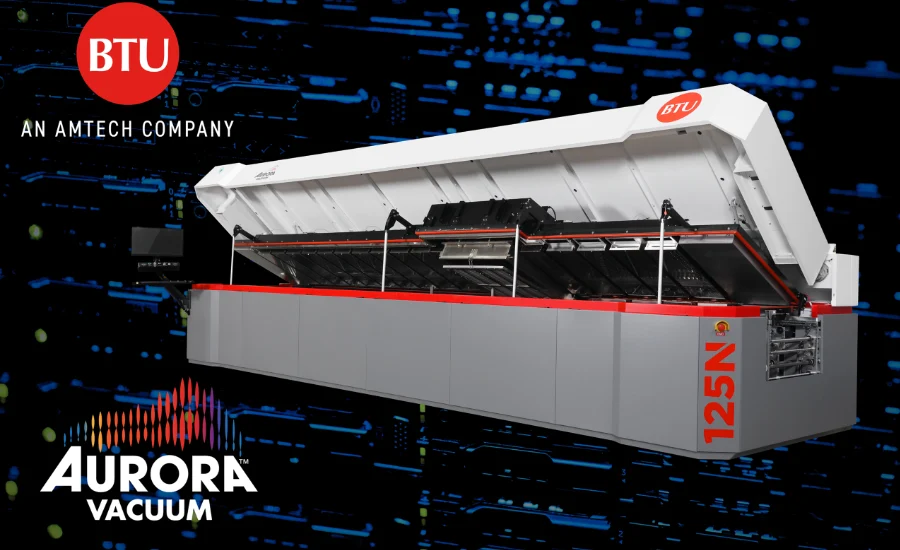
WESTFORD, Mass. — In an era where electronics are becoming increasingly dense, powerful, and thermally demanding, manufacturing defects like solder voids present a critical challenge to long-term reliability. Addressing this industry-wide hurdle head-on, BTU International Inc., a leading global supplier of advanced thermal processing equipment, has officially announced the introduction of the Aurora Vacuum Reflow Oven.
Engineered specifically to tackle the rigorous demands of modern electronics assembly, the new system is designed to drastically reduce solder voids while maintaining the high throughput necessary for high-volume manufacturing environments. Targeted at complex printed circuit board (PCB) assemblies—such as massive enterprise server boards, sophisticated automotive electronics, and high-performance computing (HPC) hardware—the Aurora platform represents a significant leap forward in thermal processing technology.
Main Facts: Engineering Excellence for Next-Gen Electronics
The launch of the Aurora Vacuum Reflow Oven comes at a time when electronics manufacturers are grappling with tighter tolerances, larger board sizes, and stricter reliability standards. Solder voids—trapped pockets of air or gas within solder joints—can severely degrade electrical conductivity, mechanical strength, and thermal dissipation. In high-performance applications like automotive safety systems and data center servers, these microscopic voids can lead to catastrophic field failures.
To combat this, BTU International has loaded the Aurora system with advanced mechanical and thermal features designed to ensure pristine solder joints without sacrificing factory line speed:
- Massive Chamber Capacity: The system features a generous 24-inch vacuum chamber capable of accommodating large circuit boards measuring up to 24.4 by 28 inches.
- Dual-Lane Production Capability: Built for maximum factory efficiency, the system supports dual-lane production configurations.
- Continuous Product Flow: Utilizing an innovative setup with three independent conveyors, the Aurora ensures a seamless, uninterrupted product flow throughout the entire reflow and vacuum process.
- Advanced Void Mitigation: A proprietary soft-start vacuum control mechanism minimizes rapid pressure changes during evacuation, effectively preventing component shift or disturbance.
- Thermal Consistency: The vacuum chamber is independently heated to maintain precise thermal conditions during the vacuum cycle. Furthermore, a low-vibration conveyor and vacuum system design work in tandem to eliminate component movement.
- The Aurora 125N50 Configuration: This flagship setup boasts an impressive layout featuring 10 heated zones leading up to the vacuum chamber, three dedicated heated zones directly on the chamber itself, two internal panel heaters, and four precisely controlled cooling zones.
Chronology: The Evolution of Thermal Processing Challenges
To understand the significance of BTU International’s latest release, it helps to look at the chronological evolution of reflow soldering and the mounting pressures faced by electronics manufacturers over the past two decades.
The Shift Toward Surface Mount Technology (SMT) and Convection Reflow
For decades, standard forced-convection reflow ovens dominated the electronics manufacturing landscape. As surface mount technology (SMT) evolved, these ovens proved adequate for consumer electronics, standard industrial boards, and basic computing hardware. By circulating heated air or nitrogen across the PCB, these systems melted solder paste reliably at scale. However, they were fundamentally limited in their ability to eliminate trapped gases within the solder joints of large, complex components like Ball Grid Arrays (BGAs) and Quad Flat No-Leads (QFNs).
The Rise of High-Density Interconnects and Power Electronics
Entering the 2010s, the automotive sector underwent a massive transformation, shifting toward electric vehicles (EVs), advanced driver-assistance systems (ADAS), and autonomous driving tech. Concurrently, cloud computing and artificial intelligence drove the demand for hyper-scale data centers powered by massive server boards. These applications required power electronics and processors that generated immense heat, making solder voids an unacceptable risk. Traditional reflow ovens could not consistently achieve the low voiding percentages (<5% or lower) required for these mission-critical environments.
The Introduction of In-Line Vacuum Reflow
Recognizing the bottleneck, the industry began adopting vacuum reflow technology. Early vacuum systems, however, often forced a compromise: manufacturers had to choose between superior void reduction (via batch processing) or high throughput (via continuous in-line manufacturing). Batch vacuum ovens slowed down production lines significantly.
The Birth of the Aurora Platform
BTU International’s development of the Aurora Vacuum Reflow Oven marks the culmination of years of research and engineering aimed at breaking this compromise. By integrating a high-capacity vacuum chamber directly into a high-speed, multi-zone, multi-conveyor architecture, BTU has bridged the gap between ultra-low voiding performance and ultra-high-volume manufacturing capabilities.
Supporting Data: Specifications and Performance Metrics
In high-volume manufacturing, uptime, thermal precision, and yield optimization dictate operational success. The technical metrics underpinning the Aurora Vacuum Reflow Oven highlight its readiness for the factory floor:
- Chamber Dimensions: 24 inches wide, optimized for boards up to 24.4 x 28 inches.
- Conveyor Architecture: Three independent conveyors ensuring zero bottlenecks and continuous throughput.
- Thermal Profiling Flexibility:
- 10 pre-vacuum heated zones for precise ramp-up and soak profiles.
- 3 dedicated chamber heated zones to prevent thermal shock or cooling during evacuation.
- 2 internal panel heaters for localized energy transfer.
- 4 controlled cooling zones to manage intermetallic growth and solidification rates.
- Vibration Dampening: Engineered low-vibration mechanical systems to protect delicate, micro-miniaturized components while the vacuum is pulled.
These specifications translate directly to hard data on the factory floor: higher First-Pass Yields (FPY), drastically reduced rework costs, and compliance with the stringent IPC-A-610 standards for solder joint acceptability.

Official Responses: Industry Leadership Insights
The commercial release of the Aurora Vacuum Reflow Oven has generated considerable buzz throughout the electronics manufacturing sector. Company leadership emphasizes that the system was built in direct response to customer pain points regarding scalability and yield optimization.
"Today’s electronics manufacturers need more than low voiding; they need consistent, repeatable production at scale," states Rob DiMatteo, General Manager of BTU International.
DiMatteo elaborates on how the engineering philosophy behind the Aurora addresses the realities of modern board design:
"Aurora Vacuum delivers the process stability, thermal precision, and production efficiency required to maximize yields while supporting the most demanding manufacturing applications, including large server boards."
Industry analysts and manufacturing engineers have echoed these sentiments, noting that as artificial intelligence hardware, 5G infrastructure, and automotive electrification continue to push the boundaries of PCB design, thermal processing equipment must evolve concurrently. BTU International’s positioning of the Aurora series places the company at the vanguard of this technological evolution.
Implications: What the Aurora Vacuum Reflow Oven Means for the Industry
The introduction of the Aurora system carries profound implications for multiple sectors within the global electronics manufacturing ecosystem.
1. Automotive Electronics Reliability
Automotive components endure harsh thermal cycles, mechanical vibrations, and continuous operational stress. Solder voids in ADAS modules or EV power inverter boards can lead to intermittent connections or complete thermal failure. By deploying inline vacuum reflow technology capable of handling high-volume automotive runs, tier-one suppliers can achieve unprecedented reliability, minimizing costly field recalls and bolstering safety compliance.
2. High-Performance Computing (HPC) and Server Manufacturing
The AI boom has superintended an insatiable demand for high-performance computing hardware. Modern AI accelerators and server motherboards feature massive silicon dies, intricate BGAs, and dense power management sections. These large server boards are notoriously difficult to reflow evenly without inducing warpage or high voiding rates. The Aurora’s 24-inch chamber and robust thermal zoning provide the exact environment needed to process these supersized boards efficiently.
3. Redefining Factory Floor Economics
Historically, implementing vacuum reflow meant accepting slower cycle times, as parts had to be paused inside a vacuum chamber mid-line. BTU’s multi-conveyor, continuous-flow approach shatters this paradigm. By maintaining high throughput without sacrificing the time needed to evacuate gas pockets thoroughly, electronics manufacturers can protect their profit margins, reduce labor-intensive rework, and maximize the Return on Investment (ROI) of their SMT lines.
Conclusion
As the electronics landscape marches toward greater miniaturization, higher power density, and uncompromised reliability, equipment manufacturers must anticipate the needs of tomorrow. With the launch of the Aurora Vacuum Reflow Oven, BTU International Inc. has demonstrated a keen understanding of these complex challenges. By marrying advanced soft-start vacuum controls, independent thermal chamber management, and high-speed continuous conveyance, the Aurora is poised to set a new benchmark for solder void reduction and high-volume electronics assembly worldwide.
For more information on the Aurora Vacuum Reflow Oven or to explore BTU International’s full suite of thermal processing solutions, industry professionals can visit the official BTU International website or consult upcoming industry expositions.